
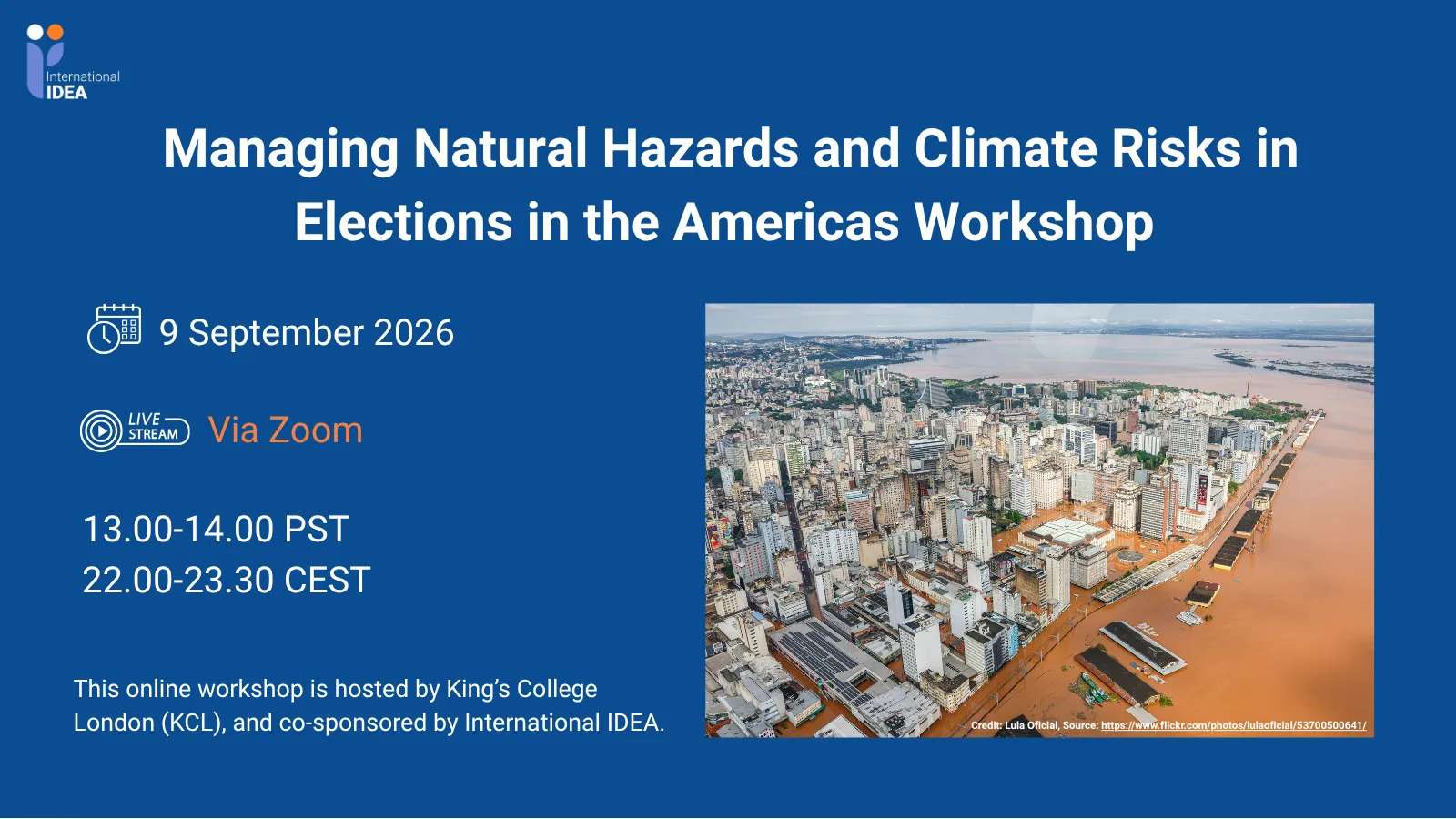
Managing Natural Hazards and Climate Risks in Elections in the Americas Workshop
This online workshop, hosted by King’s College London, and co-sponsored by International IDEA, brings together experts on natural hazards and elections to discuss how electoral practitioners can protect elections from the adverse consequences of events such as tropical storms, floods, wildfires and heatwaves.
Panelists will include contributors to International IDEA’s recently published book Managing Natural Hazards and Climate Risks in Elections.
Managing Natural Hazards and Climate Risks in Elections in the Americas Workshop
9 September 2026
22.00-23.30 CEST
Speakers:
- Irma Mendez de Hoyos (Latin American Faculty of Social Sciences (FLACSO) Mexico), ‘Heatwaves and the 2024 general elections in Mexico’
- Rafael Arias Valverde (Pontificia Universidad Católica del Perú and Oficina Nacional de Procesos Electorales), ‘Managing Elections to Withstand Natural Hazards in Peru’
- Madeline Harty (Associate, Democracy Communications Collaborative), ‘Weathering the Storm: Hurricane Sandy and the 2012 US Federal Election
- Valere Gaspard (University of Ottawa), ‘The Impact of the 2023 Wildfires on Subnational Elections in Canada’
Commentators:
- Annika Silva-Leander (UN Permanent Observer at International IDEA)
- Saskia Carusi (United Nations Office for Disaster Risk Reduction, Americas and the Caribbean)
Chairs:
- Erik Asplund (International IDEA)
- Ferran Martínez i Coma (Griffith University)
- Sarah Birch (King’s College London)
Please note the time zones:
13.00-14.00 Pacific Daylight Time
14.00-15.30 Central Time
15.00-16.30 Eastern Standard Time
16.00-17.30 Eastern Daylight Time
21.00-22.30 British Summer Time
22.00-23.30 Central European Summer Time
Additional Details
What You'll Learn
Learn how natural hazards and climate-related extreme weather can disrupt voter registration, campaigning, polling locations, election workers, infrastructure and voter access—and what electoral authorities can do to prepare for those disruptions. Through cases involving heatwaves in Mexico, natural hazards in Peru, Hurricane Sandy in the United States and wildfires in Canada, participants will explore approaches including risk assessment, contingency planning, backup capacity, coordination with disaster-response agencies and adapting election procedures when normal operations are disrupted.
Why This Matters
Climate-related hazards are increasingly becoming an electoral resilience and democratic participation issue, not simply an environmental one. International IDEA found that at least 94 elections and referendums in 52 countries were affected by natural hazards between 2006 and 2025, making preparedness increasingly important for protecting voter access, election integrity and continuity of democratic institutions. The central challenge is ensuring that floods, fires, storms, extreme heat and other disruptions do not prevent people from exercising their democratic rights or undermine confidence in election results
What You'll Leave With
Participants should leave with a practical framework for thinking about election risk, resilience and crisis preparedness, including how electoral institutions can: Identify climate and natural-hazard vulnerabilities before an election. Develop hazard-specific contingency plans. Build backup capacity into voting and registration systems. Coordinate with weather, emergency-management and disaster-response agencies. Prepare alternative polling locations and procedures. Protect displaced or otherwise affected voters. Develop crisis communication procedures. Apply lessons from previous disaster-affected elections. International IDEA's underlying research provides 11 action-oriented recommendations for strengthening election resilience, making the accompanying publication a useful resource after the event.
Best For - Community Leaders, Educators, Journalists / Media, Businesses, Local Governments, NGOs / Civil Society
Systems It Connects To - Circularity & Whole-System Design, Personal & Digital Democracy
Languages - English
Recording / Replay Available? - Unknown
Practical Next Step - Identify the natural hazards most likely to disrupt an election in your community or country and map where they could affect voter registration, polling locations, transportation, power, communications, election workers and voter access. Then identify one contingency measure and one partner—such as an emergency-management, meteorological or civil-protection agency—that should be incorporated into election planning before the next voting cycle. That moves the lesson from “What happens when disaster strikes?” to the more useful systems question: “What capacity needs to be in place before it does?”