
Connect with us

Design for Life

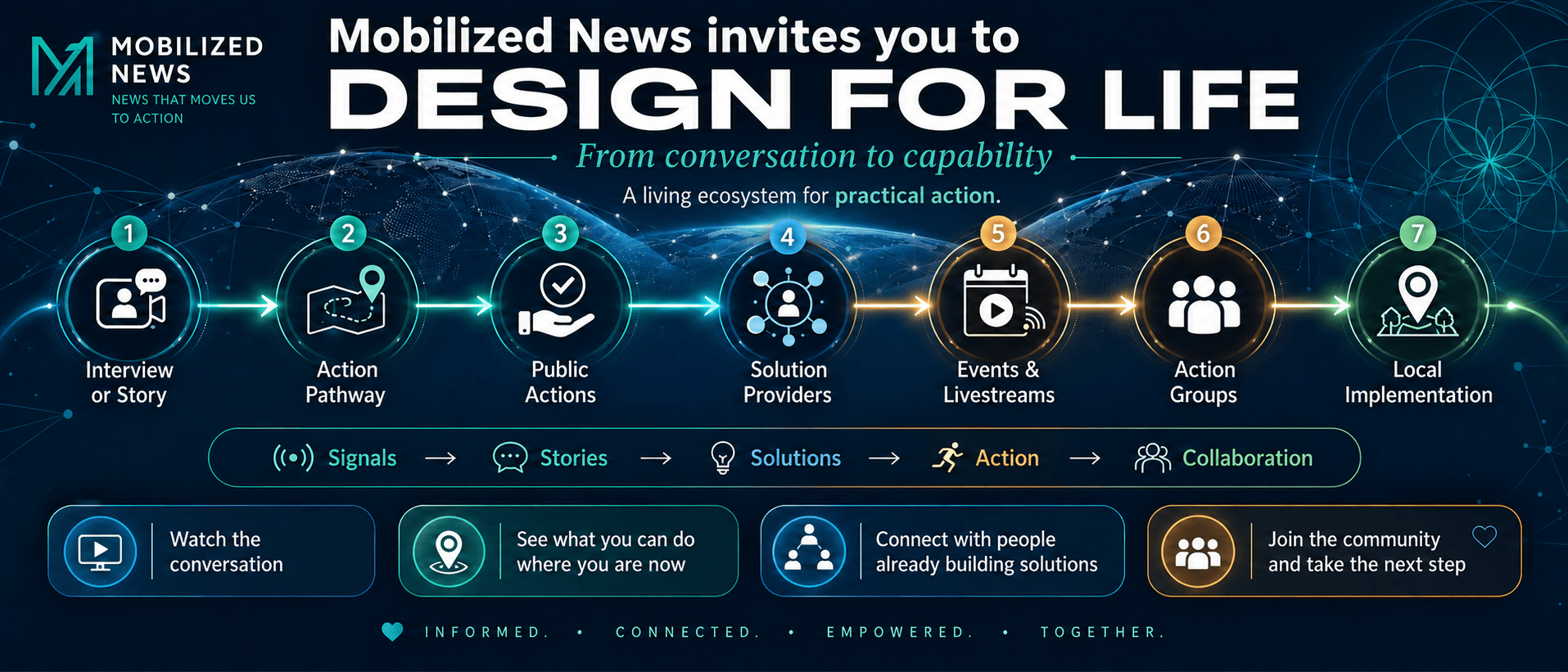
Mobilized News Announces “Design for Life,” a Connected Media Experience for Restoring Community and Planetary Health

Published

on

Mobilized News Announces “Design for Life,” a Connected Media Experience for Restoring Community and Planetary Health

Mobilized News is launching Design for Life, an eight-part connected media experience created to help communities understand how today’s most important systems are connected — and how practical solutions can be put into action locally.

Design for Life brings together experts, community leaders, innovators, organizers, educators, entrepreneurs, public agencies, and residents to explore one essential question:

What would our communities look like if every system was designed to restore life instead of extract from it?

The series focuses on the systems people depend on every day: circularity, democracy, ecological economics, energy, food, information technology, mobility, and transportation. Each experience will show how these sectors are not separate issues, but part of one interconnected web of life.

“People are overwhelmed because the problems are presented as separate crises,” said Steven Jay, Co-Founder and Executive Producer of Mobilized News. “Design for Life helps people see the connections — and more importantly, see what they can do where they live.”

Each Design for Life experience will combine expert insight, community stories, practical questions, and clear action pathways. The goal is to help communities move from awareness to understanding, from understanding to coordination, and from coordination to action.

Theeight experiences include:

  • Circularity: Turning waste into local wealth
  • Democracy: Moving from public frustration to public capability
  • Ecological Economics: Making money serve people, place, and planet
  • Energy, Mobility, and Transportation: Powering and moving communities differently
  • Food: Restoring health from soil to table
  • ICT and Public Intelligence: Using technology, media, and data to help communities act wisely
  • Ethical Finance
  • Smarter Cities
  • The Connection between Public and Planetary Health

The series will conclude with a capstone experience, The Web of Life, showing how all of these systems connect and work together to restore community health, ecological well-being, resilience, and shared prosperity.

Design for Life is part of the Mobilized News mission to help people understand what is changing, why it matters, what is working, and how to participate in building healthier communities.

About Mobilized News
Mobilized News is a solutions-focused media commons connecting signals, systems, solutions, events, and action. Its mission is to help people see what is changing, understand what is connected, and put ideas into action for a healthier, more resilient world.


INVITATION

You Are Invited to Design for Life

Dear friends, partners, and solution-builders,

Mobilized News invites you to take part in Design for Life, a connected media experience created to help communities restore health, well-being, resilience, and possibility.

We are bringing together experts, community leaders, innovators, educators, organizers, public agencies, businesses, and citizens to explore how the systems we depend on can be redesigned to serve life.

Today, people are facing pressure from every direction: rising costs, climate disruption, distrust, food insecurity, energy stress, transportation challenges, waste, misinformation, and broken systems that no longer meet the needs of our time.

But these challenges are connected.

So are the solutions.

Design for Life will focus on six connected conversations:

  • Circularity: How we design waste out of our communities
  • Democracy: How people participate beyond elections
  • Ecological Economics: How money can serve people and place
  • Energy, Mobility, and Transportation: How we power and move communities differently
  • Food: How we restore health from soil to table
  • ICT and Public Intelligence: How media, data, and technology can help people act wisely

Each experience will ask:

What is changing?
Why does it matter?
Who is already building solutions?
How are these systems connected?
What can communities do now?

The final experience, The Web of Life, will bring everything together and show how healthy communities are created when food, energy, transportation, circularity, finance, democracy, and information systems work in harmony.

We invite you to participate as a speaker, partner, contributor, collaborator, community host, sponsor, media maker, educator, or engaged citizen.

This is more than an event series.

It is a practical pathway to help communities move from:

Awareness → Understanding → Connection → Coordination → Action

The future is not something we wait for.

It is something we design together.

Join us for Design for Life.

Mobilized News
The world as it is — and what it can become.

Continue Reading

Design for Life

Less talking, More Doing.

Published

on

Reality Check

  • We all want a world that works for all life
  • But we continue to experience the decline of public and planetary health and public trust in our institutions and leaders worldwide.
  • These breakdowns exist because the systems, services and policies were designed for a world that no longer exists.
  • Those systems were designed for extraction, exploitation and colonization.
  • Since those systems were designed by people–then we can design systems that serve all life–without harming our big beautiful home planet with sustains and nourishes us.
  • Solving these ongoing problems and crises requires open collaboration and cooperation—not the proprietary institutional thinking that brought on this mess.

We have established this network and platform to put these ideas into motion.

  • Less talking. More Doing.

Design for Life is a Mobilized News experience that brings experts, communities, and solution-builders together to show how the systems we depend on can be redesigned to restore health, dignity, resilience, and well-being.

It is not just a conversation series.

It is a practical pathway from:

Awareness → Understanding → Connection → Coordination → Action

The goal is simple:

Help every community see what is connected, discover what is working, and put ideas into action.

Six connected media experiences for restoring health, community, and planetary well-being

Design for Life is a Mobilized News media experience showing how communities can move from crisis awareness to practical capability by redesigning the systems we depend on every day.

The series asks one central question:

What would our communities look like if every system was designed to restore life instead of extract from it?

Each experience focuses on one sector, but the real story is interdependence: food depends on soil, water, energy, transportation, finance, democracy, digital tools, and circular design. No system stands alone. Every solution becomes stronger when connected to the others.


The Six Experiences

Circularity: Designing Waste Out of Community Life

Theme: From throwaway culture to local resource recovery

Big question:
How can communities turn waste into value, jobs, resilience, and healthier local environments?

Topics

  • Repair, reuse, refill, sharing, remanufacturing
  • Composting and organic waste recovery
  • Building material reuse
  • Local circular marketplaces
  • Product design for durability
  • Waste as a failure of design
  • Circular procurement by cities, schools, hospitals, and businesses

Questions to ask

  • What materials are leaving our community that could be reused locally?
  • What would it take to make repair easier than replacement?
  • How can circular systems create local jobs?
  • How can cities use purchasing power to reduce waste?
  • How do food waste, packaging, energy use, and transportation connect?

Local action pathway
Create a Community Circularity Map showing local repair shops, reuse centers, compost sites, tool libraries, makerspaces, thrift systems, and businesses already reducing waste.

Health connection
Less waste means less pollution, lower costs, cleaner neighborhoods, reduced landfill burden, and more local economic activity.


Democracy: Designing Participation Into Everyday Life

Theme: From politics as performance to democracy as public service

Big question:
How can communities rebuild trust by giving people meaningful ways to participate, solve problems, and shape local decisions?

Topics

  • Civic trust
  • Participatory budgeting
  • Citizens’ assemblies
  • Community listening systems
  • Local journalism and civic information
  • Public-interest media
  • Open data and transparency
  • Youth civic leadership
  • Democracy between elections

Questions to ask

  • Why do so many people feel unheard?
  • What would democracy look like if it helped people solve everyday problems?
  • How can communities move from outrage to organized capability?
  • What information do residents need to participate wisely?
  • How can media become civic infrastructure?

Local action pathway
Host a Community Listening Lab where residents identify shared pressures, local assets, practical needs, and solutions already emerging.

Health connection
When people are heard, trusted, and included, communities become more resilient, less polarized, and better able to respond to emergencies, public health needs, and economic stress.


Ecological Economics: Designing Money to Serve Life

Theme: From extraction to community wealth and shared well-being

Big question:
How can money circulate locally in ways that restore people, place, and planet?

Topics

  • Community wealth building
  • Local purchasing
  • Public banking
  • Credit unions and cooperative finance
  • Regenerative enterprise
  • Local investment funds
  • Social procurement
  • True-cost accounting
  • Measuring well-being, not just growth

Questions to ask

  • Does our local economy keep wealth in the community or drain it away?
  • How can local institutions buy from local businesses?
  • What would finance look like if it rewarded restoration?
  • How can communities fund food, energy, housing, circularity, and care?
  • What should we measure besides GDP, profit, and growth?

Local action pathway
Create a Local Wealth Flow Map identifying where money enters the community, where it leaks out, and where it can be redirected toward local needs.

Health connection
A healthier economy reduces stress, supports livelihoods, strengthens local businesses, and funds the conditions people need to live well.


Energy + Mobility: Designing Clean Power and Movement Together

Theme: From fossil dependence to connected local infrastructure

Big question:
How can communities design energy and transportation systems that are cleaner, cheaper, more reliable, and accessible to all?

Topics

  • Community solar
  • Microgrids
  • Building efficiency
  • Electric buses and fleets
  • EV charging
  • Walkable and bikeable communities
  • Transit access
  • Mobility as a public health issue
  • Energy resilience for schools, clinics, shelters, and homes

Questions to ask

  • Who suffers first when energy or transportation systems fail?
  • How can clean energy reduce household costs?
  • What would transportation look like if designed around people, not traffic?
  • How can electric mobility strengthen the grid instead of stressing it?
  • How can communities protect critical services during outages?

Local action pathway
Build a Resilient Access Map showing energy burden, transit gaps, cooling centers, clinics, schools, food access points, EV charging, and potential microgrid sites.

Health connection
Cleaner energy and better mobility reduce air pollution, heat risk, isolation, household costs, and emergency vulnerability.


Food: Designing Local Nourishment Systems

Theme: From fragile supply chains to healthy local food webs

Big question:
How can communities create food systems that nourish people, restore land, reduce waste, and strengthen local economies?

Topics

  • Local food production
  • Regenerative agriculture
  • Urban farms and community gardens
  • Food hubs
  • Farm-to-school programs
  • Food waste prevention
  • Compost and soil health
  • Healthy food access
  • Cellular agriculture and precision fermentation
  • Emergency food resilience

Questions to ask

  • Where does our food come from, and what happens if supply chains break?
  • Who lacks access to healthy food?
  • How can food waste become soil, energy, or economic value?
  • How can schools, hospitals, and institutions support local growers?
  • How does food connect to water, energy, transportation, health, and jobs?

Local action pathway
Create a Community Food Web Map connecting growers, distributors, food banks, schools, restaurants, composters, kitchens, and health providers.

Health connection
Food is the most direct bridge between planetary health and public health. Healthy soil, healthy food, and healthy people are one connected system.


ICT + Public Intelligence: Designing Digital Tools for Human Capability

Theme: From information overload to shared intelligence

Big question:
How can communities use technology, media, data, and AI to help people understand what is changing and act wisely together?

Topics

  • Community information systems
  • Public-interest AI
  • Cybersecurity
  • Digital democracy
  • Local data commons
  • Misinformation resilience
  • Open knowledge networks
  • Digital inclusion
  • Emergency communication
  • Community media platforms

Questions to ask

  • What information do people need before crisis hits?
  • How can AI serve communities instead of replacing human judgment?
  • How can local media become a trusted civic operating system?
  • How do we protect people from misinformation and cyber threats?
  • How can digital tools connect solutions, events, experts, and action?

Local action pathway
Build a Community Intelligence Dashboard that tracks local signals, needs, resources, events, solutions, and opportunities to participate.

Health connection
Better information saves time, reduces fear, improves coordination, protects trust, and helps people respond before problems become emergencies.


The Experience: The Web of Life: How All Systems Connect

Theme: No solution works alone

Big question:
How do circularity, democracy, ecological economics, energy, food, mobility, and ICT work together to restore community health and planetary well-being?

This final experience brings together experts, community leaders, media makers, civic innovators, businesses, and residents to connect the six conversations into one operating picture.

Core story

A healthy community is not built by fixing one system at a time.

A healthy community is created when:

  • Food systems nourish people and restore soil.
  • Energy systems power homes, clinics, schools, and transportation.
  • Mobility systems connect people to food, work, care, education, and community.
  • Circular systems reduce waste and turn materials into local value.
  • Ecological economics keeps money circulating where people live.
  • Democracy gives people a voice in shaping the systems they depend on.
  • ICT and media help communities see what is happening, understand what works, and coordinate action.

Together, these become a living civic operating system.


Capstone Topics

The community as a living system

How food, energy, water, waste, transportation, finance, media, and governance affect one another.

2. Health as the organizing principle

How every sector either improves or harms public health, mental health, economic health, ecological health, and civic health.

3. From isolated projects to connected infrastructure

How local solutions become stronger when mapped, connected, funded, and shared.

4. Media as the connective tissue

How Mobilized News can help communities see the full picture: signals, systems, solutions, events, and action pathways.

5. The local action blueprint

How every community can create its own Design for Life roadmap.


Capstone Questions

  • What does a healthy community actually require?
  • Which systems are currently working against health and well-being?
  • Where are solutions already emerging?
  • What happens when food, energy, mobility, circularity, finance, democracy, and ICT are designed together?
  • What can residents, businesses, schools, local governments, and civic groups do first?
  • How do we move from scattered good ideas to coordinated local action?
  • What should every community map, measure, and mobilize?

The Design for Life Community Blueprint

Each event should produce one practical output. Together, they form a community roadmap.

ExperiencePractical Output
CircularityCommunity Circularity Map
DemocracyCommunity Listening Lab
Ecological EconomicsLocal Wealth Flow Map
Energy + MobilityResilient Access Map
FoodCommunity Food Web Map
ICT + Public IntelligenceCommunity Intelligence Dashboard
CapstoneDesign for Life Local Action Plan

Suggested Format for Each Experience


Opening Signal

What is changing right now?

Human Story

Who feels this first?

Systems View

What other sectors are connected?

Expert Conversation

What do practitioners know that the public needs to understand?

Community Roundtable

What is already working locally?

Action Lab

What can people do in the next 30, 60, and 90 days?

Mobilized Takeaway

One clear summary:
What changed. Why it matters. What we can do now.


Suggested Event Titles

  1. Design for Life: Circularity
    Turning Waste Into Local Wealth
  2. Design for Life: Democracy
    From Public Frustration to Public Capability
  3. Design for Life: Ecological Economics
    Making Money Serve People and Place
  4. Design for Life: Energy + Mobility
    Powering and Moving Communities Differently
  5. Design for Life: Food
    Restoring Health From Soil to Table
  6. Design for Life: ICT + Public Intelligence
    Using Technology to Help Communities Act Wisely
  7. Design for Life: The Web of Life
    How All Systems Connect to Restore Community Health


Continue Reading

Design for Life

From Globalization to Strategic Self-Reliance: Nations Are Rebuilding Supply Chains at Home

Published

on

Governments are moving from “buy it wherever it is cheapest” to “build what we cannot afford to lose.”

The big picture

The old globalization model was built around efficiency.

  • Find the lowest-cost supplier.
  • Stretch supply chains across borders.
  • Reduce inventory.
  • Outsource production.
  • Trust that trade would remain open.

That model is breaking.

Pandemics, wars, cyberattacks, climate shocks, port disruptions, critical-mineral chokepoints, AI competition, and geopolitical rivalry have forced governments to rethink what must be made, secured, repaired, and governed closer to home.

The new question is not only:

What is the cheapest option?

It is:

What must a nation be able to produce, protect, and recover when the system is under stress?

Why this matters

Strategic self-reliance is becoming the new industrial policy.

This does not mean every country makes everything by itself. It means governments are identifying the systems they cannot outsource without creating national risk: energy, AI, semiconductors, steel, shipbuilding, defense, critical minerals, ports, grids, medicines, food systems, and digital infrastructure.

The International Energy Agency warns that clean-energy manufacturing remains highly concentrated, with China accounting for about 85% of solar supply-chain production capacity and about 80% of lithium-ion battery supply-chain production capacity, with even higher shares in some components such as PV wafers and battery anode materials.

That concentration is now being treated as a strategic vulnerability, not just a market fact. The IEA’s 2026 energy policy review says governments are taking steps to reduce concentration in solar panels, batteries, and other clean-energy technologies because the largest supplier controls more than 70% of manufacturing capacity for many key components.

What changed

1. Procurement is becoming national-security policy

In the United Kingdom, Chancellor Rachel Reeves has reportedly instructed ministers to “buy British” in four strategic sectors: shipbuilding, steel, energy, and artificial intelligence. The move follows concern that public contracts have continued going overseas even in areas tied to national resilience and security.

Mobilized translation:
Government spending is no longer neutral. Procurement is becoming a tool to rebuild domestic capacity.

2. AI is being treated as sovereign infrastructure

AI is no longer just a software industry. It depends on chips, data centers, cloud systems, electricity, cybersecurity, skilled labor, and government contracts.

Brookings reported in May 2026 that U.S. federal AI spending is rising sharply and remains heavily focused on the Defense Department, reflecting the growing link between AI, national security, and industrial capability.

Mobilized translation:
AI power belongs to countries that control the full stack: chips, cloud, energy, data, talent, security, and procurement.

3. Energy security is becoming manufacturing security

Clean energy is expanding, but governments are worried about dependence on concentrated supply chains for solar panels, batteries, critical minerals, grid equipment, and power electronics.

The IEA says supply-chain security has become a major challenge for clean energy because manufacturing capacity is concentrated in a small number of countries and because cybersecurity now intersects with energy infrastructure risk.

Mobilized translation:
A country cannot call its energy system resilient if the equipment, minerals, software, and replacement parts are controlled somewhere else.

4. Steel is back as strategic infrastructure

Steel is not an old economy side issue. It is the backbone of shipyards, bridges, rail, ports, defense, wind towers, transmission structures, factories, and public infrastructure.

That is why steel is appearing again in national procurement policies. In the UK’s “buy British” push, steel is grouped with shipbuilding, energy, and AI as a strategic sector where national-interest considerations may outweigh lowest-cost contracting.

Mobilized translation:
You cannot rebuild infrastructure without rebuilding the materials base.

5. Shipbuilding is becoming a test of national capability

Shipbuilding shows the weakness of the old outsourcing model. A country may have naval ambitions, trade ambitions, offshore energy ambitions, and maritime-security needs — but without domestic yards, skilled labor, suppliers, steel, electronics, and repair capacity, those ambitions depend on others.

The U.S. Navy’s 2026 shipbuilding plan calls for more modular and distributed construction, with a goal of moving from roughly 10% of shipbuilding work at distributed sites to 50%, using more yards and suppliers across the country to reduce bottlenecks and speed delivery.

Australia is also moving in this direction. Its 2026 National Defence Strategy includes a major push to expand domestic defense industry and strengthen local manufacturing in response to supply-chain vulnerabilities.

Mobilized translation:
Ships are not only military assets. They are industrial ecosystems.

6. Defense supply chains are being rebuilt for redundancy

Defense planners are now focused on onshoring, reshoring, redundancy, substitution, and better supply-chain visibility.

National Defense Magazine reported in March 2026 that U.S. defense industrial-base supply chains are now part of a wider shift toward domestic production capacity, supply-chain mapping, redundancy, and stronger communication across suppliers.

Mobilized translation:
The next crisis may be decided not by who has the best weapon on paper, but by who can keep producing, repairing, and supplying it under stress.

The deeper story

Globalization did not disappear.

It changed shape.

The world is moving from frictionless globalization to guarded interdependence.

  • Countries still need trade.
  • They still need allies.
  • They still need global markets.
  • They still need shared standards.

But they are no longer willing to leave essential systems exposed to single points of failure.

This is the new doctrine:

  • Trade where possible.
  • Diversify where necessary.
  • Build at home where essential.
  • Partner with trusted allies where strategic.
  • Protect the systems that keep society functioning.

The pressure map

AI:
Nations want domestic capability in chips, cloud, data centers, cybersecurity, and defense applications.

Energy:
Countries are trying to localize clean-energy supply chains while reducing dependence on concentrated manufacturing and critical-mineral processing.

Steel:
Governments are treating steel as a foundation for infrastructure, defense, shipbuilding, and clean-energy deployment.

Shipbuilding:
Maritime capacity is being reframed as industrial sovereignty, not just naval procurement.

Defense:
Resilience now means having domestic suppliers, repair capacity, spare parts, stockpiles, and flexible manufacturing.

Infrastructure:
Ports, grids, rail, bridges, water systems, and public works are becoming part of national resilience strategy.

The risk

Strategic self-reliance can become smart resilience — or wasteful nationalism.

Done well, it builds public capability, good jobs, shorter supply chains, cleaner industry, stronger emergency response, and more democratic control over essential systems.

Done badly, it can become protectionism, political favoritism, higher prices, duplication, corruption, weaker competition, and trade conflict.

The difference is design.

The Mobilized News frame

This is not simply about bringing factories home.

It is about rebuilding public capacity.

The old system asked:

Where can we buy it cheapest?

The new system asks:

What must we be able to make, repair, secure, and govern when the world becomes unstable?

That is a profound shift.

A nation that cannot produce energy equipment, maintain ships, protect digital systems, repair infrastructure, source critical materials, or secure essential goods is not fully resilient.

It may be rich.

But it is dependent.

What good looks like

1. Strategic procurement

Public spending should strengthen domestic and allied supply chains in sectors tied to national resilience: energy, AI, steel, shipbuilding, defense, health, food, water, and infrastructure.

2. Resilience tests before contracts

Major contracts should be evaluated not only on price, but on supply-chain risk, repair capacity, cybersecurity, labor standards, environmental impact, and long-term public value.

3. Domestic capacity plus allied cooperation

Self-reliance does not mean isolation. Countries need trusted supply networks with allies, regional partners, and democratic accountability.

4. Local manufacturing with circular design

A resilient economy should repair, reuse, remanufacture, and recycle critical components instead of constantly importing replacements.

5. Workforce as infrastructure

Shipyards, steel plants, energy factories, AI labs, defense suppliers, and public infrastructure all depend on skilled workers. Training is not a side program. It is national resilience.

6. Transparent industrial policy

Governments must show who receives support, what public value is created, what standards apply, and how communities benefit.

Action Guide

For governments:
Use procurement to build resilience, not just buy products. Prioritize domestic and trusted supply chains where failure would threaten public systems.

For communities:
Ask whether public contracts create local jobs, skills, repair capacity, clean production, and long-term community benefit.

For businesses:
Map supply-chain dependencies. Identify single points of failure. Build regional suppliers and circular recovery systems.

For labor and education leaders:
Align training with strategic sectors: energy, shipbuilding, advanced manufacturing, AI, cybersecurity, grid modernization, and infrastructure repair.

For journalists:
Follow the contract. Who got the money? Where is the work done? Who owns the supply chain? What risks remain? What public value is created?

Bottom line

The age of lowest-cost globalization is giving way to the age of strategic resilience.

Nations are no longer asking only how to buy more cheaply.

They are asking how to remain functional when the world is disrupted.

That is the real shift from globalization to strategic self-reliance:

Not isolation.

Not nostalgia.

A redesign of supply chains around public purpose, resilience, democratic accountability, and the ability to

Continue Reading

Design for Life

Africa’s Renewable Leap: The Continent May Skip the Old Energy Model

Published

on

Across Africa, renewable energy is moving from “alternative power” to the most practical path for homes, mines, factories, farms, schools, clinics, and communities still waiting for reliable electricity.

Why this matters

Africa may not need to copy the old industrial energy model.

For much of the world, electricity systems were built around large centralized power plants, long transmission lines, imported fuels, and decades of capital-heavy planning.

But across Africa, a different pattern is emerging: solar, wind, batteries, mini-grids, and direct-to-user systems are often cheaper, faster, and more useful than waiting for the old grid to arrive.

A recent Associated Press report found that of 322 energy projects announced across Africa in 2025, 173 were solar, compared with 46 hydropower, 34 wind, 22 gas, and 14 hybrid projects. Africa also added a record 11.3 gigawatts of renewable capacity in 2025, about three times the previous year. (AP News)

The big picture

Africa’s renewable leap is not only a climate story.

It is a development story.
A cost story.
A sovereignty story.
A public health story.
A local enterprise story.

The old model says energy must flow from a central plant to a passive consumer.

The new model says power can be generated closer to where people live and work — on rooftops, at farms, at mines, in villages, around factories, and inside community-scale mini-grids.

That shift changes who participates in the energy economy.

What changed

1. Renewables are becoming the default for new power

Solar and wind are increasingly seen as the most bankable new energy options in many African markets because they can be built faster than coal, gas, or large hydropower projects. AP reported that solar projects can often be completed in under two years, while some coal or hydropower projects can take more than a decade. (AP News)

Mobilized translation:
Speed matters. A school, clinic, factory, farm, or village cannot wait 10 years for reliable power.

2. Off-grid is no longer a side issue

In many African communities, the question is not whether to connect to the grid or go renewable.

The question is: what works now?

The International Energy Agency says a cost-effective mix of grid expansion, mini-grids, and stand-alone systems offers a viable pathway to expand electricity access in Africa, while financing remains a major barrier.

Mobilized translation:
The future grid may not be one giant system. It may be a network of connected local systems.

3. Mines and factories are moving first

Large power users are not waiting for perfect national grids.

Mines, factories, and commercial operators need reliable electricity to operate. Where grids are unstable or diesel is expensive, solar-plus-storage and hybrid systems become practical business infrastructure.

That is why some renewable growth may be hidden from official project data: behind-the-meter systems, mine power, factory rooftops, mini-grids, and direct commercial installations can move faster than public-sector megaprojects.

4. Energy access is becoming economic access

Electricity is not just a utility.

It determines whether children can study at night, clinics can refrigerate vaccines, farmers can irrigate crops, entrepreneurs can run machines, and families can use clean cooking, refrigeration, phone charging, lighting, and digital services.

The IEA notes that hundreds of millions of people still lack electricity access globally, with most of them in Sub-Saharan Africa.

Mobilized translation:
Energy access is not only about power. It is about participation in modern life.

5. The financing problem is now bigger than the technology problem

The technology is ready. The economics are improving. The need is obvious.

But financing remains the bottleneck.

African energy projects often face higher capital costs because investors price in political, currency, regulatory, and payment risks. That can make clean energy more expensive than it should be — not because the sun is weak, but because the financing system is broken.

Mobilized translation:
Africa does not lack energy potential. It lacks fair capital.

The deeper story

Africa’s renewable leap challenges the idea that development must follow the same fossil-fuel path taken by industrial powers.

The old development script said:

First build centralized fossil infrastructure.
Then expand the grid.
Then electrify the economy.
Then clean it up later.

Africa can write a different script:

Build clean power where it is needed.
Use mini-grids and solar to reach communities faster.
Use storage to improve reliability.
Use local skills to maintain systems.
Use productive power for farms, clinics, schools, workshops, and businesses.
Build national grids that connect and strengthen local resilience, not replace it.

This is not skipping development.

It is skipping waste.

The opportunity

Africa has the chance to build a more distributed, flexible, and community-centered energy system from the start.

That means:

Homes can gain power without waiting for distant grid expansion.
Mines can reduce diesel dependence and stabilize operating costs.
Factories can protect production from blackouts.
Farmers can use solar irrigation and cold storage.
Clinics can keep medicines and vaccines safe.
Schools can power lights, internet, and learning tools.
Local entrepreneurs can build businesses around installation, repair, batteries, appliances, and energy services.

The risk

A renewable leap is not automatic.

If financing remains unfair, if regulations are slow, if imported equipment dominates without local skills, if communities are not protected from poor-quality systems, or if national utilities resist distributed energy, the leap can stall.

There is also a circularity challenge: solar panels, batteries, inverters, and electronics need repair systems, recycling pathways, local training, and responsible supply chains. Circularity experts argue that solar mini-grids can become more resilient and job-rich if they are designed with reuse, repair, skills training, and supportive policy from the beginning.

What good looks like

A strong African renewable strategy would do five things:

1. Finance the last mile
Use concessional finance, guarantees, local currency lending, and blended capital to lower the cost of renewable projects.

2. Build mini-grids as public infrastructure
Treat mini-grids not as charity projects, but as community economic platforms.

3. Power productive use
Design energy systems for farms, food processing, cold storage, clinics, schools, water systems, and small industry — not just household lighting.

4. Train local energy workers
Every project should create local capacity for installation, maintenance, repair, battery management, and digital monitoring.

5. Connect local systems into stronger national systems
The goal is not off-grid isolation. The goal is resilient interdependence: local generation, regional coordination, and smarter national planning.

Action Guide

For governments:
Create faster approvals, fair tariffs, mini-grid rules, local manufacturing incentives, and public finance tools that lower risk.

For investors:
Stop treating African clean energy as a frontier gamble. Treat it as essential infrastructure with long-term social and economic value.

For utilities:
Work with distributed energy instead of resisting it. Mini-grids, rooftop solar, storage, and demand flexibility can strengthen national systems.

For communities:
Demand ownership models, maintenance plans, transparent pricing, local jobs, and long-term service guarantees.

For journalists:
Follow the practical story: who gets power, who pays, who owns the system, who maintains it, and what local economy it enables.

Bottom line

Africa’s renewable leap is not about copying the past.

It is about building what the future actually needs: clean power that is local, affordable, resilient, repairable, and useful.

  • The old energy model was centralized, slow, expensive, and often dependent on imported fuels.
  • Africa’s emerging model can be distributed, fast, clean, and community-serving.
  • The continent does not have to wait for the future.
  • It can wire it differently from the start.
Continue Reading

Translator

Featured Upcoming Events