
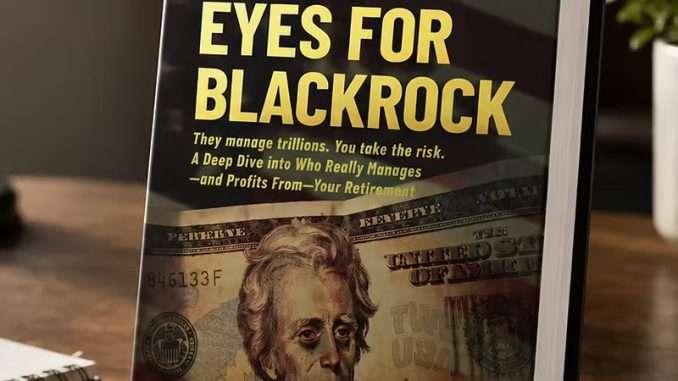
Investigative Author and Financial manager gives Black Rock a Black eye
Another shocking expose by the author of The Pirates of Manhattan, the author exposes the ongoing destruction of retirement income by Wall Street in general, and BlackRock in particular.
BlackRock, is the Pied Piper leading the charge for putting private assets into your 401(k) account.
The guardrails that once protected the American consumer are being torn down. The SEC is useless when it comes to looking out for the little guy, and is beholden to banks, asset managers, and Wall Street. The Consumer Financial Protection Bureau, which is supposed to look out for Main Street, practically does not exist anymore. Private equity and private credit, the most popular alternative investments pushed on investors are for the most part unregulated. Yet private credit–which are private loans to private companies, whose major use is to fund debt-propelled leveraged buyouts, are the canary in the coal mine of the next financial downturn. Once a popular investment which promised safe returns around 9 percent, private credit is turning into another bust.
America has lost its way and has forgotten the most important purpose of retirement planning, which is to provide secure lifetime income for retirees and their families.
Most people in financial and/or wealth management focus just on money, and not on what happens with it or where it goes. What was the impetus to your pursuit of understanding the underlying stories which rarely get covered?
The majority of savings today, which is generally called “wealth management” is for the most part, for regular Americans is their retirement savings, and those savings are for the most part used by Wall Street, and the asset management complex for their gain, their wealth and not the American retirement saver. In essence, Wall Street makes more money than retirement savers. Wall Street manages trillions of other people’s money, but retail savers bare all the financial risks—particularly with 401(k)
You warned readers about Wall Street in The Pirates of Manhattan. What made BlackRock the focus of your latest investigation?
In the first Pirates of Manhattan book, I documented the immense corruption of the scandals at the time with mutual
funds, with market timing of mutual funds, round trip trades, etc. , and documented how major financial institutions such
as banks, who gambled with other people’s money, were hypocrites and purchased more high cash value life
insurance and annuities to fund their retirement. Why I wrote Black Eyes for BlackRock, was that they have
emerged as the largest asset manager in the world, largely by being almost the sole provider of retirement benefits
with the $1 trillion Thrift Savings Plan, the 401(k) for government workers and have largely succeeded with the
help of Uncle Sam’s wallet, and controlling retirement plan narrative at Davos, the Federal Reserve and so on.
It was BlackRock who promoted the ESG marketing mantra beginning in 2012—as a way of marketing their funds—
and this took off even more in Europe. However, the ESG movement (environmental, social and governance model)in the end turned out to be more of a marketing plan for Wall Street instead of a better environment, social
framework and corporate governance model. It was for the most part hype. Everyone whatever party wants a better
environment, governance and social model.
What does the title Black Eyes for BlackRock mean, and what are the “black eyes” you believe the public needs to understand?
Largely window dressing, BlackRock has abandoned the ESG model, but there are numerous examples such as TRI Color, SolarZero, Proterra and others which backed by BlackRock, lost billions. There have been billions lost in other companies such as Northvolt which just lost about $15 billion in Sweden, which made batteries for electric cars. BlackRock paints itself as the guy in the white hat, but it has numerous black eye failures in asset management and investments such as its own private credit fund which has lost roughly 80 percent after it purchased it in 2018. They have destroyed a lot of companies and remain.

Your book argues that many Americans do not understand how their retirement savings are being managed. What is the most important thing every 401(k), IRA, and pension participant should know right now?
Retirement plans are essentially rudderless today, as the funds are either passively managed, and or managed in secrecy. The most important job of any retirement income plan is to produce retirement income—this is the most important function or job of any retirement plan, but something the U.S. and press ignores this fact, as well as the asset management industry. 401(k)s and the stock market were never designed to produce retirement income. The only purpose of the stock market is to allocate capital. However, this is being corrupted as well as SpaceX, the largest IPO brought public, is not even profitable.
You write about BlackRock’s growing interest in alternative assets such as private equity, private credit, infrastructure, and cryptocurrencies. Why do you believe these investments may be dangerous for ordinary retirement savers?
Again, these investments private credit, private credit, infrastructure, cryptocurrencies and so on are highly complex, opaque, and for the most part illiquid. The reason why Wall Street wants to promote them is because they are high fee, done mostly in secret, and lack transparency, and that is the way Wall Street wants it. My research in both books, such as The Retirement Ruse, and Black Eyes for BlackRock document the numerous alternative assets which have blown up and gone into insolvency, and often bankruptcy.
Wall Street often presents private equity and private credit as tools for diversification and higher returns. What do you think is missing from that sales pitch?
The pitch is somewhat correct for institutional investors (e.g., public pensions, endowments, insurance companies
etc.) is that private equity are good diversifiers, but research from Ludovic Phallippou, PhD from Oxford, and
numerous others have found that returns are not that much better than a simple index tractor. Higher returns have
been manipulated with fuzzy mathematics such as Internal Rate of Return (IRR) which are highly misleading. In the
past these investments did perform than public markets, but that is no longer the case.
You argue that retail savers may carry risks that large institutional investors, pension systems, and asset
managers can avoid or shift. How does that risk transfer happen?
The truth is that in a 401(k), IRA , Simple Plan the individual investor and retirement saver bares all economic risks—inflation, market, interest rate risk and so on, while a pensioner such as a government employee or another pensioner in a public defined benefit pension bares none of the risks. Even if a state or government pension goes into insolvency, the pensioner is not at risk, -the employer (e.g., federal, state, municipal, county etc. bares all economic risks not the pensioner.
What is the difference between investing for retirement income and investing for Wall Street’s fee income?
Investing for retirement income is to produce a guaranteed income stream in retirement, for annuity income, which pays a retiree and their partner a lifetime income stream that they can never outlive. Fee income or FRE (fee related earnings) is the guaranteed income stream banks, and other managers consistently earn whether or not the stock market goes up or down. For private equity and private credit fee structure is generally 2 percent , and 20 percent profit sharing. Fees are guaranteed for Wall Street, but not
the 401(k) saver.
You have criticized the movement to open 401(k) plans to more alternative investments. Who benefits most from that change, and who could be left exposed?
but not the 401(k) saver. Wall Street has not been able to exit their private equity investments particularly ones they overpaid for during the COVID 19 pandemic, when there was an orgy of mergers and acquisitions. Wall Street wants to use retail savers funds to liquify their bad investments. Wall Street benefits, while retail investors retirements get worse. Plus, there is little transparency in private alternative investments.
Your work connects retirement insecurity with opaque financial products. How can ordinary people recognize when complexity is being used against them?
Complexity and opaqueness make retail savers totally co-dependent with asset managers, and institutions like it that way. More complexity leads to confusion, market breakdowns and so on. In world league tables, America already ranks one of the worst in the top 30 countries with somewhat uncomplicated financial products. With opaque financial products, if a five-year-old cannot understand, or the manager cannot explain it, you should generally stay away from them.
You discuss public pensions, private equity, and the use of performance metrics such as internal rate of return.
What should people understand about how investment performance can be presented in misleading ways?
Stay away from them. The internal rate of return has been gamed by private equity industry to make it appear that the
funds actually earned considerably more then they actually do.
I write about this extensively in my book, Black Eyes for BlackRock, but the best empirical studies done on this fallacy have conducted by Ludovic Phallipou, PhD:
About Ludovic Phallipou, PhD.
- Professor of Financial Economics, Saïd Business School, University of Oxford
- Fellow of The Queen’s College, Oxford
His research specializes in:
- Private equity
- Asset management
- Performance measurement
- Fees and carried interest
- Private markets
His IRR study: The Tyranny of IRR
- Author: Ludovic Phalippou
- First posted: December 2024
- Revised: December 2025
- Available on SSRN
Main argument:
Phalippou argues that the private equity industries commonly reported since-inception IRR (IRR) is not a true rate of return.
His central criticisms include:
- IRR does not measure how fast investor wealth actually compounds.
- Early successful investments dominate the calculation indefinitely.
- Gains or losses decades later have surprisingly little effect.
- Investors therefore receive a distorted impression of long-term performance.
He writes that this misuse of IRR has helped fuel the belief that private equity substantially outperforms public markets.
His recommendations:
He argues regulators should consider:
- Banning reported since-inception IRRs,requiring horizon-based IRRs or money-weighted measures under standardized conditions and even renaming the traditional IRR to something like “Internal Discount Rate” because calling it a “rate of return”is misleading.
Earlier work
Although The Tyranny of IRR is his dedicated paper on the subject, Phalippou has criticized IRR for many years in:
- Aacademic papers
- CFA Institute presentations
- Financial Times articles
- Investor conferences
- Pension fund presentations.
His work has become especially influential as regulators examine bringing private equity into retirement plans.
His latest research (2026)
Since The Tyranny of IRR, he has released several new papers.
1. Leveraged Buy-Out Algebra (May 2026)
This develops a mathematical framework showing how private equity returns arise from:
- Leverage
- Earnings growth
- Purchase price
- Exit multiple expansion
- Holding period.
Rather than focusing on IRR, it decomposes what actually creates LBO returns and provides a closed-form expected
return formula.
The Trillion-Dollar Bonus of Private Capital Fund Managers (published April 2026)
This paper estimates carried interest across more than 12,000 private capital funds.
Major findings include:
- Aggregate carried interest paid to fund managers exceeds $1 trillion.
- Carried interest accounts for roughly 18% of investorprofits, close to the contractual 20% share.
- Past carried interest earned predicts future performance better than past reported returns.
Private Equity’s Retail Turn: Anatomy of a Mis-selling Risk (January 2026)
This paper examines private equity’s expansion into retail investing. Phalippou argues that products sold to individuals often feature:
- Opaque valuations
- Multiple fee layers
- Misleading performance metrics (including IRR),
- Structures that could create significant litigation and
- Regulatory risk as retail participation grows.
Why his work matters
Phalippou’s research has been influential among:
- Public pension plans
- Sovereign wealth funds
- Institutional investors
- Financial regulators
- Academics studying private markets.
His work has been cited in the Financial Times, The Economist, and by organizations such as the CFA Institute. The Tyranny of IRR is likely the most directly relevant paper. It provides a concise but forceful critique of the industry’s most widely cited performance measure and is increasingly being discussed in debates about allowing private equity investments in 401(k) plans and other
defined-contribution retirement vehicles.
What lessons should people take from BlackRock’s role in the Stuyvesant Town–Peter Cooper Village
collapse, especially regarding leverage, public pensions, and real estate speculation?
The investigation was conducted by Ludovic Phallipou, PhD . By my calculations, and that of others, lost rough $4+Billion in the collapse when in collapsed in 2010. Fannie Mae/Freddie Mac lost $2-$3 billion, California Public Employees pension $500
million, California Public Teachers $100 million, Florida Public Pension $250 million, Church of England $70 million in losses and other since its first buyout in 2006.
Twenty years later, still owned by private equity firms Blackstone and Caisse de depot et Placement du Quebec is still losing money. The losses are earth shattering and detailed in the book.
How has the retirement system drifted away from its original purpose of providing secure lifetime income?
Purposed of a retirement plan is to produce income, like a pension or social security system does. We have totally drifted away from this, but recent major public companies in the retirement space, Fidelity, BlackRock and now Vanguard are now all recommending using annuities to secure retirement income streams. Fidelity started recommending lifetime income using its “Four Box Strategy” with annuities around 2003. BlackRock started to recommend using annuities in 2020, entering formal
partnership with Equitable and Brighthouse in 2026 Few retirement plans in the U.S recommend or promote lifetime income though other countries such as Iceland, The Netherlands, Israel, Norway, Singapore and others are
designed for lifetime income—not the U.S.
What role do government, regulators, financial media, and academia play in either challenging or enabling the asset-management system you describe?
Governments, regulators, financial media and academia mainly carry water for Wall Street and the banking system,
and do not serve in the public’s interest.
For someone who does not have a financial background, what are three practical questions they should
ask before trusting any retirement product, plan, or advisor?
What is the income guarantees, what are the fees, how does the asset allocation work, and what is the strategy for lifetime income.
At the systems level, what would a healthier retirement system look like—one designed around security,
transparency, and human dignity rather than extraction?
Great question. A healthier system first demands that people know the problem and also know possible solutions. A look at other systems around the world that work much better than in the U.S. Stop listening to the media, gambling and all other noise which are destroying America’s retirement plans.
About the Author
Barry James Dyke is a best-selling author, financial advisor and public speaker who has spent more than four decades examining the institutions, policies and investment practices shaping Americans’ financial security. He is president of Castle Asset Management, a New Hampshire-based fiduciary advisory firm specializing in holistic macroeconomic planning, risk management, capital preservation and dependable retirement-income strategies. During his career, Dyke has practiced financial planning and established firms focused on pension consulting, employee-benefit administration, health and welfare consulting, and independent investment advice.
Dyke is best known as the author of The Pirates of Manhattan, an investigation into the power and practices of Wall Street, major banks and the broader asset-management industry. The book, published before the 2008 financial crisis, has reached readers in more than 23 countries. His subsequent books—including The Pirates of Manhattan II: Highway to Serfdom, Guaranteed Income, The Retirement Ruse and Black Eyes for BlackRock—continue his examination of retirement insecurity, institutional financial risk and the growing influence of large asset managers.
A persistent advocate for financial transparency and consumer protection, Dyke challenges conventional assumptions about mutual funds, pensions, retirement accounts and market-dependent financial planning. He has appeared in financial documentaries, hosted radio and podcast programs, and regularly speaks about economic conditions, retirement planning and the risks facing working and middle-class households. Through his writing, advisory work and public education, he encourages individuals to better understand how the financial system operates and to build strategies centered on stability, resilience and long-term financial independence.