
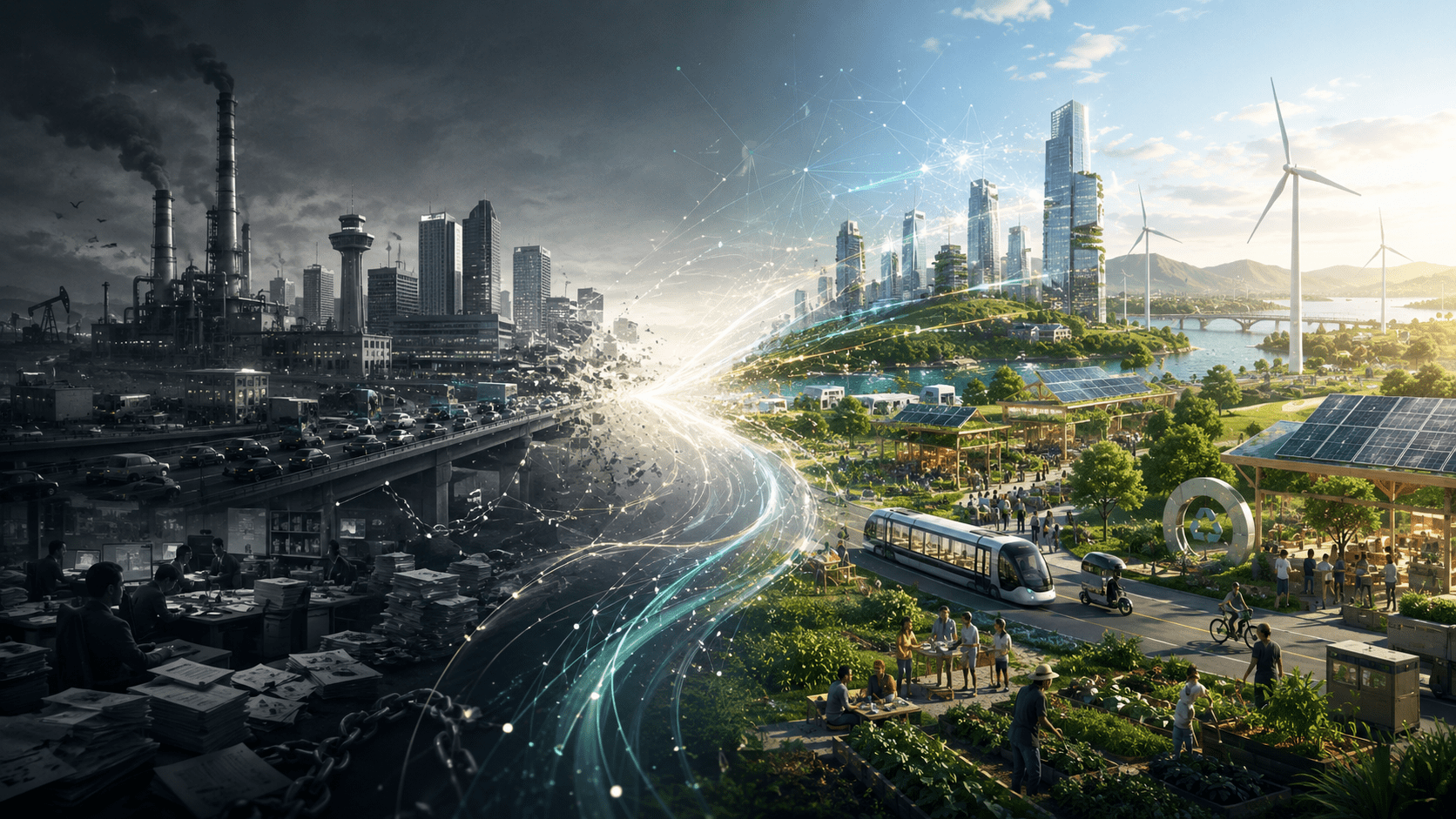
 Most of today’s institutions were built for a world of mass production, centralized power, cheap energy, endless extraction, command-and-control management, and one-way communication. That world is disappearing.
By Steven Jay
That world is disappearing.
The problem is not that solutions do not exist. Many already do. The problem is that our systems, services, structures, and policies are still designed to protect the old model instead of helping people implement what works now.
The big picture
People are trying to solve 21st-century crises with 20th-century operating systems.
Food insecurity, climate instability, public health breakdowns, housing pressure, digital disruption, supply-chain shocks, loneliness, misinformation, political distrust, and economic precarity are not separate problems.
They are symptoms of systems that no longer fit reality.
The industrial-age model was built around:
Centralization.
Power, finance, media, energy, food, and decision-making were concentrated in the hands of a few large institutions.
Extraction.
Nature, labor, attention, data, and communities were treated as resources to be used, not living systems to be cared for.
Standardization.
People and places were forced into one-size-fits-all models, even though every community has different needs, assets, and conditions.
Separation.
Education, health, energy, food, housing, media, transportation, finance, and governance were managed in silos, even though in real life they are deeply connected.
Control from the top.
Policy and business decisions were often made far away from the people most affected by them.
That system produced growth. It also produced instability.
Mobilized is seeking collaborators in creation worldwide. If you are part of the solution, understand the needs of your community and want to add your voice, we’d love to hear from you.
[forminator_form id=”90027″]
Why the old systems no longer serve us
The industrial model assumed the world was predictable, controllable, and endlessly expandable. It is not.
The old systems move too slowly
Industrial-age institutions were designed for stability, not rapid adaptation.
But today’s problems move fast.
A cyberattack can shut down services in minutes. A supply-chain disruption can ripple across continents. A weather event can expose weak infrastructure overnight. A public health crisis can spread globally before institutions agree on a response.
The old model waits for permission.
The new reality requires readiness.
2. The old systems separate problems that are connected
A food crisis is also an energy crisis.
An energy crisis is also a finance crisis.
A housing crisis is also a health crisis.
A media crisis is also a democracy crisis.
But most institutions still treat these issues as separate departments, budgets, agencies, or verticals.
That is why so many solutions fail.
They fix one part of the system while ignoring the relationships that caused the problem in the first place.
Reality is interconnected.
Our institutions are not.
The old systems reward short-term gain over long-term resilience
Many businesses and governments still measure success through quarterly returns, election cycles, growth metrics, and short-term output.
But communities need long-term security.
They need clean water, healthy food, local energy, trustworthy information, affordable housing, digital safety, meaningful work, and shared public purpose.
A system that rewards extraction will keep producing extraction.
A system that rewards regeneration can produce resilience.
The old systems were built for consumers, not citizens
The industrial age turned people into customers, audiences, workers, voters, and data points.
But people are not passive users of systems.
They are participants in them.
Communities already know where the breakdowns are. They know which services are missing. They know what is not working on the ground. They often know who is helping, who is blocking, and where better solutions already exist.
The missing piece is not intelligence.
It is access, coordination, trust, and the ability to act together.
The old systems confuse scale with success
Industrial systems often define scale as bigger, faster, cheaper, and more centralized.
But the future requires a different kind of scale:
Local food networks.
Distributed clean energy.
Community-owned media.
Circular materials systems.
Open knowledge networks.
Participatory governance.
Local finance.
Regional resilience hubs.
Digital tools that serve people, not exploit them.
The future is not one giant solution.
It is many connected solutions, adapted to place, shared across communities, and supported by better infrastructure.
The reality: new systems already exist
We do not have to imagine everything from scratch.
Many of the systems we need already exist.
They include:
- Community-owned clean energy that keeps power and wealth closer to home.
- Regenerative agriculture and local food systems that rebuild soil, reduce dependency, and improve health.
- Precision fermentation and alternative proteins that can reduce pressure on land, water, animals, and supply chains.
- Circular economy models that turn waste into feedstock, materials recovery, repair, reuse, and new local industries.
- Public-interest technology that protects privacy, strengthens civic trust, and improves access to services.
- Open-source knowledge platforms that allow communities to share tools, templates, data, and best practices.
- Participatory budgeting and civic assemblies that help people shape decisions that affect their lives.
- Community media networks that replace noise and division with trusted local intelligence.
- Cooperatives and local ownership models that keep value circulating in communities.
- Integrated resilience planning that connects energy, food, water, health, housing, mobility, media, and finance into one living system.
These are not fantasies.
They are signals of a new operating system already emerging.
The core question
If better solutions already exist, why are they not being implemented at the speed and scale required?
Because the old system is not designed to replace itself.
Why institutions and business leaders struggle to understand this
It is not always because they are bad people.
Many are trapped inside outdated incentives, outdated language, outdated measurements, and outdated assumptions.
They were trained to manage the old system
Most leaders were educated and rewarded for operating within existing structures.
They learned how to manage departments, protect budgets, reduce risk, satisfy investors, win elections, defend market share, and preserve institutional authority.
They were not trained to redesign systems for interdependence.
So when the world changes, many leaders try to improve the old machine instead of building a better one.
They mistake control for leadership
Industrial-age leadership often means control:
Control the message.
Control the budget.
Control the process.
Control the public.
Control the outcome.
But living systems cannot be controlled that way.
They must be cultivated.
The leadership we need now is not command and control. It is coordination, trust-building, shared intelligence, and rapid learning.
3. They fear losing power
New systems often decentralize authority.
That can threaten institutions built on gatekeeping.
- Community energy challenges monopoly power.
- Independent media challenges narrative control.
- Open knowledge challenges expert silos.
- Local finance challenges extractive capital.
- Participatory democracy challenges closed-door decision-making.
Many leaders say they want innovation.
But what they often mean is innovation that does not disturb existing power.
They measure the wrong things
If success is measured only by profit, GDP, growth, efficiency, clicks, ratings, or election wins, then the deeper health of the system disappears.
What is not measured gets ignored.
- Community trust.
- Soil health.
- Public understanding.
- Local ownership.
- Mental health.
- Ecosystem resilience.
- Civic participation.
- Time saved.
- Waste prevented.
- Lives stabilized.
The future requires new scoreboards.
They confuse complexity with impossibility
Systems change can sound overwhelming.
But complexity does not mean we do nothing.
It means we need better maps.
When leaders cannot see how systems connect, they default to fragmented fixes, consultants, pilot programs, slogans, and temporary funding cycles.
Communities need something better:
- Clear signals.
- Shared language.
- Practical tools.
- Visible solutions.
- Local implementation pathways.
- Networks that help people learn from one another.
Why implementation must come from communities
The future cannot be delivered from the top down.
It has to be grown from the ground up and connected across regions.
Communities know the real conditions
A national policy may define a problem.
But communities live it.
They know which roads flood, which schools need support, which food deserts are worsening, which elders are isolated, which families are struggling, which local businesses are ready to help, and which resources are being wasted.
No central institution can see all of that clearly enough.
Communities can move faster than institutions
When people are organized, informed, and connected, they can act before large systems finish debating.
- They can launch local food exchanges.
- Create mutual aid networks.
- Start repair cafes.
- Build community media hubs.
- Map local solutions.
- Support small producers.
- Share emergency information.
- Organize energy cooperatives.
Host civic learning circles. - Connect local problems with working models elsewhere.
This is not charity.
It is distributed public intelligence.
Communities create trust
Trust cannot be mass-produced.
It is built through relationships.
People are more likely to act when information comes from those they know, when solutions are visible, and when participation feels real.
That is why community media, local convening, and shared learning matter so much.
The future is not just technical.
It is relational.
Communities turn solutions into culture
A solution does not become real because it exists.
It becomes real when people understand it, trust it, adapt it, use it, improve it, and share it.
That is culture.
- Institutions can fund programs.
- Businesses can build tools.
- Governments can pass policies.
But communities turn change into daily life.
The shift we need
The old question was:
How do we grow the economy?
The new question is:
How do we design systems that help life thrive?
That means moving from:
- Extraction → regeneration
- Centralization → participation
- Silos → systems
- Competition alone → cooperation where it matters
- Consumers → citizens and creators
- Information overload → public intelligence
- Crisis response → resilience by design
- Short-term profit → long-term value
- Top-down control → community-powered implementation
The Mobilized view
Mobilized News exists because people do not only need more headlines.
They need a new way to see.
They need to understand what is changing, why it matters, how systems connect, where solutions already exist, and what they can do where they are now.
The media of the industrial age often taught people to watch the world fall apart.
The media of the future must help people participate in building what comes next.
Why this matters now
We are living through a systems transition.
The institutions that shaped the last century are losing legitimacy because they are failing to meet the needs of this one.
But collapse is not the only story.
Everywhere, people are building alternatives.
The task now is to connect them.
To make them visible.
To help communities learn from one another.
To turn scattered solutions into shared infrastructure.
To move from awareness to action.
Bottom line
The industrial age built systems for production, extraction, and control.
The next age must build systems for life, resilience, and participation.
The solutions already exist.
The question is whether we will keep waiting for institutions to lead a transformation they were not designed to understand — or whether communities will organize the intelligence, courage, and cooperation to implement what already works.
The future will not be delivered.
It will be mobilized.