
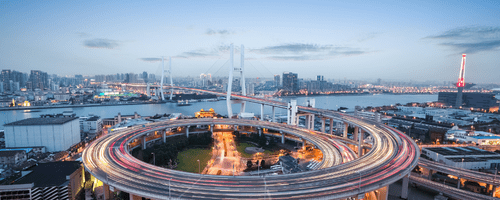
The strongest signal of the week: transportation is no longer just about vehicles. It is becoming an integrated system of energy, data, infrastructure, public access, safety, climate resilience, and governance.
The major systems upgrade: from moving cars and trucks → to designing resilient mobility ecosystems.
Today’s Pattern
Mobility is being redesigned around five connected pressures:
- Electrification: EVs and charging networks are expanding, but grid capacity and road-funding models are lagging.
- Public infrastructure: Rail and transit hubs are being modernized as economic and civic infrastructure.
- Autonomy: Robotaxis and autonomous commercial vehicles are moving forward, but weather, safety, labor, and regulation remain unresolved.
- Resilience: Climate disruption is exposing weaknesses in roads, rail, ports, charging networks, and digital systems.
- Access: Mobility must serve people, not only vehicles — including disabled riders, workers, young people, older adults, and communities without reliable transit.
Top News Updates + Systems Upgrades
1. EVs forced a rethink of how roads are funded
What happened: U.S. House lawmakers proposed a bipartisan highway bill that would create a $130 annual fee for electric vehicles and a $35 fee for some plug-in hybrids to help pay for road repairs. The larger five-year highway reauthorization bill would authorize $580 billion before current law expires on September 30, 2026.
System upgrade: Transportation finance is shifting from fuel-tax funding to vehicle-use and infrastructure funding.
Why it matters: Gas taxes have historically funded roads, but EVs do not pay gasoline taxes. As vehicle fleets electrify, governments need new ways to pay for roads without punishing cleaner transportation or slowing EV adoption.
Mobilized signal: The EV transition is not only a vehicle transition. It forces a redesign of public finance.
2. Autonomous vehicle regulation entered the highway bill
What happened: The same U.S. House proposal would direct the Department of Transportation to issue performance-based safety standards for autonomous buses, trucks, and other commercial vehicles within two years. It would require human operators on autonomous school buses carrying young children.
System upgrade: Autonomy is moving from pilot projects into federal transportation governance.
Why it matters: Autonomous mobility cannot scale safely without rules for safety performance, liability, human oversight, emergency response, data reporting, and local control.
What to watch: Whether regulation focuses only on innovation — or also on safety, labor, congestion, accessibility, and public accountability.
3. Solar-powered EV charging advanced on a major African transport corridor
What happened: South Africa’s Zero Carbon Charge launched its first off-grid, solar-powered EV charging stations on the Johannesburg–Durban N3 corridor, one of the country’s busiest freight and passenger routes. The company plans 60 nationwide sites by the end of 2027 and is also targeting commercial transport, including truck charging hubs.
System upgrade: Mobility and energy are merging into distributed clean-transport infrastructure.
Why it matters: In countries with grid constraints, EV charging cannot depend only on centralized utilities. Off-grid solar charging can reduce dependence on volatile fuel prices while creating more stable transport energy costs.
Mobilized signal: The future of mobility is energy-integrated, corridor-based, and increasingly local.
4. Global EV planning became more data-driven
What happened: The International Energy Agency released its Global EV Outlook 2026, which tracks electric vehicle deployment, charging infrastructure, battery demand, policy developments, affordability, manufacturing, trade, and the growing links between vehicles, software, and AI.
System upgrade: EV adoption is becoming a systems-planning discipline, not simply a consumer-market trend.
Why it matters: Electrification affects electricity demand, oil demand, emissions, battery supply chains, charging access, trade policy, road funding, and industrial strategy.
Mobilized signal: The EV story is no longer “how many cars were sold?” It is “is the full operating system ready?”
5. New York Penn Station modernization moved forward
What happened: The U.S. Transportation Department announced another $200 million to begin construction by the end of 2027 on an $8 billion plan to rebuild New York Penn Station. The plan includes expanded track capacity, a new Eighth Avenue entrance, modern concourses, and upgrades to the country’s busiest transit hub.
System upgrade: Transit hubs are being treated as regional mobility infrastructure, not just train stations.
Why it matters: Penn Station serves about 10 million Amtrak passengers annually and about 100 million total passengers when regional rail systems are included. The connected Hudson Tunnel Project serves more than 200,000 travelers and 425 trains daily and is critical to the Northeast Corridor.
Mobilized signal: Rail modernization is economic development, climate strategy, public access, and resilience policy at once.
6. Europe’s transport innovation agenda focused on all modes
What happened: The Transport Research Arena 2026 took place in Budapest from May 18–21. The European Commission described TRA as Europe’s flagship transport and mobility research and innovation conference, covering transport infrastructure, intelligent transport systems, road safety, sustainable mobility, urban transport, rail, road, maritime, aviation, logistics, multimodal transport, energy efficiency, and carbon neutrality.
System upgrade: Mobility innovation is becoming multimodal systems design.
Why it matters: A functioning mobility system cannot be solved mode by mode. Rail, roads, ports, aviation, freight, logistics, cities, digital systems, safety, and energy must be planned together.
Mobilized signal: The future is not “cars versus transit.” It is integrated mobility architecture.
7. Transport resilience moved higher on the global agenda
What happened: Around the International Transport Forum 2026 agenda, transport resilience was framed as a major global priority: how to fund systems that can withstand climate shocks, geopolitical disruption, economic volatility, cyberattacks, and supply-chain stress.
System upgrade: Transportation planning is shifting from efficiency-only to resilience + reliability.
Why it matters: The cheapest transport system is not always the safest or most durable. A resilient system can absorb shocks, recover quickly, and keep essential services moving.
Mobilized signal: Mobility is now part of emergency preparedness.
8. Freight and driver infrastructure became part of resilience
What happened: ESPORG reported that secure parking for professional drivers was highlighted as part of transport resilience, supply-chain continuity, and driver wellbeing in Europe.
System upgrade: Logistics resilience now includes human infrastructure.
Why it matters: Freight systems depend on people, rest, safety, secure parking, charging access, border flows, digital systems, and predictable routes. Driver wellbeing is not separate from supply-chain performance.
Mobilized signal: A transport system that burns out people is not resilient.
9. Autonomous mobility exposed the weather-resilience problem
What happened: Waymo reportedly paused service in multiple U.S. cities because of severe weather and flooding concerns after a prior incident involving floodwater. The broader signal is clear: autonomous mobility must handle not only normal driving, but extreme weather, construction zones, emergency conditions, and public trust.
System upgrade needed: Autonomous mobility requires climate-aware safety systems.
Why it matters: A vehicle may perform well in ordinary conditions but fail when roads flood, lane markings disappear, construction zones shift, or emergency vehicles reroute traffic.
Mobilized signal: Robotaxis are not just software. They are part of a real-world public safety system.
10. Public transit electrification continued at city scale
What happened: Ambala, India, became the first city in Haryana to operate a fully electric air-conditioned local bus fleet after adding 10 new electric buses, completing a 25-bus electric fleet. Officials also pointed to real-time bus tracking, mobile-app service improvements, and new terminal development.
System upgrade: Transit electrification is moving toward clean, trackable, rider-centered public mobility.
Why it matters: Electric buses reduce local air pollution and operating emissions, but the real upgrade comes when clean fleets are combined with reliable routes, real-time information, accessible stops, and integrated terminals.
Mobilized signal: Electrification must improve the rider experience, not just replace diesel engines.
The Big Picture
The old mobility model was built around:
- Private cars.
- Fossil fuel.
- Highways.
- Centralized planning.
- Siloed modes.
- Reactive maintenance.
The emerging mobility system is:
- Electric.
- Multimodal.
- Digitally coordinated.
- Energy-integrated.
- Climate-resilient.
- Public-access focused.
- Designed around corridors, hubs, and communities.
Why It Matters
Transportation connects everything:
- Energy: EVs, charging, batteries, grid capacity, and renewable power are now part of mobility planning.
- Climate: Transport systems must cut emissions and survive extreme weather.
- Equity: People need affordable, safe, accessible ways to move without needing a private car.
- Economy: Freight corridors, rail hubs, ports, and transit stations shape regional productivity.
- Public health: Cleaner buses, safer streets, and less congestion improve daily life.
- Digital systems: Routing, autonomy, payment, logistics, and traffic control all depend on secure data infrastructure.
What you can do where you are, now:
For cities: Build mobility plans around people, not vehicles: walking, biking, buses, rail, EV charging, accessibility, and safe streets.
For regions: Treat corridors as systems: energy, freight, passenger mobility, charging, logistics, emergency response, and land use.
For businesses: Plan fleets around total operating cost: charging access, route design, energy price stability, maintenance, software, and driver needs.
For communities: Push for transit that is reliable, accessible, clean, safe, and connected to jobs, schools, healthcare, food, and services.
For policymakers: Align transportation funding with the future: EV road use, public transit, rail modernization, charging infrastructure, safety, resilience, and equity.
The Big Picture
The future of transportation is not about one better car.
It is about a better mobility operating system: cleaner energy, safer streets, smarter logistics, stronger transit, resilient infrastructure, and access for all.