
Heroes
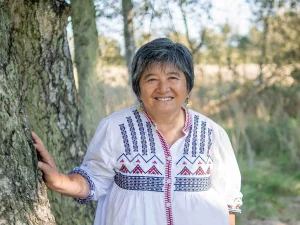
Raising Indigenous voices in the face of the global ecological breakdown and her leadership in defending people, lands and culture.
Joan Carling is a Filipino Indigenous activist who has been defending the rights of Indigenous Peoples for more than 30 years. Her work spans grassroots and international levels, focusing on human rights, sustainable development, climate justice and the fight against land exploitation. Since the late 1990s, Carling has led multiple Indigenous rights organisations. She continues to play a pivotal role in amplifying the voices of Indigenous Peoples across the Philippines, Asia, and globally, with a focus on combating the systemic marginalisation and criminalisation of Indigenous communities.
Carling has dedicated her life to protecting Indigenous communities, often at great personal risk. She has been unjustly arrested, labelled a terrorist, falsely accused of crimes and received threats on her life. Despite this, she continues to fight for Indigenous Peoples’ rights, helping communities defend their lands and resist exploitation by powerful corporate and state interests.
Carling’s advocacy has had a profound impact, from helping stop destructive mining projects opposed by Indigenous communities to influencing policies on Indigenous women’s rights at the United Nations. Her work in the Philippines, one of the most dangerous countries in the world for Indigenous Peoples—where activists are frequently targeted, killed and forcibly disappeared—has been especially critical. By empowering Indigenous Peoples to defend themselves against these threats, Carling has helped communities across the Philippines take an active role in defending their rights and protecting their lands.
Joan Carling
- Philippines
- Place of Birth: Baguio City, PhilippinesDate of Birth: June 30, 1963Website: https://iprights.org/
Heroes
The Man who put war on trial
On April 14th, The man who put war on trial at Nuremberg posthumously receives Congressional Gold Medal.
Benjamin Ferencz lived in Delray Beach, Florida.
By Steven Jay, Creative Director
In 1945, a 27-year-old lawyer helped prove a radical idea after World War II:
👉 War crimes can be prosecuted—not just fought.
That lawyer was Benjamin Ferencz.
- At the Nuremberg Trials, Ferencz led the prosecution of Nazi death squads.
- His case: well over 1 million murders, proven largely through documents.
- Outcome: unanimous guilty verdicts.
No revenge. No spectacle. Just evidence.
Why it mattered
It changed the rules of the system:
- Individuals—not just nations—can be held accountable
- “Crimes against humanity” became enforceable
- Law entered a space previously dominated by war
This helped inspire the creation of the International Criminal Court.
The gap today
We have the blueprint. We’re not scaling it.
- The United States is not a member of the ICC
- Conflicts are rising globally
- Civilian exposure remains high
The issue isn’t knowledge.
It’s implementation.
Flip the script
Ferencz’s model challenges the old operating system:
Old pattern:
War → retaliation → escalation
New possibility:
Law → accountability → prevention
Systems insight
This is bigger than history.
It’s a systems design question:
- Do we resolve conflict through force…
- Or through shared legal infrastructure?
Ferencz’s life suggests:
👉 Justice can scale—if institutions and nations choose to align.
What leaders should consider now
- Expand participation in global legal frameworks
- Strengthen enforcement mechanisms across borders
- Integrate legal accountability into geopolitical strategy
📊 Bottom line
War is not the only tool. It’s just the default one.
Ferencz proved another option exists:
👉 Law as infrastructure for peace
Heroes
Vishal Prasad of Fiji accepts ‘Alternative Nobel Prize’ on behalf of Pacific Islands Students Fighting Climate Change
Vishal Prasad, Director and co-founder of Pacific Islands Students Fighting Climate Change (PISFCC), will accept the 2025 Right Livelihood Award in Stockholm on 2 December on behalf of the group. Since 2019, he has been at the forefront of the youth-driven campaign that united more than 130 countries behind the call for an Advisory Opinion on climate change from the International Court of Justice (ICJ). The six-year effort pushed governments to seek clarity on states’ legal duties to safeguard present and future generations from climate harms. On 23 July 2025, the ICJ issued its landmark opinion, confirming those obligations and opening the door to new avenues for climate justice worldwide. Prasad is now continuing this work to operationalise the ICJ’s ruling at PISFCC, strengthening global youth action to
hold governments accountable for the climate crisis.
The 2025 Right Livelihood Award, also known as the “Alternative Nobel Prize,” is being given to four Laureates: Pacific Islands Students Fighting Climate Change and Julian Aguon (Pacific Islands and Guam), Justice For Myanmar (Myanmar), Audrey Tang (Taiwan), and Emergency Response Rooms (Sudan).
Since 1980, the Right Livelihood Award has recognised 203 Laureates from 81 countries, celebrating their courage to solve global problems


