
Connect with us

Activism

Aline Sousa Speech to the United Nations in Geneva

Published

on

October 5, 2020: Geneva and Brasilia
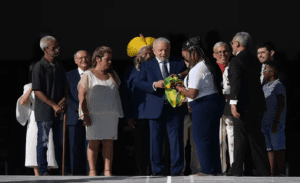
It is a most exciting time to be alive right now. Think about it for a moment: there’s so much we can do together with all these great nations here if we want to.

With all the crises we must overcome, solving them while preventing new ones requires a different way of thinking:

We must be cooperative, not proprietary, in our thinking and actions.

There has been too much talking and minimal action. To improve the quality of life on this beautiful planet, we must COOPERATE!

In 2018, Brazil, the country with the most prominent black population outside of the continent of Africa AND the most indigenous that survived colonial genocide, elected a white supremacist president. That hadn’t happened since Hitler’s Germany!….

Imagine–a once brutally colonized country that kidnapped and enslaved the most Africans to this new world. 

We lived four years of hate, fear, and genocide. Black and brown people displayed the swastica, and some even marched to the nazi goose step. 

When the resistance defeated fascism through the next elections, the regime did not want to give up its power.  

Brazil was under threat of a violent coup. Our new democratically elected president, who always respected diversity, decided that people’s power would be the only way to establish a peaceful transition. Seven representatives, each leader of their class and position in Civil society, were chosen out of 220 million Brazilians. 

Our famous indigenous chief, the disabled, a great teacher and educational advocate, leading woman activists, lgbt, domestic workers, and my category, recyclers. 

I, as my mother and father, as their mother and father before them, was born homeless. We grew up in landfills separating trash, some of which we would build shacks, cloth, and sometimes even used to nourish ourselves.  

This went on for three generations! One day after another, of the many times that the police would arrive with bulldozers and trucks to destroy the little we had, I decided that one day we could break that cycle of poverty and violence of what was nothing more than ethnic cleansing. Like the untouchables of Índia, we were an eyesore that the then-ruling elite was uncomfortable with. 

We began to organize, and today, I’ve been honored with the task of leading one of Latin America’s largest waste cooperatives. My people have real homes and work and are part of what our planet needs for all, including that ruling elite, to survive. 

Now, they award us; they depend on our advice for social public inclusion policies. Never in my wildest dreams could I have ever imagined that I would be chosen to represent the seven leaders who helped transform a country infested with hatred and on the verge of civil war into the even stronger democracy we are today.

However, political democracy can not survive without economic democracy. We can not eliminate racism without identifying classism. Also, many talk about diversity today, but what good is diversity when we are dangerously close to decimating our biodiversity? 

 Many today will talk about cultural racism, but what about environmental racism? Ecological racism or ecological apartheid is a form of institutional racism leading to landfills, incinerators, and hazardous waste disposal disproportionately placed in communities of color. 

This I’ve earned the right to claim some expertise with. I lived and studied it, and my life’s mission has been to abolish it. 

Now, Even that powerful elite that discriminated against us by demolishing our homes, destroyed our livelihoods, and, in my case, took what I most treasured as a child, the books I would read to dream about myself, my family, and all the many living in extreme and humiliating poverty to escape from.

Today, that same elite is starting to understand that we, once untouchables and invisible people marginalized by society, are vital to the survival of all, not just human society but all species of life on our planet. Now they understand that interconnectedness, Love, and tolerant coexistênce are natural laws. 

Our planet will not survive through continued resource extraction. Recycling has now leaped from the dark shadows towards a light for solution. Hence, I must end this speech with an important warning. The world is in the process of transformation from a unipolar to a multipolar one. This is a good thing, but I made the following alert.

We are on the right path, but some suffer as all shifts in world order. And history has taught us that people experiencing poverty are the most vulnerable.

Today, Recycling has become an essential part of a successful transition to a better world. Still, the instrumental changes needed for a revolution, as in de-dollarization, make Recycling impossible. The recent fall of the dólar has animated my people’s wages. For example, within the last few months, we must collect 8 tons of discarded boxes and paper to earn 270 dollars a month!  

In these same months, I’ve been invited to speak at events like this the world over; I’ve been awarded many awards, including the environmental and social justice award from the US ambassador to the UN, the very body I’m speaking to today, yet another event, another talk. 

With all due respect, I say enough awards, enough talk!

IF recyclers are critical to a sustainable world, I call on the UN to take emergency action to help recyclers survive because, at this moment, this is a category that is about to become extinct. After many years of struggle, the irony is that one of the critical solutions to climate change, meeting sustainable development goals and species survival, is in danger…in this war to save our planet, we need fewer awards and recognitions. We need more comprehension because I must apologize for the repetition, but again, the human diversity we defend here will not even exist without biodiversity. After decades of plodding and painful progress, Recyclers worldwide need immediate, urgent assistance. I am very sad to say that again, just in the last few months, this critical activity has quickly degenerated back to my grandmother’s generation, an endangered species……thank you for your attention and consideration, and much gratitude to this noble family of nations, may God help us all……

Continue Reading

Activism

Why we need a new media ecosystem

Published

on

Just listen….

Danny Schechter adapted the name “News Dissector” when he worked on air at WBCN in Boston.

He was one of the most respected documentarian and someone who couldn’t be bought.   He was one of the first people in America to bring the name Nelson Mandela into the public consciousness.

Schechter produced and directed many television specials and documentary films, including:

  • Beyond A Long Walk To Freedom (2014)
  • America’s Surveillance State (2014)
  • DeWitt Clinton HS: The School That Can Teach Them All, on the fight for Public Education (2013)
  • Who Rules America? (2012)
  • Plunder: The Crime Of Our Time (2010)
  • Barack Obama: The People’s President (2009)
  • Boob Tube: Sex, TV and Ugly George (2008)
  • Viva Madiba (2008)
  • A Work in Progress: Danny Schechter and the Journalism of Change (2007)
  • In Debt We Trust: America Before The Bubble Burst (2006)
  • WMD: Weapons of Mass Deception (2004)
  • Counting on Democracy (2004), about the 2000 Florida election recount, narrated by Ossie Davis and Ruby Dee
  • We Are Family (2002), about a benefit recording of the Sister Sledge song following the September 11, 2001 attacks; shown at the Sundance Film Festival
  • Nkosi: A Voice of Africa’s AIDS Orphans (2001), narrated by Danny Glover
  • Falun Gong’s Challenge to China (2001)
  • A Hero for All: Nelson Mandela’s Farewell (1999)
  • Globalization & Human Rights (1998)
  • Beyond Life: Timothy Leary Lives (1997)
  • The World of Elie Wiesel (1997)
  • Sowing Seeds/Reaping Peace: The World of Seeds of Peace (1996)
  • Prisoners of Hope: Reunion on Robben Island (1995), co-directed by Barbara Kopple
  • Countdown to Freedom: Ten Days that Changed South Africa (1994), narrated by James Earl Jones and Alfre Woodard
  • Sarajevo Ground Zero (1993)
  • The Living Canvas (1992), narrated by Billy Dee Williams
  • Beyond JFK: The Question of Conspiracy (1992), co-directed by Marc Levin and Barbara Kopple
  • Give Peace a Chance (1991)
  • Nelson Mandela: Free at Last (1991), PBS national broadcast
  • Mandela in America (1990)
  • The Making of Sun City (1987)
  • Student Power (1968)

Little Steven Van Zandt and Danny SchechterBooks

Continue Reading

Activism

Humanitarian Artists for Ukrainians

Published

on

Arts + Solidarity

The Arts as Connector

February 14th is the day the world celebrates Valentines Day.  A day of celebrating the love we have for one another–no matter where in the world we are.  Now, something special to celebrate the love for others kicks off in Southen California on February 15th.

For as long as we know, the Arts has been a catalyst for awareness and change.  From the “Sun CityRockers Against Apartheid movement produced by Steve Van Zandt, Arthur Baker and Danny Schechter to convey opposition to the South African apartheid to, to Woodstock, the No Nukes Concerts Live Aid, No Nukes and many others creators worldwide have found ways of utilizing human creativity to create awareness about human suffering, or the need to create change.”

“In the alternative art world, performance artists have championed the issues of social justice, freedom of expression and human rights. Artists such as the NEA Four, Suzanne Lacey, Barbara T. Smith and so many others have paved a way for today’s current generation of humanitarian arts-based practices.”

While the struggles and oppression continue in Ukraine and Belarus, we’ve seen little reporting on their struggles.   

One group of humanitarian artists have come together to shine the light on helping those who have nflicted from harms way. 

Pavuk (Ukrainian for “Spider”) is a collective installation and day-long performance centered on a traditional suspended straw structure symbolizing cosmic balance, protection, and interconnected life.


What’s happening

  • Fifteen artists from around the globe will each create one geometric element of the Pavuk and send it to Los Angeles, where the pieces will be assembled into a single monumental installation. This multinational and multigenerational group of artists, curators and organizations, are volunteering their efforts in support of a critically important cause: the survival of the Ukrainian people. 
  • Additionally, performance artists, including the legendary LA MUDPEOPLE, will activate the installation while accompanied by a durational piece by project creator, Alina Kalinouskaya, who is immobilized, bound by rope in symbolism of the struggles in Ukraine. Singer/songwriter Lali Bell performs throughout the 3-hour durational experience.
  • The 3-hour experience will be live-streamed via the Pavuk website.
  • The event takes place and is hosted by 18th Street Arts Center, in Santa Monica, California. Long a home for progressive social change,  The 18th Street Arts Center has, since its founding in 1988 been champion and home to the intersection between art and social activism.


Why diversity is essential.

Alina Kalinouskaya, Performance Artist

“I believe this diversity, and the project’s multidisciplinary nature, creates a sense of unity among us as humans. In addition, Olena shared information about trusted and widely recognized charitable organizations, and I selected the Prytula Foundation because I deeply respect and value the work they do.

Why it matters

Pavuk is presented in solidarity with the people of Ukraine — and as an urgent reminder to U.S. audiences that the humanitarian and political crisis remains ongoing.

  • In support of victims of the Russian invasion of Ukraine.
  • In support of individuals facing political repression for protesting the war and invasion.

The big picture

Olena Yara, Yara Studio

The structure at the center — a traditional Pavuk — represents a worldview where balance and protection emerge through relationship.

This project mirrors that principle: distributed creation → shared assembly → collective witnessing → direct support.

What to anticipate.

  • Durational performance: Alina Kalinouskaya will remain suspended in ropes for the entire day — acting as a living axis within the installation.
  • Live music: Lali Bell will perform live on guitar throughout the day, including a song composed in dedication to the people of Ukraine.

Where donations go

Visitors will be encouraged to donate directly to the Prytula Foundation, supporting its Emergency Response Program, “Light of Ukrainian Hope” — providing generators to communities where electricity has become a matter of survival.

  • Direct donations during the performance support the same emergency program.
  • Proceeds from project-related NFTs will also be donated to the program.

Credits

  • Curated by: Michael J. Masucci
  • Supported by: Yara Agency

The bottom line: Pavuk is both memorial and mechanism — a living, collective work designed to keep attention on Ukraine and route it into direct support.
Continue Reading

Activism

Prophetic Words

Published

on

Continue Reading

Translator

Featured Upcoming Events