Connect with us

Books

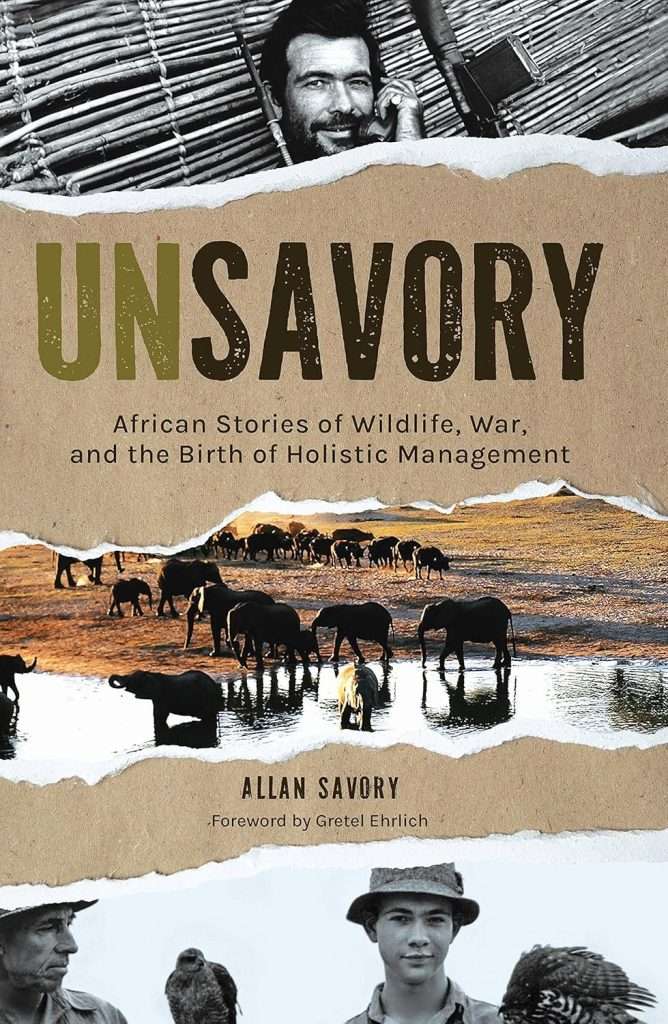
UNSAVORY

Published

on

UnSavory: African Stories of Wildlife, War, and the Birth of Holistic Management Kindle Edition


In the wild heart of Africa, one man’s fight to save the land nearly cost him everything.
In the mid-1950s, Allan Savory was a young biologist in a corner of Africa where the bush reverberated with trumpeting elephants and bellowing hippos, and the politics were as dangerous as the wildlife. Over the next three decades, he would become a soldier and tracker in a brutal civil war, a member of Parliament fighting to end it, and an exiled ecologist challenging the world’s most sacred environmental beliefs.
Savory’s insistence that livestock—not their removal—could heal degraded land sparked both breakthroughs and outrage. Branded a heretic, pursued by political enemies, and scarred by personal loss, he pressed on, convinced the future of humanity depended on restoring our life-supporting habitat.
UnSavory is the untold story behind Holistic Management—woven through encounters with man-eating lions, political betrayal, and a lifelong battle with the “common sense” that destroys the natural world. It is a front-row seat to Southern Africa’s turbulent history and one man’s stubborn, improbable quest to change the fate of the earth.
Continue Reading

Books

MEAT isn’t anti-meat. That’s the point.

Published

on

MEAT isn’t anti-meat. That’s the point.

Why it matters:
Global meat consumption keeps breaking records—and will keep rising. Arguing people out of meat has failed for 50 years. Science may succeed where persuasion hasn’t.

The misunderstanding:
Many readers expect MEAT to be a manifesto telling people to eat less meat. It isn’t.

“I’m not here to tell anyone what to eat,” writes Bruce Friedrich in the opening pages.

The book:
MEAT: How the Next Agricultural Revolution Will Transform Humanity’s Favorite Food—and Our Future (on sale Feb. 3, 2026) argues something more disruptive: humans will keep eating meat—but we don’t need animals to make it.

Big picture:
Humans have eaten meat for ~2.6 million years and farmed animals for ~12,000. Today we consume 550+ million metric tons of meat and seafood annually, with no sign of slowing. Friedrich’s thesis is pragmatic, not moral:

  • Meat demand is structural.
  • The current system is inefficient.
  • Science offers a cleaner, cheaper upgrade.

What’s actually changing:
Friedrich walks readers through why producing meat by cycling crops through animals is economically obsolete—and how plant-based and cultivated meat can deliver the same product with radically lower costs.

The stakes (chapters 1–4):

  • Hunger and malnutrition
  • Climate and land-use pressure
  • Antibiotic resistance
  • Pandemic risk

Why reduction campaigns failed (chapter 5):
People like meat. Culture beats messaging. The book treats this as a design constraint, not a moral flaw.

The innovation arc (chapters 6–8):
Early products are expensive and imperfect. Then science compounds. Friedrich compares alternative meat to once-mocked technologies like artificial ice—and AI—before scale and price unlocked ubiquity.

Who’s backing it (chapter 9):
Not just startups. Incumbents like Tyson, Cargill, ADM, and JBS are investing—because efficiency wins markets.

Security angle (chapter 10):
Food security is national security. Distributed, biosecure protein systems reduce geopolitical and domestic instability—a theme underscored in the foreword by Caitlin Welsh of Center for Strategic and International Studies.

Who’s moving fastest:
Early leaders: Singapore, Israel.
Current scale leaders: U.S., China.
Active investors: India, Brazil, Japan, Korea, Canada, Australia, much of Europe.

What experts say:

  • George Church (Harvard): “An engaging treatise on using science to make meat far more efficiently.”
  • Michael Kremer (Nobel laureate): Alternative proteins address hunger, climate, and pandemic risk.
  • Jane Goodall: “Please read this book… it gives us hope for a kinder future.”

About the author:
Friedrich—founder of The Good Food Institute—isn’t a lab theorist. He grew up around cattle ranches, ran homeless shelters, taught in inner-city schools, and now leads a global science organization spanning six regions.

The takeaway:
MEAT doesn’t ask people to change their tastes. It asks systems to change their methods.

Bottom line:
If humanity won’t give up meat, the next agricultural revolution won’t be about restraint—it will be about redesign.

Continue Reading

Subscribe


Translator

Featured Upcoming Events