
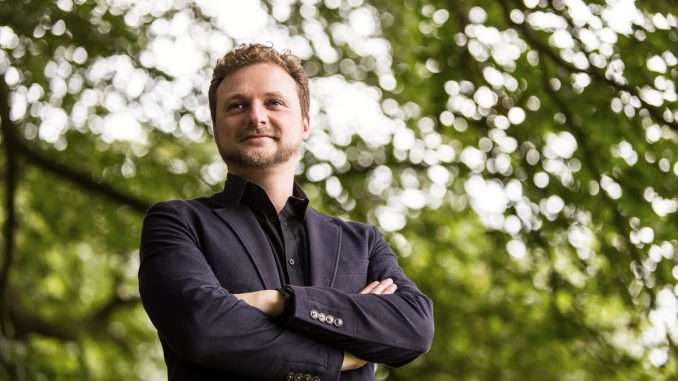
Tom Bosschaert is the founder and director of Except Integrated Sustainability, a Netherlands-based innovation, design, and development consultancy focused on building systemic solutions for a sustainable society. He founded Except in 1999 at age 19 with a mission to connect science, business, design, and communication to solve complex social and environmental challenges. His work spans sustainable cities, circular economy, architecture, urban design, bio-based development, regenerative communities, and systems innovation.
Bosschaert is best known for developing the Symbiosis in Development framework, which combines systems thinking, complexity analysis, design thinking, and co-creation to help communities, companies, and governments create practical pathways toward resilience. His project work has included concepts and designs such as ReGen Villages, Shanghai vertical agriculture systems, Salesforce Park in San Francisco, bio-based urban projects, and self-sufficient city models. For Mobilized News, his work matters because it shows how imagination, design, and whole-systems thinking can move sustainability from isolated ideas into real-world infrastructure, communities, and daily life.
Many organizations still make plans as if the world is stable. What changed?
Yvoke says it works with companies whose business depends on systems that are no longer behaving the way they used to. What are the clearest examples you are seeing right now?
There are some areas that are obvious and lie on the surface. For example, anything impacted by global logistics and trade. Shipping route disruptions, jumping shipping costs and delays, and the policies that influence this area like protectionism, tariffs, and regulation. Agriculture and food, and weaponization of hunger, are also obviously clear and present. Then there’s less visible, but not less impactful, areas. Rare earth and shortages of what we assume are commonly available materials, like sand for concrete, metals, certain chemicals, etc. Lastly, there’s technological and sociological disruptions that affect nearly every industry right now. Obviously AI itself but also the (often bad) decisions on how AI is (non)implemented. But also the shifts in generational demographics, living patterns, consumer behavior. Often these areas connect to make a point of ‘perfect storm’. These can cause far-reaching risk profiles, but also opportunity gaps.
What is the difference between a sustainability strategy and a systemic strategy?
You talk about resilience, regeneration, and systemic strategy as three core terms for an unstable world. How do these three ideas work together?
In an unstable world, resilience is the only strategy that can lead to success (as opposed to a growth based strategy). When those unexpected events hit, will the organization dapt and go on, or break? Regeneration is how practically that approach touches the road; leaving the trail better than you found allows you to build primary and secondary value, not just for now, but also going forward. This affects the supply chain, human capital, and lowers risk. Regenerative practices are most literally applicable for organizations that are somewhere along the chain of products and services that use ecological services. Food, construction materials, cosmetics, land use, etc. However, since they’re so ubiquitous, most other industries are at least tangentially related, and can investigate how regenerative practices can help them as well. Systemic strategy is the roadmap and blueprint to make these terms concrete for your organization. Not just for tomorrow but for the years ahead. So you know what way you’re going, what dot on the horizon you are navigating towards, and not just be reactionary.
How do you help leaders see the whole system instead of optimizing isolated parts?
What is the smallest move that can shift the largest variable?
What are the biggest barriers to systemic change: money, politics, outdated business models, institutional fear, or lack of imagination?
Yvoke’s work includes cases involving IKEA, Heineken, the IKEA Foundation, Pizza 4P’s, the Dutch carpet sector, and Orchid City. What do these cases teach us about how systems actually change?
How should communities and smaller organizations apply systemic strategy when they do not have the resources of a multinational company?
If the future belongs to those who understand networks, what should media, education, business, and government do differently right now?
Start learning the basics of systems thinking and systems mapping. It’ll open eyes, visions, insights beyond any other approach that we know of. It’s no surprise this lies at the foundations of some of the most important work done worldwide. Most climate science, the UN, most successful global businesses… it’s just a surprise it’s not yet a foundational element in schools and universities. But that’s coming, slowly, as it’s becoming increasingly obvious that our globalized society cannot be understood without it anymore.
What would change if every organization stopped asking, “How do we grow?” and started asking, “How do we become resilient, regenerative, and useful to the whole system we depend on?”
We start building a world where we can continue into the future without destroying ourselves, and to have businesses that can help develop value while also becoming foundational in our transition towards new, sustainable, and socially beneficial agencies. Many companies that have been around for more than 100 years have always known this. Now, for all the new ones, they will either learn this, or wash away with time.