
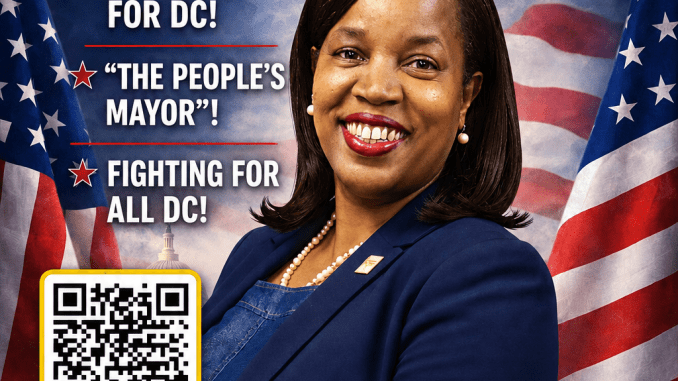
While news of the current administration in Washington D.C. tends to focus on corruption, Mobilized has chosen to speak with Mayoral candidate, Dr. Rhonda Hamilton about how she would lead as Mayor of Washington, D.C.–the City,
Mobilized is apolitical. But times like these, we require seeing new perspectives for new possibilities. We hope that this conversation helps to reveal a different ‘side’ of D.C. Not right. Not left. But FORWARD.
Our overarching conversation focuses on “What would you actually redesign, how would the systems connect, who participates, and how will we know it worked?”
Mobilized: You have said that Washington needs to address problems at their root rather than continually paying for the consequences. If you became mayor, which three systems would you redesign first—and what would you do differently?
Dr. Rhonda Hamilton: “I would, per my executive powers or make recommendations where required, to firstly redesign the Metropolitan Police Department, Broader Public Safety, and Housing Authority systems. Currently these systems share systemic failures in leadership, chronic understaffing as well as they are heavily contributing to a deteriorating public infrastructure.
As executive, I would improve the operational standards or make necessary recommendations where required, of each with investments in frontline staffing and capital repairs, as well as conducting a complete audit of each system and overall agency’s performance to identify the intersecting challenges of inadequate management, budgetary accountability, and investigatory public responses to help shape immediate reforms to include senior staff qualifications review, training or removal, elimination of fraud, waste, and abuse occurrences, and implementation of independent civilian oversight boards with subpoena powers.”
Mobilized News focuses on the interdependence between housing, health, education, transportation, employment, public safety and economic opportunity. Where do you see these systems failing to work together in Washington today, and how would your administration reconnect them?
“My observation is that the common denominator for failure of these systems is the lack of appropriate and adequate oversight. I would work with the legislative branch to ensure that there is a deliverance of what is called “wrap-around” services and responses that will address the existent systemic fragmentation, efficiently manage bureaucracy and raise the standard of citizen expectation and outcomes.”
You describe housing as healthcare. What would that idea actually mean in practice for a Washington resident struggling with rent, displacement, homelessness or an unstable living situation?
“As DC’s next Chief Executive, I recognize that the foundation for overall mental and physical well-being rests with having safe, stable, and habitable housing. “Housing as healthcare” means prioritizing policies and systems that address economic strife, housing affordability and instability, as well as enforcing laws that deter slumlord behaviors and balances out the effects of gentrification.
In practice concerns for DC residents’ lack of healthy living, mental wellness, access to dignified living services and resources remains to be observed as a crisis that my administration will treat with the absolute urgency, systemic reform, and compassionate action it demands.”
Your background includes years of mental-health advocacy and helping families navigate complex systems of care. What have those experiences taught you about what government gets wrong—and how would you redesign Washington’s mental-health system around prevention, accessibility and human dignity?
“Many years of observing and working alongside DC’s mental health system have taught me that DC is seemingly operating with a “one size fits all” model. This approach has limited the nature of care offered and often lacks a comprehensive treatment plan for DC resident mental wellness outcomes.
My administration will seek to redesign the existent core service model and case management structures to include robust training, higher standards in vendor contractual awards, and community level investments in preventative and holistic care approaches. Additionally, system wide education, oversight, and safety protocols will be implemented to protect the integrity of care and deter systemic stigma.”
Public safety debates often become arguments between policing and criminal-justice reform. What would a whole-system public-safety strategy look like—one that also addresses youth opportunity, mental health, addiction, housing, education and economic conditions that can contribute to instability?
“A whole-system public safety strategy would involve treating crime and violence as indicators of deeper social problems. Rather than relying solely on policing and imprisonment, investments in after school programming, mentorships and safe spaces for teens, paid internships, deployable mobile crisis units, community based treatment services for mental health, harm reduction task forces, housing peer advocates, emergency housing resources, restorative justice programs, vocational education, job training and placement, small business grants and incentives, well stocked food banks, a properly staffed, trained, and motivated government workforce would in my opinion be a more appropriate whole system public safety strategy.”
You have called for greater investment in Washington’s young people. Instead of simply creating more programs, how would you give young residents a genuine role in designing the policies, businesses, technologies and community initiatives that will shape their future?
“My administration will recruit young DC residents to join youth advisory boards for city policies, test new technology products and programs, lead local green energy projects, exchange business/entrepreneur ideas, host community youth forums and town halls to provide input on budgetary and senior executive advisory involving school and community programs, youth wellness strategies, safety initiatives, social media and internet trends, youth led digital literacy workshops and companionship services for seniors, peer to peer mentoring, as well as they will receive access and opportunities to formally engage in civic and governmental operations through paid internships and entry level trainings and placement.”
Washington contains enormous wealth, world-class universities, federal institutions, businesses, nonprofits and extraordinary human talent, yet deep disparities remain between neighborhoods. How can the city mobilize those existing resources so prosperity reaches communities that have historically been left behind?
“Mobilizing these resources to address the deep community disparities and disseminate prosperity should include investing in entrepreneurship or small businesses run by residents in underserved communities. Hosting monthly business mentoring, and grant writing workshops, financial literacy education and training to help remove barriers to wealth building. Converting commercial properties to create additional affordable housing units, as well as sponsoring land trust initiatives and partnerships to offset rising housing costs, displacement and gentrifying realities. Increasing investment in schooling infrastructure, staffing and mental health supports, community center programs, healthcare/trauma centers, and higher education access. Investing in sustainable career training models, community owned co-ops, homeownership opportunities, and increasing tax incentives for hiring local residents. Partnering with universities, non-profits, and local businesses to provide increased access for free community legal and healthcare services, as well as to create a research data sharing pipeline to help identify and reduce disparity gaps.”
You have emphasized small businesses, jobs, economic security and partnerships with private industry. How would you encourage community ownership and locally generated wealth rather than development that ultimately displaces the people it was supposed to benefit?
“In addition to my response for question #7, my administration will work aggressively at introducing sustainable economic opportunities to help strengthen our communities, combat social determinants, encourage and support local equity and investment models.”
You are running as an Independent and say leadership should be about humanity rather than political party. In a highly partisan environment, how would you build working coalitions across the D.C. Council, neighborhoods, businesses, community organizations and the federal government without sacrificing your principles?
“Simple. I will lead from a resident first position, and encourage my colleagues and community members to follow suit. DC’s governing body must be accountable to our United Nations designation of being a human rights city. Thus, we must ensure that above partisan politics the economic needs and well-being of all of our constituents are being met. Upon being elected as DC’s next mayor I will serve the people of DC, not subscribe to unprincipled, political strongholds. I will simply remind them that in the wake of fighting to preserve “Home Rule” we must be united in our efforts to remain independent.” (smile)
10. Washington’s unusual relationship with the federal government makes Home Rule and local democracy especially important. What do you believe D.C. residents must do now to protect their ability to govern themselves, and what role should the mayor play in that effort?
“DC residents must elect a leader that will successfully galvanize efforts on the government and community levels to unify in the face of the threats to our Home Rule. Beyond being a mental health advocate, I am a leader that also organizes. My role will be to get the city off from its knees and march us upright to Congress, the entirety of our citizenry, before the world’s stage and demand that our Congressional leaders and the President recognize the change in our leadership, and the unyielding resolve of DC residents to fight for our independence through demonstrated efforts in the media and in court.”
You have spoken about transparency, accountability and reforming programs that aren’t working. What measurable outcomes should residents use to judge a Hamilton administration after its first year—and what would you do if the evidence showed one of your own policies wasn’t working?
“As the President and Executive Director of two mental health organizations I recognize transparency and accountability as being the cornerstone of measurable outcomes for our government. Mental health should and will always matter. In 2022, the ongoing failures of our current Mayor’s administration and elected leaders prompted my organization to place them on a “Community Report Card” to help DC residents’ voices from across all 8 Wards to be heard. Of course, citizen voices were met with more of the same dismissive, silent, and unaccountable responses from each member of our then, elected body of leaders. My administration plans to implement the “Community Report Card” as a tool in our efforts to reunite citizen concerns with matters of government and to ensure that their right to accountable and transparent government is restored. Should their voices indicate that a Hamilton administration’s policy isn’t meeting its measurable outcome based on the expressions of the Community Report Card, and other communicated concerns, I will work with members of my already appointed community-led advisory commissions to modify and adopt policies that the community’s input have determined would work better. As a public official, I want what the community wants, as long as it is healthy and would benefit the whole of DC.”
Mobilized News asks a larger question: How do we create a better future while the world feels upside down? If Washington, D.C. could become a working model for a healthier, more democratic, resilient and economically inclusive city, what would that city look like—and what can ordinary residents begin doing right now to help build it?
“Just as we would eat an elephant, one bite at a time, so shall we create a better future, one step, one policy, and one day at a time. If Washington, DC could be the healthy example it would look like a city that is unified, respecting of one another’s differences, cultures, ethnicities, politics, and religion.
It would be the beacon of happy, dignified housed citizens in communities where healthy demonstrations of low-, middle-, and higher-class citizens live among one another with low or no crime or homelessness, village styled neighborhoods that join in efforts to advance our properly educated children to ample platforms of higher learning or career sustainable employment/self-employment, and wonderfully prepared for the world that they will inherit mentally, civically, and politically.
Seniors living out their years in comfort with stable housing, stress free environments, free of healthcare concerns and feeling loved and valued by their communities. Families growing happily, a flourishing economy, an independently recognized state with a governing body that is respected and a surplus budget that is complimented by 0% unemployment, net zero wealth gap, and one where all branches of the federal government respect their presence and positioning as the nation’s seat of governance.”
DC residents can begin spreading the word in their communities to vote for the Independent mayoral candidate, Rhonda Hamilton on Nov. 3rd and get ready to join me in cleaning up the current mess in our local government by serving on one of the many citizen-led advisory commissions that I will bring forth.
When most people think of Washington, D.C.,they think only of politics and lobbies and not the people who actually LIVE there. What would you like to say to people who want to understand the People who Live in Washington, D.C.?
“Washingtonians are a wonderful blend of generationally connected and migrated citizens who live, work, and worship in DC communities rich with history, culture, and structure. We are no different than many other regions, gentrified, and dealing with failed promises from elected public officials which has placed our beloved DC in a temporary state of disarray.
However, our strong sense of pride and resilience will kick in high gear as we prepare to remove the failures in our government and restore DC to its people. All of its people. We like the monuments and appreciate the lawmakers, however, make no mistake about it, We Are DC!
This is our land and we will not retreat. Many have and will try to displace or discredit who we are, however, our forefathers paid in blood in order that the generations will remain and build with others. All 8 Wards of the city offer something unique to who we are, and yes East of the river can be intimidating, however, rest assured that there is a “big momma” somewhere near by waiting to greet you and dismantle your fear.
We Are DC, Urban, territorial, and always ready to dance. Being raised in a political town it’s interesting to witness unfamiliar folks “remark” that there are two DC’s, nope not at all, just one. The one that I happily embrace as the best city in the world, that has nurtured me, and that has endorsed my nominating petitions to be placed on the ballot in the Nov. 3rd General election, as an Independent mayoral candidate. That is DC, always ready to support its own. I AM DC!”