
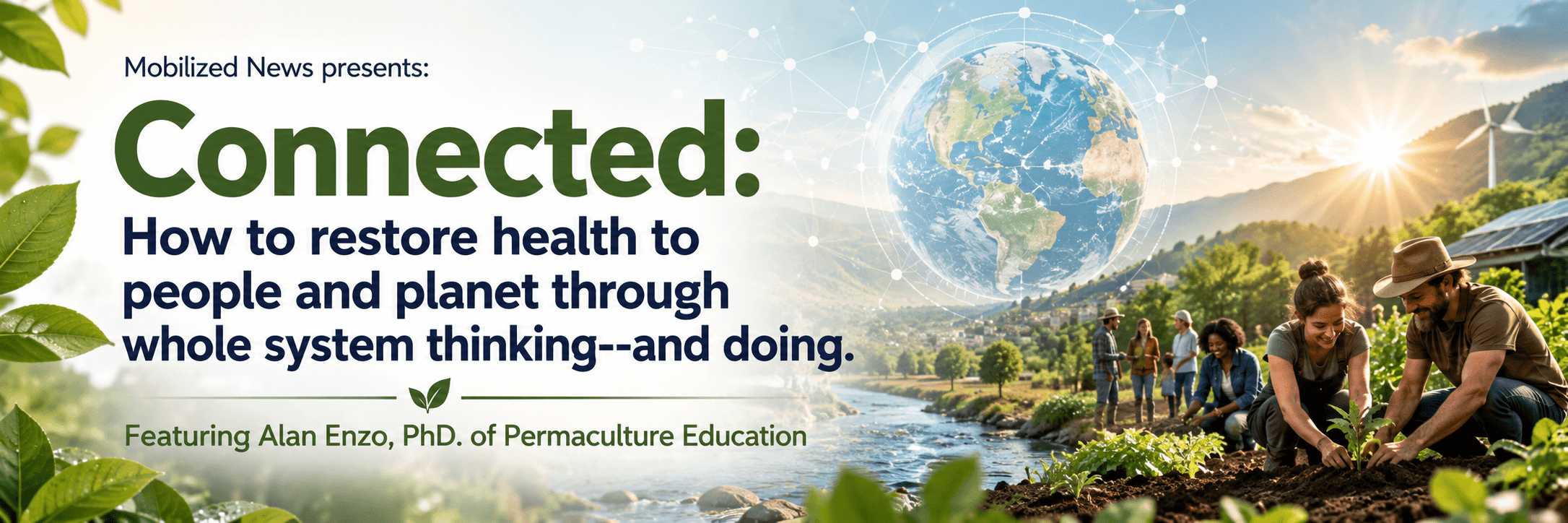
Connected: How to restore health and well-being where we are now
Below is a complete framework for reintroducing Alan Enzo, founder of Permaculture Education, through Mobilized News as part of a larger conversation about designing living systems that restore health, resilience, food security, local capability, and ecological intelligence.
Mobilized News Presents
Alan Enzo: Permaculture Education for a World That Must Learn How to Live Again
Working Theme
Designing for Life: How Permaculture Education Can Help Communities Restore Land, Food, Water, Health, and Local Resilience
Core Premise
Alan Enzo’s work is not only about gardens, farms, or ecological design. It is about helping people understand how life works — and how communities can redesign their homes, neighborhoods, schools, farms, businesses, and local economies to work with nature instead of against it.
Mobilized News is reintroducing Alan Enzo to the world because the moment demands practical wisdom. Communities everywhere are facing food insecurity, climate disruption, soil depletion, water stress, rising costs, loneliness, and a loss of basic life skills. Permaculture Education offers a way back to common sense, ecological literacy, and local self-reliance.
This conversation asks: How can people learn to design systems that support life — starting where they are now?
Key Topics to Address
1. What Permaculture Really Means
Permaculture is often misunderstood as gardening, homesteading, or organic farming. This conversation should clarify that permaculture is a design system for creating resilient, life-supporting human habitats.
2. Why Permaculture Education Is Needed Now
The world is facing connected crises in food, water, health, climate, housing, economics, and community trust. Permaculture offers practical tools for thinking and acting systemically.
3. From Consumption to Participation
Modern life trains people to buy solutions. Permaculture teaches people how to observe, design, grow, repair, conserve, share, and participate.
4. Food Security and Local Resilience
How can communities grow more of what they need, reduce dependency on fragile supply chains, improve nutrition, and reconnect people to the land?
5. Water, Soil, and Living Systems
Healthy communities require healthy soil, clean water, biodiversity, and regenerative land care. These are not side issues. They are survival systems.
6. Permaculture as Education for All Ages
Permaculture can be taught in schools, community centers, farms, gardens, prisons, churches, neighborhoods, and online learning spaces.
7. The Design Mindset
Instead of asking “What product can solve this?” permaculture asks: “What relationships, patterns, flows, needs, resources, and feedback loops already exist?”
8. Local Economies and Mutual Support
Permaculture is not only ecological. It can help communities redesign exchange, cooperation, shared resources, food distribution, skill-sharing, and local livelihoods.
9. Health, Food, and Daily Life
Food is medicine, culture, ecology, economy, and community. Permaculture helps people reconnect daily choices to living systems.
10. From Individual Gardens to Community Systems
The goal is not isolated self-sufficiency. The goal is interdependence: neighborhoods, schools, farms, markets, makers, educators, and local leaders working together.
11. Media, Storytelling, and Public Imagination
People need to see what is possible. Mobilized News can help document permaculture projects, community transformations, working models, and practical pathways.
12. The Mobilized Exchange Connection
Permaculture Education can connect through the Exchange by listing courses, mentors, tools, demonstration sites, local projects, community needs, seed networks, food hubs, and action groups.
Suggested Agenda
Opening: Why This Conversation Matters Now
Frame the moment: climate disruption, food insecurity, rising costs, fragile supply chains, degraded ecosystems, and disconnected communities.
Key question: Why does the world need permaculture education now?
Segment 1: Reintroducing Alan Enzo
Introduce Alan’s story, his founding of Permaculture Education, and the life experiences that shaped his work.
Key question: What led Alan to this path?
Segment 2: What Permaculture Is — and Is Not
Clear up misunderstandings. Explain permaculture as whole-system design, not just gardening.
Key question: How should people understand permaculture in plain language?
Segment 3: The Problems Permaculture Helps Solve
Connect permaculture to food, water, soil, health, local economies, education, community resilience, and climate adaptation.
Key question: What breaks down when communities lose ecological literacy?
Segment 4: Education as the Starting Point
Explore how people learn practical life skills, systems thinking, observation, design, cooperation, and stewardship.
Key question: What should every child, adult, and community know about living systems?
Segment 5: Practical Action Where People Are Now
Move from philosophy to application: homes, apartments, schools, community gardens, vacant lots, farms, churches, and neighborhoods.
Key question: What can people do this week, this season, and this year?
Segment 6: Building Local-to-Global Learning Networks
Explore how local projects can teach other communities and how media can help amplify useful models.
Key question: How do we connect local wisdom to global learning?
Segment 7: Mobilized Exchange Activation
Identify what should be listed in the Exchange: courses, mentors, demonstration sites, needs, tools, volunteers, land access, seeds, water systems, food projects, media stories, and funding opportunities.
Key question: What do we need to connect right now?
Closing: The Invitation
Invite communities, educators, growers, designers, media makers, funders, and local leaders to participate.
Closing question: What kind of world becomes possible when people learn how life works?
15 Questions for Alan Enzo
- For people who are new to your work, who is Alan Enzo, and what led you to found Permaculture Education?
- When you use the word “permaculture,” what do you mean in plain language?
- Many people think permaculture is only about gardening or farming. What are they missing?
- Why is permaculture education so urgent right now, especially for communities facing food insecurity, climate disruption, rising costs, and social disconnection?
- What does it mean to design with nature instead of against it?
- What are the first principles people should understand if they want to make their homes, neighborhoods, schools, or communities more resilient?
- How can people begin practicing permaculture even if they live in an apartment, city, suburb, or place with very limited land?
- What is the relationship between healthy soil, healthy food, healthy people, and healthy communities?
- How can permaculture help communities reduce dependency on fragile food, energy, water, and economic systems?
- What role should schools, libraries, community centers, faith communities, and local governments play in teaching practical ecological literacy?
- How can permaculture become part of a new local economy — one based on shared skills, local food, repair, reuse, cooperation, and mutual support?
- What are the most common mistakes people make when they try to start a permaculture or regenerative project?
- What kinds of partnerships are needed now between growers, educators, designers, media makers, landowners, funders, and communities?
- For the Mobilized Exchange, what should people post, offer, request, or build together to help permaculture education spread where it is needed most?
- What is one action an individual can take today, one action a neighborhood can take this month, and one action a community can take this year to begin designing for life?
Conversations That Need to Happen
Conversation 1: What Do Communities Actually Need?
Before offering solutions, communities need to name their realities: food access, soil loss, flooding, heat, poor nutrition, isolation, lack of skills, high costs, or unused land.
Conversation 2: What Is Already Working?
Many communities already have growers, gardeners, teachers, elders, makers, herbalists, cooks, builders, and organizers. The network should discover and connect them.
Conversation 3: What Can Be Taught Locally?
Seed saving, composting, rainwater harvesting, food growing, soil repair, cooking, preservation, cooperative work, tool sharing, design thinking, and ecological literacy.
Conversation 4: What Resources Are Missing?
Land access, tools, seeds, volunteers, funding, mentorship, media visibility, transportation, translation, training, and local coordination.
Conversation 5: How Do We Turn Education Into Action?
Every class, interview, article, or workshop should lead to a practical step: a garden, a map, a skill share, a local team, a demonstration site, or an Exchange listing.
Conversation 6: How Do We Share the Story?
Media can help people see what is possible. Mobilized News can document local projects, show before-and-after stories, interview practitioners, and connect audiences to action.
How This Connects to the Mobilized Exchange
The Mobilized Exchange can become the action layer for Permaculture Education.
People and communities can post:
- Permaculture courses and workshops
- Local demonstration sites
- Community gardens
- Food forests
- Seed libraries
- Tool libraries
- Land access opportunities
- Volunteer needs
- Mentorship offers
- School programs
- Soil and water projects
- Regenerative design services
- Media stories and documentary projects
- Funding needs
- Local action groups
This turns the conversation into a living marketplace of learning, cooperation, and action.
Benefits
Benefits for Individuals
People gain practical skills, confidence, healthier food, stronger connection to place, and a clearer sense of how they can contribute.
Benefits for Families
Families learn how to improve food choices, reduce waste, grow some of what they eat, save money, and teach children useful life skills.
Benefits for Communities
Communities become more resilient, less dependent, more connected, and better able to respond to disruption.
Benefits for Schools and Educators
Permaculture provides a living curriculum that connects science, health, food, climate, design, economics, cooperation, and civic life.
Benefits for Media Makers
Creators gain powerful stories of transformation, hope, practical wisdom, and local action.
Benefits for Funders
Funders can support visible, grounded, practical projects that improve food security, climate resilience, health, education, and local capacity.
Permaculture Education helps people see those connections and act on them.
Mobilized News can help bring that wisdom into the public conversation — and the Mobilized Exchange can help turn it into local-to-global action.