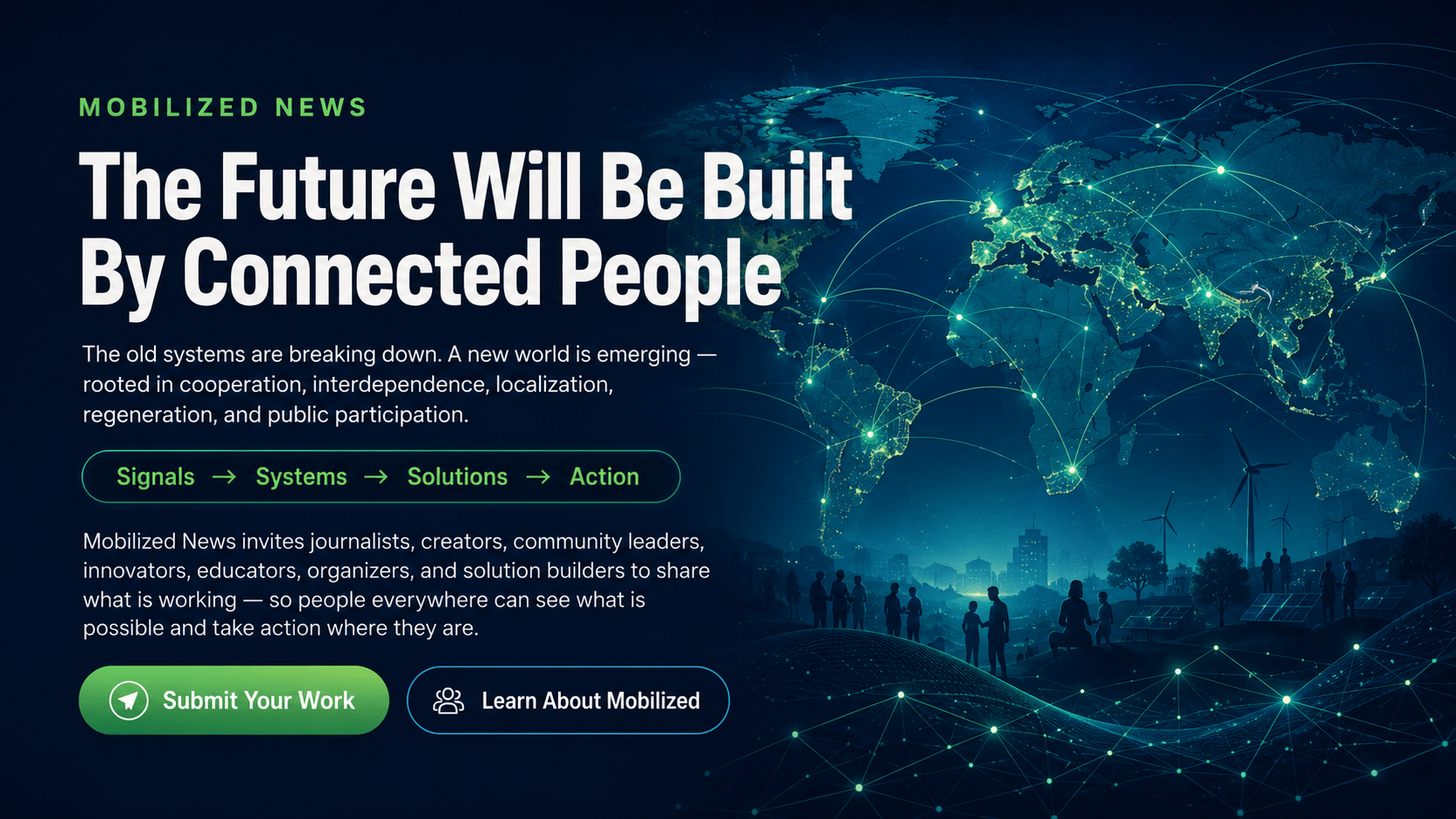
The Future Is Local, Connected, and Alive
“What works now — and how communities can bring it home.”
INSERT PRESS RELEASE HERE
Best Master Theme
From Global Promises to Local Power
This is the clearest framing for the Mobilized vision.
It says:
People are tired of promises.
Communities need tools.
Solutions already exist.
The missing piece is connection.
Mobilized makes the solutions visible, understandable, and usable.
Best Promotional Copy
What if the future is not waiting for permission?
One week before the U.N. General Assembly, Mobilized News will release a new series of conversations with the people already building the systems we need now.
Food.
Energy.
Transportation.
Finance.
Technology.
Localization.
Community resilience.
These are not separate issues. They are one living system.
Mobilized brings them together in one place — through conversations, signals, events, solutions, and a growing media commons for people ready to build where they are.
This is tomorrow’s network today.
od production
Where it helps, where it does not, and how communities can avoid replacing one centralized system with another.
Strong title:
Feeding Ourselves: Rebuilding the Local Food Web
Mobilized question:
What would it take for every community to know where its food comes from, who produces it, how it is distributed, and how to strengthen it?
3. Localization Movements
Localization Is Not Isolation. It Is Resilience by Design.
Core question:
How can communities restore local power without disconnecting from the world?
Conversation focus:
Localization is not about retreat. It is about rebuilding local capacity, local ownership, local decision-making, and local accountability. It strengthens communities by creating shorter feedback loops between people, resources, decisions, and outcomes.
Best conversation topics:
The local economy as a living system
How money, food, energy, care, housing, culture, and governance reinforce one another.
Community wealth building
How anchor institutions, public procurement, local ownership, co-ops, and social enterprises keep value circulating locally.
The end of one-size-fits-all development
Why every place needs solutions rooted in its culture, ecology, skills, and real needs.
Local media as local infrastructure
Why communities need their own trusted information systems to see what is changing and coordinate action.
From dependency to capability
How communities can map what they import, what they waste, what they can produce, and what they can share.
Strong title:
The Localization Revolution: Restoring Power Where People Live
Mobilized question:
What can a community do in the next 12 months to become less dependent, more connected, and more capable?
4. Affordable Clean and Renewable Locally Owned Energy
Energy Democracy: Power to the People, Literally
Core question:
How can clean energy become affordable, local, resilient, and community-owned?
Conversation focus:
Clean energy is not only about replacing fossil fuels. It is about redesigning ownership, access, reliability, affordability, storage, and governance. The best conversation should connect solar, wind, batteries, microgrids, community choice, public power, co-ops, resilience hubs, and local workforce development.
Best conversation topics:
From centralized power to distributed energy systems
Why the future grid must be more flexible, local, and resilient.
Community solar and energy ownership
How renters, low-income households, schools, churches, farms, and small businesses can benefit.
Microgrids and resilience hubs
How communities can keep critical services running during outages, storms, fires, and heat events.
Energy affordability and justice
How clean energy can reduce household costs instead of becoming another elite transition.
The local energy workforce
Training electricians, installers, maintenance teams, energy auditors, and community energy planners.
Public power, co-ops, and community choice
Different models for keeping energy value closer to home.
Strong title:
Power Where We Live: The Future of Community-Owned Clean Energy
Mobilized question:
What would it take for every community to produce, store, share, and govern more of its own energy?
5. Transportation as a System
Mobility Is More Than Cars. It Is Access to Life.
Core question:
How do we design transportation around people, access, affordability, health, and local prosperity?
Conversation focus:
Transportation is usually discussed as cars, roads, traffic, or emissions. Mobilized should frame it as a system connecting housing, health, work, food access, energy, public space, logistics, safety, and local economies.
Best conversation topics:
From transportation to access
The goal is not movement for its own sake. The goal is access to work, school, food, health care, culture, and community.
Mobility as a service for communities
How transit, bikes, walking, shared vehicles, shuttles, EVs, and digital tools can work together.
The connection between mobility and energy
EVs, charging, fleets, batteries, grid demand, and local renewable power.
Local logistics and last-mile delivery
How communities can move food, goods, medicine, and services more efficiently.
Streets as public health infrastructure
Safer streets, cleaner air, walking, cycling, shade, and reduced isolation.
Rural and small-town mobility
How to solve access problems outside major cities.
Strong title:
Moving Differently: Transportation as a Living System
Mobilized question:
How can mobility help people live better, not just move faster?
6. ICT, AI, Cybersecurity and Digital Public Infrastructure
Digital Systems Must Serve Life, Not Control It
Core question:
How can technology strengthen democracy, resilience, trust, and local coordination?
Conversation focus:
ICT is not just apps, broadband, AI, or cybersecurity. It is the nervous system of modern society. Mobilized should focus on digital tools that help communities understand change, coordinate resources, protect data, improve services, and participate in decisions.
Best conversation topics:
Digital public infrastructure for communities
How shared digital systems can support identity, services, participation, disaster response, and local coordination.
AI for public intelligence, not manipulation
Using AI to map risks, translate knowledge, summarize signals, support journalism, and help communities make better decisions.
Cybersecurity as civic resilience
Why hospitals, utilities, schools, local governments, food systems, and media need digital protection.
Community broadband and digital inclusion
Connectivity as a basic condition for participation, education, health, work, and emergency response.
Participatory democracy platforms
How digital tools can support citizens’ assemblies, participatory budgeting, local planning, and community decision-making.
Data sovereignty and trust
Who owns the data, who benefits, who governs it, and how communities protect themselves.
Strong title:
The Civic Nervous System: Technology for Trust, Resilience, and Participation
Mobilized question:
How do we design digital systems that help communities see clearly, decide wisely, and act together?
7. Finance and Funding
Finance Must Move From Extraction to Regeneration
Core question:
How do we fund the systems communities actually need?
Conversation focus:
Many solutions already exist but cannot scale because money flows through old models. Mobilized should focus on practical funding pathways: community finance, public banks, credit unions, local investment, procurement, philanthropy, blended finance, cooperative finance, climate adaptation funding, and regenerative capital.
Best conversation topics:
The money is there. The pathways are broken.
Why good projects often fail to get funded while harmful systems remain subsidized.
Community finance and local ownership
Credit unions, CDFIs, public banks, community investment trusts, co-ops, and local funds.
Procurement as a transformation tool
How schools, hospitals, cities, universities, and governments can shift markets by buying differently.
Funding resilience before disaster
Why prevention, adaptation, and local capacity are cheaper than emergency response.
Regenerative investment
Capital that restores ecosystems, builds community wealth, and measures long-term value.
The missing middle of implementation
Many communities do not need another idea. They need planning support, technical assistance, staffing, legal help, and bridge funding.
Strong title:
Funding the Future: Moving Money Into What Works
Mobilized question:
What new financial architecture would help communities move from pilot projects to permanent capability?
8. Cross-Sector Conversation
When Food, Energy, Transport, Finance, and Technology Work Together
Core question:
What happens when communities stop solving problems in silos?
Conversation focus:
This should be the signature Mobilized conversation. It shows the whole-system vision clearly.
A community food hub needs energy.
Energy systems need financing.
Transportation moves food, workers, medicine, and materials.
ICT helps coordinate demand, delivery, risk, and participation.
Finance determines who owns the system.
Localization keeps value circulating.
Best conversation topics:
The community resilience stack
Food, energy, mobility, finance, digital coordination, local media, and governance.
The new civic operating system
How communities can map needs, identify assets, match solutions, and coordinate action.
Designing for interdependence
Why the strongest systems are modular, local, connected, transparent, and adaptive.
From projects to ecosystems
How to stop launching isolated initiatives and start building reinforcing systems.
Strong title:
The Community Operating System: How Local Systems Work Together
Mobilized question:
What would a community look like if food, energy, transport, finance, media, and governance were designed as one living system?
9. Solutions Showcase Conversation
What’s Working Now: Real Projects, Real Places, Real Lessons
Core question:
Which communities are already proving that another system is possible?
Conversation focus:
This should be practical, story-driven, and hopeful without hype. Feature real examples from cities, towns, Indigenous communities, co-ops, food networks, energy projects, digital democracy platforms, and regional resilience efforts.
Best conversation topics:
The 10-minute case study format
What problem did they face?
What did they build?
Who owns it?
Who benefits first?
How was it funded?
What failed?
What worked?
What can others copy?
What support do they need now?
Strong title:
Proof of Possibility: Communities Building the Future Now
Mobilized question:
What can other communities learn, adapt, and implement?
10. Closing Conversation
Beyond the U.N. Week: Building the Always-On Solutions Network
Core question:
How does this continue after the global spotlight moves on?
Conversation focus:
This is where Mobilized explains the ecosystem: directory, events guide, livestreams, podcasts, wire, signals, solutions showcase, contributors, community media, and ongoing collaboration.
Best conversation topics:
Why one-time summits are not enough
The world changes daily. Communities need daily intelligence, ongoing visibility, and practical connection.
The role of Mobilized News
A program guide, signal system, solutions wire, media commons, and community collaboration network.
How communities can join
Submit shows, events, solutions, case studies, experts, livestreams, local reports, and working groups.
Strong title:
After the Summit: Building the Media Commons for a Regenerative World
Mobilized question:
How do we turn attention into coordination, and coordination into action?
Recommended Programming Lineup
Day 1: The Big Shift
- The World We Inherited No Longer Works. What Comes Next?
- The Localization Revolution: Restoring Power Where People Live
- Food Is Community Infrastructure
Day 2: The Systems We Need
- Power Where We Live: Community-Owned Clean Energy
- Moving Differently: Transportation as a Living System
- The Civic Nervous System: Technology for Trust and Participation
Day 3: Making It Real
- Funding the Future: Moving Money Into What Works
- The Community Operating System: How Local Systems Work Together
- Proof of Possibility: Communities Building the Future Now
- After the Summit: Building the Always-On Solutions Network
Best Master Theme
From Global Promises to Local Power
This is the clearest framing for the Mobilized vision.
It says:
People are tired of promises.
Communities need tools.
Solutions already exist.
The missing piece is connection.
Mobilized makes the solutions visible, understandable, and usable.
Best Promotional Copy
What if the future is not waiting for permission?
One week before the U.N. General Assembly, Mobilized News will release a new series of conversations with the people already building the systems we need now.
Food.
Energy.
Transportation.
Finance.
Technology.
Localization.
Community resilience.
These are not separate issues. They are one living system.
Mobilized brings them together in one place — through conversations, signals, events, solutions, and a growing media commons for people ready to build where they are.
This is tomorrow’s network today.