
Connect with us

INSIGHTS

Who Owns the World?

Published

on

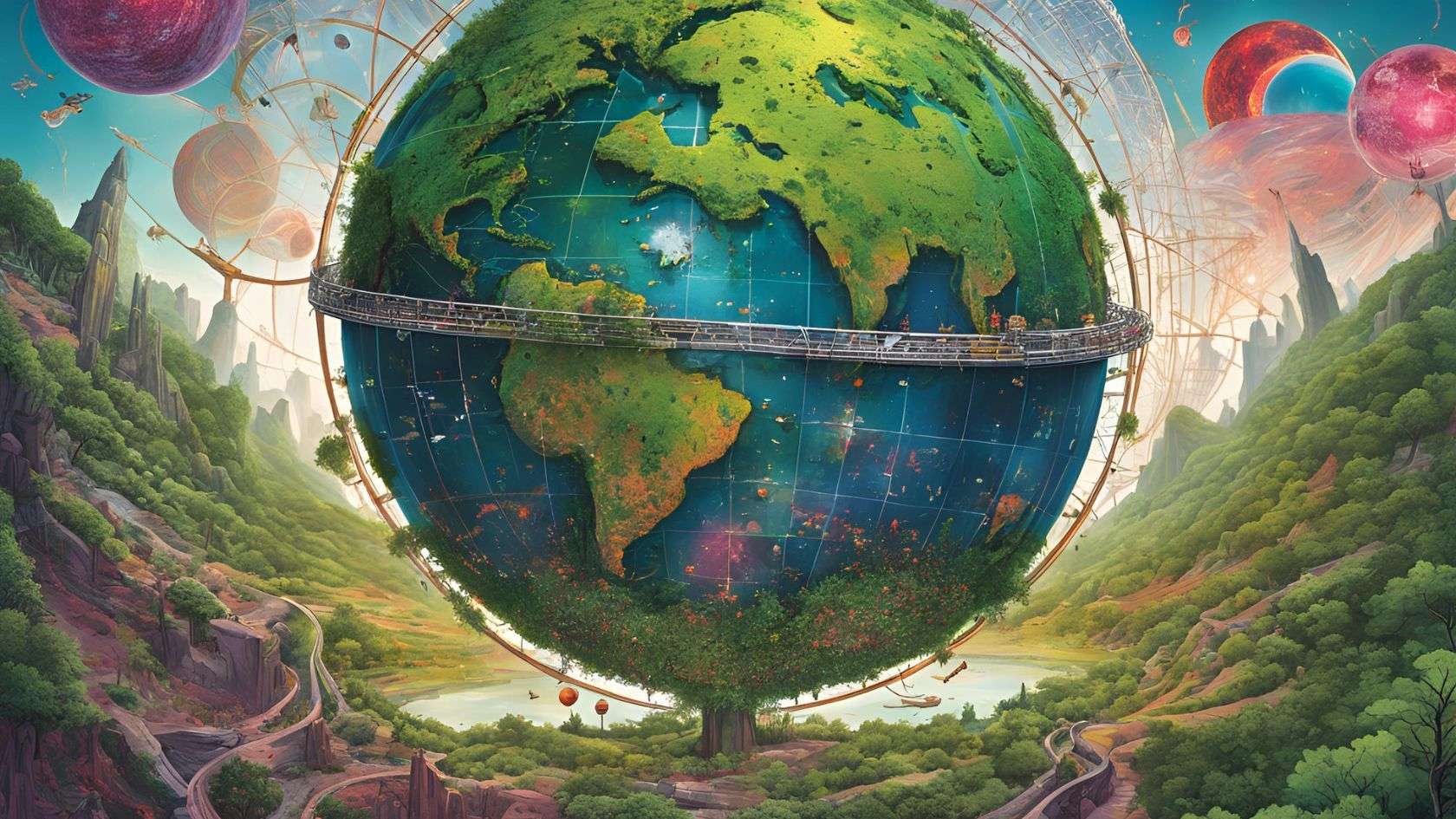
After 50 years of failed environmental diplomacy, we need to ask the obvious question: “Who owns the world?”


Half a century ago, 122 countries met in Stockholm for the first UN Conference on the Environment. Last June, the Swedish government hosted an anniversary summit with no political clout or ambition. This was emblematic of the failure of 50 years of environmental diplomacy due to the fact that our leaders have consistently avoided the central question – that of justice.

This essay by Right Livelihood Executive Director Ole von Uexkull originally appeared in the May 25, 2022, issue of the German magazine Die ZEIT. The article has been translated into English and edited for clarity by the author.

In his opening speech, the Swedish Prime Minister chose clear words: “We know that our resources, both renewable and non-renewable, are limited,” said Olof Palme, who had invited the world to Stockholm for the first UN Conference on the Environment. “These simple facts inevitably raise the question of equality, of more equal distribution between countries and within countries.” For the industrialised regions of the world, Palme demanded a “serious cutdown on luxury production.”

There were inklings of a new era in the air. Fifty-four ministers had come to the Swedish capital, and hundreds of journalists from all over the world had been accredited for the “United Nations Conference on the Human Environment”. Before leaving for Stockholm, the Austrian UN Secretary-General had set the bar for what was to be achieved during those days in the Swedish capital. Future generations, said Kurt Waldheim, would look back on the conference as “a turning point in history, when a major correction was introduced in the process of the industrial revolution.”

That was in June 1972. In June this year, the Swedish government has yet again invited the world under UN auspices. Stockholm+50 was the name of the event, a title meant to remind the world of the birth of environmental diplomacy half a century ago – and about Sweden’s role in it. But this time, there was no sign of any significant vision or ambition. In the bureaucratic lingo of UN diplomacy, the summit had been planned “as a contribution to the environmental dimension of sustainable development to accelerate the implementation of commitments in the context of the decade of action and delivery for sustainable development, including a sustainable recovery from the coronavirus disease (COVID-19) pandemic.” A sense of urgency, of a political turning point? Not here.

Put the two together – the sense of a new dawn in 1972 and the lack of vision today – and it becomes clear: environmental diplomacy is at rock bottom. But why?

When environmentalism entered the dominant global consciousness, it was a spectacular challenge to the post-war success story of strong material growth in many places. The year 1972 played a key role in this development. Ten years earlier, the American biologist Rachel Carson had published her famous Silent Spring, the first popular environmental book. The connection she described between agricultural pesticide use and the death of songbirds made the general public aware for the very first time that nature was not at our infinite disposal.

The most important event in the run-up to the Stockholm conference was the March 1972 publication of the report “The Limits to Growth“, commissioned by the Club of Rome, which had been founded 4 years earlier. The young systems researchers Dennis and Donella Meadows – he, an economist, and she, an environmental scientist – had calculated the development of world population, food production, industrialisation, pollution and resource consumption using a computer model with their research group at MIT. Their results showed that Carson’s finding about the effects of pesticides on the ecosystem was not an isolated case: Earth was a closed system and humanity was on its way to overstepping its limits within less than a hundred years with catastrophic consequences.

But even though the world was very much aware of these revolutionary findings in June 1972, the Stockholm meeting did not achieve a breakthrough on par with its preparatory rhetoric. A decent final declaration was achieved and the UN Environment Programme (UNEP) was founded. But like so many of its successor conferences, Stockholm was marked by disputes about realpolitik. For despite Palme’s inaugural truth-telling, the rich countries showed little willingness to share. The poorer nations, in turn – with Indian Prime Minister Indira Gandhi as their most prominent representative at the conference – feared that rich countries would deny them their badly needed material progress, under the guise of their newfound environmental awareness.

Under the impression of the American aerial bombings and the use of defoliants in Vietnam, there was also a dispute about the condemnation of “ecocide” – which remains an unfulfilled demand of the environmental movement until this day. And the Eastern bloc stayed away from the conference altogether in a dispute over the participation of East Germany.

And so, until the end of the East-West confrontation almost 20 years later, progress in environmental policy was mainly made at the national level. It was not until the world met in Rio in 1992 for the “Earth Summit” that there was a new spirit of optimism. The destruction of forests, the hole in the ozone layer and the fear for desertification had made the limits to growth more obvious than ever before, and there was considerable public pressure for an economic order more strongly oriented towards environmental protection. This time, some of the most important truth-telling was delivered by a 12-year-old girl. In her speech to the delegates, the Canadian Severn Suzuki demanded that those who had more than enough needed to share with others.

Conferences and “blah, blah, blah”

The Rio Conference adopted documents that still shape international environmental policy today, including the Framework Convention on Climate Change, which led to the Kyoto Protocol in 1997. But once again, there was no change to the economic system. Because in the meantime, another project had gained strength. The neoliberal economic order, tested by Ronald Reagan and Margaret Thatcher at the national level in the 1980s, set out for its international triumph. The yardstick here was not system boundaries and sharing, but eternal growth, unleashed through the elimination of regulatory restrictions.

This ideology became a resounding success. With the WTO founded in 1995 and hundreds of bilateral trade agreements, a global economic and trade regime was created that had everything the sustainability agenda lacked: enforceable rules, strong institutions and, not least, a supportive global elite. The globalisation of the 1990s became a project of excess, defying natural boundaries by continuing its destructive growth into the last intact ecological spaces of the planet.

International environmental and climate protection, on the other hand, remained subordinate, as the failed climate conferences in Johannesburg (2002) and Copenhagen (2009) demonstrated – in grotesque disproportion to the desperately acute need for regulation. Even the 2015 Paris Agreement was only made possible by foregoing any binding effect from the outset. Following the motto of Rio, “Think globally, act locally,” Right Livelihood Laureate Hermann Scheer therefore characterised the tortuous procedure of the climate conferences as “Talk globally, postpone nationally.” Greta Thunberg, another Right Livelihood Laureate, later spoke of the “blah, blah, blah” at such conferences.

Both express the feeling that the things that should be addressed – and decided – at the international climate and environment conferences will not even be put on the agenda. It seems that international environmental diplomacy has forfeited the interpretive space cautiously opened up in 1972 in favour of a description of reality that is not its own. A phrase like Palme’s dictum of a “more equal distribution” and “cutdown on luxury production” would no longer find a place at environmental conferences today. And that is the core of the problem.

The insights of 1972 should have completely changed our understanding of the world, but they are largely ignored until this day. Their historical significance is no less profound than the Copernican revolution. Before 1972, man was smaller than nature. Nature was out there, it was hostile and boundless, and man held his own against it. After 1972, it is not nature that is our enemy, but we ourselves have become our own enemy if we do not respect its limits.

This change of perspective turns many former certainties of human existence upside down, right up to the Western concept of property, which is still considered sacrosanct. According to the famous theory of private property by the English philosopher John Locke, the appropriation of land was justified by the fact that the owner “mixed” his labour with the natural resource of land. But even the liberal Locke, in his 1689 Second Treatise of Government, formulated an important proviso. For the appropriation to be legitimate, he demands that there has to be “enough, and as good, left in common for others” – a condition that is no longer fulfilled on a limited planet.

The concept of homo economicus, depicting man as a self-interested being optimising his own benefit with cold rationality, also falls short in a limited world – and has been proven wrong in the real world over and over again. The Senegalese economist and public intellectual Felwine Sarr for instance points to cooperative economic models in African societies that do not know the concept of unlimited growth. “Homo africanus,” he writes in his book Afrotopia, “is not a homo economicus in the strict sense.”

But how can it be that Western economic thinking, which originated in the context of a supposedly unlimited world, during the reclamation and enclosure of agricultural land in rural England and the open frontier of North American colonisation, still holds us captive today, despite its obvious fallacies?

The demands have become unmistakable.

The answer to this question has the shape of a champagne glass and is rooted in economic interests. The height of the glass describes the global distribution of property – the poorest at the bottom, the very rich at the top. The width of the glass, in turn, indicates CO₂ emissions – from the tiny narrow stem of the lowest groups to a slight widening halfway up to a sweeping width only in the upper tenth. According to Oxfam, the richest 10 per cent of the world’s population are responsible for half of the emissions, while the poorest 50 per cent are only responsible for 10 per cent. The richest 1 per cent cause twice as many emissions as the poorest 50 per cent of the world’s population.

The glass can be represented with many parameters – the shape is always similar. Income and resource consumption, for example, are distributed similarly to CO₂ emissions. When it comes to wealth, the injustice is even more extreme: according to the Credit Suisse Global Wealth Report, the world’s 1.1 per cent dollar millionaires own almost half of global assets.

To these people, the idea of limits to growth must seem like a fatal misconception: they have been able to record the greatest material gains and multiply their wealth over the past 25 years. That is why the ecological transformation is in the interest of many, but NOT in the interest of all.

If one assumes that political influence increases significantly the further we go up the wealth distribution, then it becomes clear why there is so little political interest to question the growth narrative. After all, the wealthy part of humanity is least affected by climate and environmental crises and has better means to protect themselves and their loved ones. During the Covid crisis, the ten richest men in the world were able to double their wealth, while 99 percent of the world’s population is now economically worse off than before the crisis.

The myth of infinite growth is still the most important justification for the continuation of this radically unequal distribution. As long as the losers of unequal distribution see only themselves as responsible for their own material advancement, they will not perceive the excessive consumption of resources by others as a problem. If, on the other hand, the realisation prevails that the cake is in fact limited, then Palme’s demand for equality is the logical consequence.

That should have been the seismic shift in the way we understood the world in 1972: On a finite planet, extremely unequal control over its vital resources can never be legitimate. Indian lawyer and Right Livelihood Laureate Ritwick Dutta, who represents the poorest of the poor in the struggle against the takeover of their land by the coal and mining industries, calls this concept simply “ecological democracy”. For even more than the right to vote in elections, control over local resources determines the fate of these people. Just as the democracy movement fought for the equal distribution of political rights, today we must fight for people‘s equitable control of vital natural resources.

This could not have been expected from the anniversary conference in Stockholm. But the demands have become unmistakable. The Indian peasant protests last year, the resistance of the Yanomami Indigenous people against overexploitation of the Amazon, the Ugandan campaign against the EACOP pipeline: millions of people worldwide are fighting for climate and environmental justice. Fifty years after the world community invoked the “One Earth” in Stockholm, our best hope for its future rests on them.

Courtesy of Right Livelihood

Continue Reading

INSIGHTS

The most important governance word never used.

Published

on

As the U.S. approaches the 250th anniversary of “Declaration of Independence” only 61 days away, it’s past time we consider the most damaging word in American history. It has led to more deaths, environmental destruction, and hate than any other. The word is independence.

By Chuck Woolery, Rockville, Md.

A careful reading of the 1776 Declaration reveals something transformative. The noun “independence” appears nowhere in its text or original title “The unanimous Declaration of thirteen United States of America”, the world’s most profound document.  It rightfully and justly declared the colonies desire to be “Free and Independent States,” and used the adjective “independent”, not the noun “independence” a thing.  A thing that Albert Einstein later called a “delusion”.

This distinction is the difference between true freedom (the Declaration’s original intent) and the mass murdering chaos that both the U.S. Constitution and the U.N. Charter unleashed globally.

An independent state (or states) can possess political autonomy existing within a web of relationships, responsibilities, and be mutual dependent on other states (or nations).  Unfortunately, the word “Independence” has evolved in our mind’s imagination as something absolute: self-sufficiency, exceptionalism, immunity from consequences beyond our borders, and worth mass killing and dying for, as well as ignoring nature, the basis of all human health, wealth, and other life on earth.

This could have – should have stopped immediately after the invention and use of nuclear weapons. Einstein warned about it, yet the UN Charter was founded on the same delusional concept as the U.S. Constitution. Both ignored the wisdoms offered in the 1776 Declaration based on “the Laws of Nature and of Nature’s God” (in common speak, ‘take care of nature and each other’ because everything is interdependent and vulnerable).

Ironically, we annually celebrate our illusion of independence every July 4th using explosives and eating nitrate loaded meats that cause cancer.  Then over 250 years of repetition, celebration, and civic mythology, that single word blunder has hardened into our minds a global worldview that has shaped our perception of reality and killed hundreds of millions of people.  Because independence exists nowhere in known universe except as a word on paper, in sound, or as a delusional concept in our mind.

No human being is independent of oxygen, food systems, ecosystems, microbes, gravity, family, trade, or civilization itself. No nation is independent of climate systems, oceans, pandemics, financial networks, or global stability. Even stars depend upon relationships with gravity and matter. Interdependence is not a political opinion; it is the architecture of reality.

And yet our governing systems still behave as if independence were achievable. Ironically, both the U.S. constitutional framework and the United Nations Charter are rooted in sovereign independence as their organizing principle. We continue attempting to solve planetary-scale crises — climate disruption, pandemics, cyberwarfare, nuclear risks, migration, and ecological collapse — with governance structures designed around fragmented and delusional sovereignty.

Then wonder why the systems fail and things are getting worse.

Perhaps the deepest challenge of our species is to accept our irreversible interconnectedness and interdependence.  And learn to govern everyone and nature wisely, fairly, and ethically.  Thus, the most important word in America’s founding document may be the one that was never actually written into law.

Continue Reading

INSIGHTS

Don’t Fear the Future

Published

on

Every tool can be used for good–or bad.

  • A hammer can build a house.
  • A hammer could kill a person.

We should not be afraid of AI.

We should be afraid of unaccountable power using AI without ethics, oversight, or public understanding.

By Steven Jay

AI is a tool.

Like fire, electricity, television, money, medicine, or the internet — it can help people heal, learn, organize, create, solve problems, and see patterns.

It can also be used to manipulate, exploit, surveil, replace, divide, and control.

The question is not whether AI is good or bad.

The question is:

  • Who controls it?
  • Who benefits from it?
  • Who is harmed by it?
  • And how do we make sure it serves life — not power alone?

The Big Question

Should we be afraid of AI?

  • Not exactly.
  • Fear alone does not help us understand change.
  • But blind excitement is dangerous too.

AI is moving into every part of life:

  • Media.
  • Education.
  • Health care.
  • Finance.
  • Transportation.
  • Government.
  • War.
  • Work.
  • Art.
  • Search.
  • Science.
  • Everyday decision-making.

That means AI is not just a technology story.

It is a systems story.

  • It affects how we know what is true.
  • How we make decisions.
  • How we organize society.
  • How power moves.
  • How people work.
  • How communities respond to crisis.
  • How the future is designed.

Why It Matters

AI can help humanity do things we badly need.

  • It can detect patterns humans miss.
  • It can help doctors diagnose disease earlier.
  • It can help farmers use less water.
  • It can help communities prepare for floods, fires, and storms.
  • It can translate languages.
  • It can help small organizations produce media, maps, research, and learning tools.
  • It can make knowledge more accessible.

But AI can also make existing problems worse.

  • It can spread false information faster.
  • It can deepen surveillance.
  • It can automate discrimination.
  • It can replace workers without a plan for human dignity.
  • It can concentrate power in the hands of a few companies and governments.
  • It can make people dependent on systems they do not understand.

AI reflects the values of the systems that build and deploy it.

That is the real issue.


The Mobilized View

  • AI is not magic.
  • AI is not a god.
  • AI is not a replacement for human wisdom.
  • AI is a tool created by people, trained on human information, shaped by human choices, and deployed inside human systems.

So, the future of AI depends on the same thing every major tool depends on:

  • Governance.
  • Ethics.
  • Transparency.
  • Education.
  • Accountability.
  • Public participation.
  • Human purpose.

The danger is not intelligence itself.

The danger is intelligence without wisdom.


The Better Question

Instead of asking:

“Will AI destroy us?”

We should ask:

“How do we design AI so it helps us restore health, dignity, democracy, and well-being?”

  • That changes the conversation.
  • It moves us from fear to responsibility.

It asks whether AI can help us:

  • Spot risks earlier.
  • Strengthen local communities.
  • Improve public health.
  • Support teachers and students.
  • Expose corruption.
  • Translate complex issues into clear action.
  • Help people understand systems.
  • Connect solutions across the world.
  • Make better decisions faster.

Used wisely, AI can help people see the whole picture.

Used recklessly, it can distort the picture completely.


What AI Can Help Us Do

1. Make Complexity Easier to Understand

  • The world is overloaded with information.
  • Most people are not lacking data.
  • They are lacking clarity.
  • AI can help organize complex information into patterns people can understand.
  • That matters for climate, health, energy, food, democracy, economics, and crisis response.

Signal → System → Solution → Action.

  • That is where AI can be useful.
  • Not as the source of truth.
  • As a tool to help people ask better questions.

2. Help Communities Act Faster

  • AI can support local problem-solving.

A community group could use AI to:

  • Map local food needs.
  • Find clean energy options.
  • Translate public documents.
  • Create emergency plans.
  • Compare policy models.
  • Build public education campaigns.
  • Identify partners and funding opportunities.
  • Summarize public meetings.
  • Turn expert knowledge into action guides.

This is where AI becomes useful.

Not as a replacement for people.

As a support system for people trying to get things done.


3. Expand Access to Knowledge

  • For too long, useful knowledge has been locked behind institutions, paywalls, jargon, and professional gatekeeping.
  • AI can help translate expert knowledge into plain language.
  • That can help students, workers, organizers, journalists, small businesses, local governments, and citizens understand what is happening and what they can do.
  • But access must be paired with accuracy.
  • A fast answer is not always a true answer.

That is why human verification still matters.


4. Improve Public Interest Media

AI can help journalists and media makers:

  • Track signals.
  • Summarize reports.
  • Compare claims.
  • Organize research.
  • Find patterns across sectors.
  • Translate stories into multiple languages.
  • Build explainers.
  • Create accessible formats for different audiences.

But AI should not replace journalism.

It should strengthen journalism.

The public still needs editors, reporters, investigators, community voices, source verification, and moral judgment.

AI can support the work.

It should not become the newsroom’s conscience.


Where the Risks Are Real

Misinformation

  • AI can produce convincing falsehoods at scale.
  • That means people need stronger media literacy, better verification tools, and trusted public-interest information systems.

Surveillance

  • AI can be used to monitor people, predict behavior, and control populations.
  • This is especially dangerous when used by governments, employers, platforms, or private firms without transparency.

Bias

  • AI systems can repeat and amplify the biases built into their data.
  • Bad data creates bad decisions.
  • That can harm people in hiring, housing, policing, lending, health care, and education.

Job Disruption

  • AI will change work.
  • Some jobs will disappear.
  • Some will change.
  • Some new ones will emerge.

The issue is not whether work changes.

The issue is whether people are protected, trained, included, and respected during the transition.

Power Concentration

  • If only a handful of corporations control the most powerful AI systems, the public loses leverage over the future.
  • AI must not become another tool for extracting wealth, attention, and control from people.

The Bottom Line

We should not fear AI as a machine.

We should question the systems around it.

  • Who owns it?
  • Who trains it?
  • Who audits it?
  • Who profits from it?
  • Who gets access?
  • Who is left out?
  • Who decides the rules?

AI can help us build a healthier world.

But only if we build the guardrails first.

Technology does not create a better future by itself.

People do.


What We Can Do Now

For Citizens

  • Learn how AI works.
  • Question what it produces.
  • Check sources.
  • Use it to learn, organize, and create.
  • Do not outsource your judgment.

For Journalists

  • Use AI as a research assistant, not a truth machine.
  • Disclose when it is used.
  • Verify everything.
  • Protect human sources and editorial independence.

For Educators

  • Teach AI literacy early.
  • Help students understand bias, evidence, authorship, and ethics.
  • Use AI to expand learning, not replace thinking.

For Policymakers

  • Require transparency.
  • Protect privacy.
  • Regulate high-risk uses.
  • Support public-interest AI.
  • Prevent monopoly control.
  • Defend human rights.

For Communities

  • Use AI to strengthen local resilience.
  • Map needs.
  • Share knowledge.
  • Connect solutions.
  • Make participation easier.

Mobilized Takeaway

  • AI is not the future.
  • The future is what people decide to do with AI.
  • It can become another system of control.
  • Or it can become a tool for collective intelligence.
  • It can deepen confusion.
  • Or it can help create clarity.
  • It can serve extraction.
  • Or it can serve life.
  • The choice is not automatic.
  • The choice is ours.

Final Word

We do not need to be afraid of AI.

We need to become informed enough to shape it.

Because a well-informed public is still the most powerful and valuable natural resource of all.

Continue Reading

Better Understandings

The health care evolution whose time is now

Published

on

We are entering a new era of healthcare based on a categorically different kind of medicine whose purpose isn’t just to save us from illness, but to help us be the best version of ourselves.

Discover Mobilized’s interview with RethinkX Co-founder, James Arbib

About Rethink X

RethinkX is an independent not-for-profit research organization that analyzes and forecasts technology-driven disruptions and their implications. We produce impartial, data-driven analyses that identify pivotal choices to be made by investors, policymakers, civic leaders, and other decision-makers.

Our research team uses the Seba Technology Disruption Framework( TM) to understand the dynamics of disruption and their associated interactions among technology, business models, and market forces.

We then leverage this understanding to forecast the scope, speed, and scale of a disruption’s impacts across social, economic, geopolitical, environmental, and other dimensions, and their implications for market sectors, industries, and geographic regions.

RethinkX aims to facilitate a robust global conversation about the threats and opportunities of technology-driven disruptions, and highlight choices that could lead to a more equitable, healthy, resilient, and stable future for all of humanity

Continue Reading

Subscribe


Translator

Featured Upcoming Events