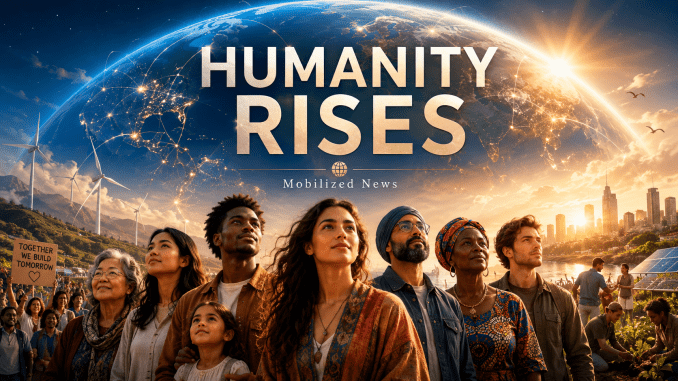
Across different countries and communities, people are turning exhaustion into participation—and building a future they can help shape.
Mobilized | October 27, 2026
Your attention. Your money. Your data. Your vote.
Every day, someone wants a piece of you.
The headlines demand alarm. The campaigns demand loyalty. The platforms demand another minute. Meanwhile, the rent is due, someone needs care, and the future can feel like something being decided somewhere else.
It is easy to feel overwhelmed. It is also easy to mistake that exhaustion for indifference.
Look closer.
In Serbia, students helped turn sustained protest into an electoral breakthrough. In Hungary, voters ended a political dominance that had lasted sixteen years. In Brazil, participation helped deliver another term for a familiar president.
These are different political stories. Together with community initiatives far beyond the ballot box, they raise a powerful possibility:
People can change what happens next when they organize around something they can do together.
SERBIA: THE WORK BEHIND THE CELEBRATION
On October 25, Aleksandar Vučić conceded parliamentary election defeat to Serbia’s student-backed movement. Nearly two years of demonstrations had followed the Novi Sad railway-station canopy collapse that killed sixteen people in 2024. Protesters connected the disaster to demands for accountability over alleged corruption. Preliminary official results subsequently gave the Student List a parliamentary majority.
Aleksandar Matković’s Guardian essay highlights a further lesson: shared learning and collective decision-making helped prepare the ground for political change.
Mobilized’s reading: the crowd is the visible part. The ability to keep working together is what gives a movement endurance.
Someone has to arrange transport. Someone has to explain the issues. Someone has to listen to a person who disagrees. Someone has to return after a disappointing meeting.
These tasks rarely make the front page. They help make the next front page possible.
HUNGARY: PARTICIPATION CAN CHANGE WHAT LOOKS PERMANENT
In April, Péter Magyar’s centre-right Tisza party defeated Viktor Orbán after sixteen years in power, amid record turnout and public discontent over the economy and concentrated wealth.
Two days before the election, Magyar credited more than 50,000 volunteers with building the campaign. That figure was his claim; the underlying point was visible in his appeal for supporters to speak with relatives, friends and colleagues.
This was a movement with a prominent leader. Its experience differs from Serbia’s.
The useful connection is the work of participation: conversations, local relationships and people taking responsibility for reaching other people.
BRAZIL: THE BALLOT AND THE NEIGHBORHOOD
Brazil offers another distinction. On October 25, Luiz Inácio Lula da Silva won a fourth presidential term. Reuters reported that stronger-than-expected turnout helped deliver his victory. Voters were returning an incumbent to office, rather than removing one.
A separate Brazilian story brings the possibility of change closer to daily life.
The Homeless Workers’ Movement, known as MTST, developed solidarity kitchens providing free meals in underserved communities. Its work expanded to include community gardens and spaces for connection and support.
A meal meets an immediate need. Preparing it together can also build relationships, knowledge and the confidence to address the next problem.
The future becomes more believable when people can experience a piece of it.
THE QUESTION EINSTEIN ASKED STILL MATTERS
In his 1949 essay Why Socialism?, Albert Einstein warned that concentrated private wealth could influence political parties and control important sources of public information.
That was an argument about power and democratic judgment. Today, it offers a useful question for an environment crowded with messages:
Who gets to shape what we see—and whose needs get heard?
People have reason to scrutinize wealthy donors, opaque public contracts and commercial influence over public decisions. Scrutiny needs evidence. Anger becomes more useful when it produces a clear demand: disclose the funding, publish the contract, explain the decision, show the result.
Democracy needs citizens with enough information, time and practical opportunity to participate.
THE FUTURE IS ALREADY UNDER CONSTRUCTION
Electoral victories make headlines. Other forms of shared power grow through years of patient work.
On Scotland’s Isle of Eigg, a community-owned company operates an independent electricity system using wind, water and solar power. Residents have a role in the infrastructure their lives depend on.
In India, the SEWA Cooperative Federation supports women working in the informal economy through cooperative enterprises, leadership development and access to markets. Its work spans livelihoods including farming, dairy, crafts, care and financial services.
These projects have different histories, resources and challenges. A small island’s energy system cannot simply be copied into a large city. A cooperative still needs sound finances, skills and customers.
Their value lies in the questions they make practical:
- Can the people doing the work share in ownership and decisions?
- Can communities retain more of the value they create?
- Can essential services answer more directly to the people using them?
- Can a successful approach be adapted elsewhere?
Real change happens on Main Streets, not Wall Street.
National policy, investment and public institutions matter enormously. Their value must show up where people live: in affordable homes, dependable services, healthier surroundings and a meaningful say in decisions.
That is where promises meet reality.
“I’M JUST ONE PERSON! WHAT CAN I DO?”
Imagine nine billion people asking that question.
Then imagine each waiting for someone else to begin.
The paralysis is familiar. So is the way through it: find other people, identify a shared need and take responsibility for one useful step.
One person can invite a conversation. A small group can document a problem. An existing organization can give that work continuity. A wider coalition can bring the evidence to people with the authority to act.
You do not need to carry every cause or attend every meeting.
Choose a contribution you can sustain—and people you can sustain it with.
MAKE THE NEXT SEVEN DAYS COUNT
Start with something specific enough to change.
-
Name one local need. An unsafe crossing. An inaccessible public meeting. Food going to waste while neighbors go hungry. Be precise about who is affected.
-
Find the people already working on it. Ask a neighborhood association, library, cooperative, union or community organization. Learn before creating another project.
-
Bring together a small group. Include people living with the problem. Ask what has already been tried and what would make participation possible.
-
Choose one achievable next step. Document the crossing and request an inspection. Help an existing food program fill a volunteer gap. Ask for meeting information in an accessible format.
-
Assign responsibility and a date. Agree who will do what, how you will check progress and when you will meet again.
-
Share an honest result. Explain what changed, what remains unresolved and what help is needed. Make it easier for the next person to join.
A useful beginning could take one hour this week. Start at a scale your group can maintain.
KEEP THE POWER ACCOUNTABLE
An election victory opens a chapter. It does not guarantee fair government.
A community project needs the same discipline it asks of larger institutions: understandable finances, clear decisions, room for disagreement and ways to challenge leadership.
Make participation practical. Consider working hours, disability access, language, transport and care responsibilities. Share the workload so the project can continue when someone needs to rest.
Local initiative also needs functioning public services. Volunteers can strengthen a community while continuing to demand that governments meet their responsibilities.
The test is what improves—and who shares in the improvement.
HUMANITY RISING
The people in these stories have different beliefs. They will face setbacks, compromises and difficult choices.
What makes their work worth watching is the willingness to participate: to take a need seriously, find others and build the capacity to respond.
That is also the opportunity for connected media. Show who is doing useful work. Explain how it operates, what it costs, where it falls short and how others can participate. Help a community’s experience become another community’s starting point.
Humanity rises through people making room for one another to act.
Find the work near you.
Bring what you can.
Help it continue.