Thomas Linzey is considered to be the “Father of rights of nature policies that have been successfully implemented in communities and nations around the world.
 He’s an outspoken advocate of the community rights movements, and has discovered the stumbling blocks communities have encountered in trying to safeguard the health of people and the planet.
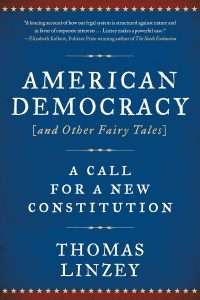
In this fascinating conversation, he clearly states what communities can do where they are now to protect the health of their communities through legally binding rights of nature laws. His latest book, “American Democracy (and Other Fairy Tales): A Call for a New Constitution” will be released in hardcover on March 9, 2027, with pre-ordering of the book available now. It will be followed by a two month book tour in March and April of next year.
Mobilized: What are some of the big misunderstandings that the community rights movements holds on to and why is this holding them back from real progress?
Thomas Linzey: The myth is that we live in a democracy which allows communities to say “no” to things like data centers, factory farms, largescale water withdrawals. The truth is that there is an overarching structure of law, mostly based on corporate rights and property rights, that strips communities of the ability to say no to things that harm them. And until that changes, those communities will always be under the thumb of this country’s largest corporations.
There must have been a moment in time when after law school, and trying to make change in your communities, that you had an epiphany: What was the situation that led you to shift your focus, with the understanding that Democracy doesn’t work and the Constitution and Declaration of Independence are truly flawed?
 It was spending a decade trying to make existing laws work on behalf of communities – litigating the Clean Air Act, the Clean Water Act, and the litany of other environmental laws that we have on the books. The truth is that those laws don’t really stop anything; they just carve some of the rough edges off of projects already moving forward. Most of the override of community control comes from property rights and corporate rights, both of which are embedded into the U.S. Constitution. So, whatever is done at the local or state level, those constitutional rights override the ability of communities to stop harmful things from happening. The promise of the Declaration of Independence – i.e., that people have the power to protect their life, liberty, and the pursuit of happiness – tends to end at the corporate boardroom.
Once you came to this realization, what steps did you take to transition your life and career?
I stopped trying to enforce existing environmental laws and began working with communities to make their own laws – to recognize community rights to clean air and clean water, for example. I then worked to argue that those laws should override corporate rights, and in some cases, state and federal law, when those “higher” laws limited how much the community could protect their air and water, from things like data centers, factory farms, and water withdrawals.
What really happens when corporations come into a community with plans to tear up their local ecosystems? Is this reported? If not, why is it not reported?
It’s usually reported as “David v. Goliath” in terms of the money available to communities and the money available to corporations. But the advantage is about more than money – it’s about a structure of law that preferences corporations over those communities. That’s harder to get people to understand, but it is what determines the outcome of these conflicts. It’s not reportable in that form because it is too complex to relate in short news articles. It’s also difficult for people to understand that the system is anti-democratic when they’ve been taught that our system is democratic – i.e., that people make the rules.
What can communities do to restore health where they are, now? If we don’t live in a true democracy, what is it that we’re living in?
Mostly an oligarchy of some sort masquerading as a democracy. Communities need to begin standing up – across the board – and directly challenging state and federal governments that keep issuing permits and permissions for harmful projects to site. This means challenging the basic premise under which those governments operate, when they override local and community governments.
Is there a way to reverse the motion that “Corporations are people” which continue to influence public elections?
Yes, I believe there is. The first is to begin to build a constitutional movement, from the ground up, which understands that as long as corporations have constitutional rights, that protecting their own communities is impossible. Second, there’s some really good work being done in Hawai’i and Montana, in which state laws are being passed which de-charter corporations and issue new charters which deprive corporations of being able to participate in elections. I think that’s a new frontier – state control over the corporate form – which has tremendous potential to change the way that corporations participate in elections and politics.
Where in the world are you finding communities who are more open to rights of nature work?
Definitely Ecuador, where the national-level work began. There have been a couple of dozen rights of nature enforcement cases now. And at the indigenous tribal level in the U.S., where tribal governments and activists are finding that the rights of nature work is more closely aligned to their own cultural systems. That’s where I expect most of the growth in rights of nature laws to happen next – in places like the Rappahannock Tribe in Virginia which became the first tribe in the U.S. to put rights of nature into their tribal constitution.
Let’s talk about Ecuador. You helped to place Rights of Nature Laws into their Constitution. What were some of the steps (that you can talk about) that you took to make that happen? How much effort is needed to maintain these laws?
It mostly happened through the network that included us – which was initiated by the Pachamama Foundation in the U.S. and Ecuador. Their connections to the Ecuadorian government led to an invitation to us to assist there. It was also prodded forward by the work being done in the U.S. to adopt rights of nature laws at the community level. Plus, the new constitution there wouldn’t have passed without the aggressive support of the indigenous communities in Ecuador, who pushed for its passage.
So, someone in a community in another nation–outside of the United States of America–wants to enable a Rights of Nature law in their community. Can you help them, and if so, how? What steps can they take?
We can, as most local governments around the world can (and have) adopted rights of nature laws at the community level. The first step is to decide that something more than conventional environmental laws are necessary, and a frustration that existing laws continue to treat nature as property or as a “thing.” Second step is to figure out “how” to draft the law around a particular ecosystem and how to move that proposed law into law – either via their elected government or through a citizen initiative process. Final step is to enforce the law on behalf of the protected, rights-bearing ecosystems.
Comedian/Philosopher George Carlin said that “America was founded on the biggest oxymoron of all! America was founded by slave owners who wanted to be free!” Could the misunderstanding and corporate/education indoctrination of the public be a root cause to many of our ongoing crises?
Absolutely. It’s about a corporate minority having governing authority over community majorities. It’s that system that people instinctively feel when these harmful projects come into their community. Until we fix that power imbalance, and until we recognize nature as being rights-bearing and a check on human activity, we’re cooked. And to fix that power imbalance, we have to begin to understand that we don’t live in a democracy when corporations have as much governing authority as they have.
The Indigenous people can teach us all a lot. What did you learn from them?
That nature is a relative, not something that can be owned and exploited. They also understand that while humans are a part of nature, it’s only a small part, and that nature is alive; not a dead thing to be exploited, as western civilizations believe.