
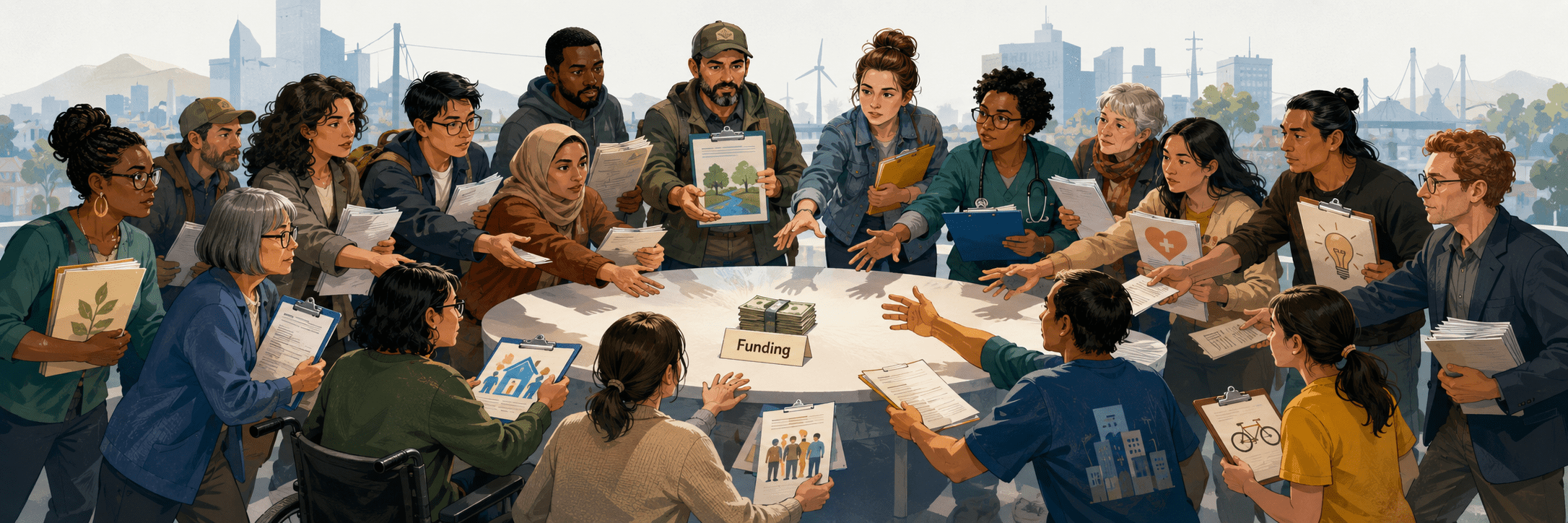
It’s What Happens When Institutions Become the Problem They Were Built to Solve
The people living with the consequences of broken systems should not be priced out of conversations about how to fix them.
- Around the world, thousands of organizations, institutions, foundations, associations, think tanks, agencies, and nonprofits say they are working to improve the quality of life for people and planet.
- Many are filled with sincere people doing important work.
But we have to ask a difficult question:
Are our institutions designed to solve the problems — or to survive the problems?
This is not an insult. It is an invitation to be honest.
Because too often, the very organizations created to address poverty, public health, climate disruption, inequality, democracy, food insecurity, housing, energy, education, and ecological breakdown are operating inside the same economic logic that created the crisis in the first place.
- They hold conferences that many people cannot afford.
- They send constant fundraising emails to people already under financial pressure.
- They build campaigns around urgency, but often do not provide clear local action pathways.
- They gather experts, funders, sponsors, and insiders — while many communities most affected by the issues remain outside the room.
And then, year after year, the problems remain.
The issue is not bad people. The issue is bad design.
- Most institutions are not failing because the people inside them do not care.
- They are failing because their operating model is built around survival.
- The nonprofit must raise money.
- The association must sell memberships.
- The conference must sell tickets.
- The foundation must protect its endowment.
- The media organization must chase sponsors, clicks, subscriptions, or grants.
- The institution must keep the lights on.
- So over time, the mission can quietly shift.
The original question was:
How do we solve the problem?
But the operating question becomes:
How do we keep the organization alive?
- That shift changes everything.
- It changes the language.
- It changes the priorities.
- It changes who gets invited.
- It changes what gets funded.
- It changes what is considered “success.”
- It can turn real-world problems into permanent programming categories.
When crisis becomes a business model
- Many institutions depend on the continuation of the very problems they claim to solve.
- This does not mean they want the problems to continue.
- But it does mean their revenue model may depend on constant urgency, repeated fundraising, annual events, reports, panels, campaigns, and donor engagement.
- That creates a dangerous contradiction.
- If the problem is actually solved, what happens to the organization?
- If people become self-sufficient, what happens to the fundraising model?
- If communities build local capability, what happens to the expert-driven conference circuit?
- If solutions become open, shared, and accessible, what happens to institutions that charge for access?
- These are uncomfortable questions.
- But they must be asked.
Because people everywhere are tired of being told to donate, attend, subscribe, register, and support — while the systems affecting their lives continue to break down.
Access is part of the solution
If an organization claims to serve the public good, but most of the public cannot afford to attend its events, access its knowledge, or participate in its decisions, then something is out of alignment.
- A $500, $1,000, or $2,500 conference ticket may be normal inside institutional culture.
- But to many people, that is rent, groceries, medicine, transportation, childcare, or a utility bill.
- If solutions are locked behind paywalls, professional networks, donor circles, closed conferences, and insider language, then we are not building a movement.
- We are building another gated system.
The people living with the consequences of broken systems should not be priced out of conversations about how to fix them.
The deeper problem: industrial-age thinking
Many institutions were built for a world that no longer exists.
- They were designed around hierarchy, scarcity, competition, branding, ownership, gatekeeping, and centralized authority.
- But today’s crises are interconnected.
- Food connects to energy.
- Energy connects to water.
- Water connects to health.
- Health connects to housing.
- Housing connects to transportation.
- Transportation connects to climate.
- Climate connects to migration.
- Migration connects to democracy.
- Democracy connects to media, trust, technology, and finance.
No single institution can solve these problems alone.
And yet many still operate as if their sector, brand, funding stream, or audience is separate from the rest of the system.
That is the failure point.
The world is interdependent.
Our institutions are still too often fragmented.
From institutional survival to public capability
Mobilized News believes the question must change.
Not:
How do we build a bigger institution?
But:
How do we help people, communities, and partners build real capability where they are now?
Not:
How do we attract more donors?
But:
How do we make solutions easier to find, understand, share, adapt, and act on?
Not:
How do we host another event?
But:
How do we connect knowledge to action, action to resources, and resources to measurable improvement in people’s lives?
Not:
How do we protect our organization?
But:
How do we serve the living system we are part of?
A better model is possible
The next generation of public-interest institutions must be designed differently.
- They must be more open.
- More cooperative.
- More collaborative.
- More transparent.
- More affordable.
- More accountable.
- More useful.
- They must move beyond awareness campaigns and toward action pathways.
- They must stop treating communities as audiences and start treating them as co-creators.
- They must connect sectors instead of competing for attention inside separate silos.
- They must share knowledge in plain language.
- They must make participation possible for people without wealth, titles, credentials, or institutional access.
They must measure success not by money raised, seats filled, reports published, or impressions generated — but by whether people are better able to improve their own lives and communities.
The Mobilized question
This is why Mobilized News keeps asking one essential question:
What can people do where they are now?
- That question changes the purpose of media.
- It changes the purpose of events.
- It changes the purpose of institutions.
- It moves us from performance to participation.
- From speeches to solutions.
- From fundraising to function.
From awareness to capability.
From institutional survival to public service.
An invitation, not an accusation
Mobilized News is not here to condemn organizations trying to do good.
We are here to invite them into a deeper conversation.
If your institution exists to improve the quality of life, then let us ask together:
- Are we making solutions easier to access?
- Are we reducing barriers or creating new ones?
- Are we empowering people or keeping them dependent?
- Are we collaborating across systems or protecting our own lane?
- Are we measuring real-world improvement or only institutional activity?
- Are we willing to redesign ourselves if our model no longer serves the mission?
- These questions are not attacks.
- They are the beginning of accountability.
The way forward
The world does not need more isolated institutions competing for attention while communities struggle to navigate overlapping crises.
- The world needs a shared solutions ecosystem.
- A way to connect knowledge, action, resources, media, community, policy, and practical tools.
- A way to help people move from confusion to clarity.
- From isolation to connection.
- From concern to action.
- From crisis management to systems change.
- From extraction to regeneration.
- That is the work ahead.
And it begins with telling the truth:
An institution is only useful if it helps life flourish beyond itself.
- If the goal is only to survive, the institution becomes the center.
- If the goal is to serve, life becomes the center.
- That is the design shift we need now.
If you are committed to being the change we need now, please contact us through our website or our public email addresses.