
Connect with us

Circularity

Water from Air: An engineered solution to water scarcity

Published

on

Around 1.1 billion people worldwide lack access to water. Out of the total fresh water on earth, 2/3 is tucked in glaciers and the 1/3 available for use is being polluted, exploited and wasted every single day. 

Rivers, lakes, and aquifers are drying up or becoming too polluted to use. More than half the world’s wetlands have disappeared. Irrigation for industrial agriculture is highly inefficient and results in massive water waste across the world. Climate change is altering patterns of weather and water around the world, causing shortages and droughts in some areas and floods in others. At the current consumption rate by 2025, two-thirds of the world’s population may face water shortages. Modern-day developments in technology are actually trying to help solve this crisis. One proposal: magically extract water out of thin air.

Atmospheric water generators use condensation (not magic) to extract water from warm humid air (relative humidity over 50%). Their functioning is similar to that of a dehumidifier (air is moved over a coil in order to condense water), but the end goal of AWG’s is to generate potable water. These systems decrease air temperature, which in turn reduces the air’s capacity to carry water vapor. This is the most common technology in use, but this system uses huge amounts of coal-based electricity it has one of the worst carbon footprints amongst all the water purification sources (3 times more than reverse osmosis of seawater)

Low impact alternative technology uses “wet” desiccants such as lithium chloride to pull water from the air via hygroscopic processes. Solid desiccants, such as silica gel and zeolite, with pressure condensation, are also used. Direct drinking quality water generating devices using solar energy is also under development. Overall there is scope for improvement, but in places with water scarcity, this is an extremely viable solution that ensures a constant water supply, even today.

Consider how Permaculture talks about learning from nature. The concept of AWG’s is also considered a great example of biomimicry. The beetle Stenocara gracilipes has a natural ability to extract water from the fog and accumulate it on its wings.

GoSun  is a brand working on revolutionary solar appliances to help you cook (day or night), cool, charge, light or purify water with only the power of the sun. Their idea of independence and resilience is further propagated by their AWG’s 

Each modular Tsunami 500 can produce up to 200 gallons of freshwater per day. Perfect for home or small business, Tsunami, first creates then delivers potable water to your storage tank, appliance or dispenser, with nothing but a 240VAC electrical connection.

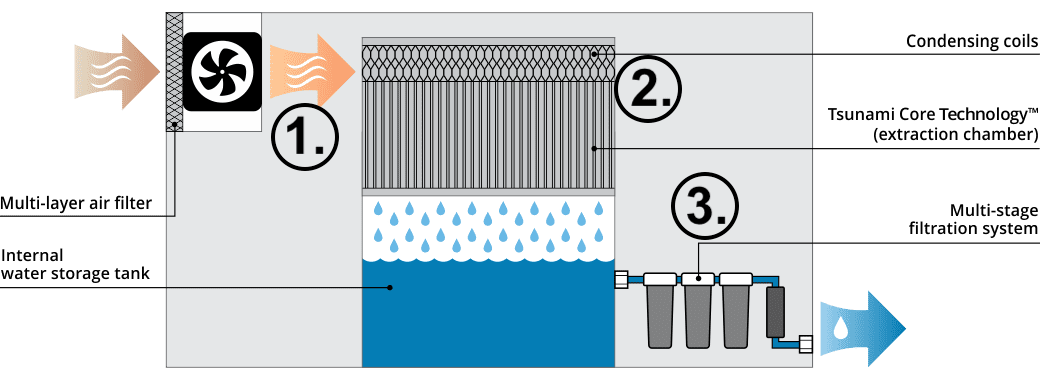
Functioning of the AWG:

Step 1:  Air Intake – Moist ambient air is pulled into the Tsunami® unit by fans. A multi-layer air filter removes dust, pollens, and other airborne particles.

Step 2:  Water Extraction – Next, the air is drawn through a series of condensing coils, where water vapor is cooled down sufficiently to reach the dew point. This converts water vapor into droplets. Water is then extracted and collected into a storage tank.

Step 3: Water Purification – Collected water is purified through a multi-stage filtration system, where all the possible impurities and pathogens are removed. At this point, water is completely pure and safe to drink. What’s more: unlike tap water, it’s chemical-free.
Benefits

  1. Supplies Water on demand: Atmospheric water generation works anywhere, even in draughts- mimicking conditions inside a cloud
  2. Ultra-Pure : The multi-stage filtration process produces the highest quality drinking water
  3. Scalable: Systems can be expanded to meet the fresh water needs of any facility.
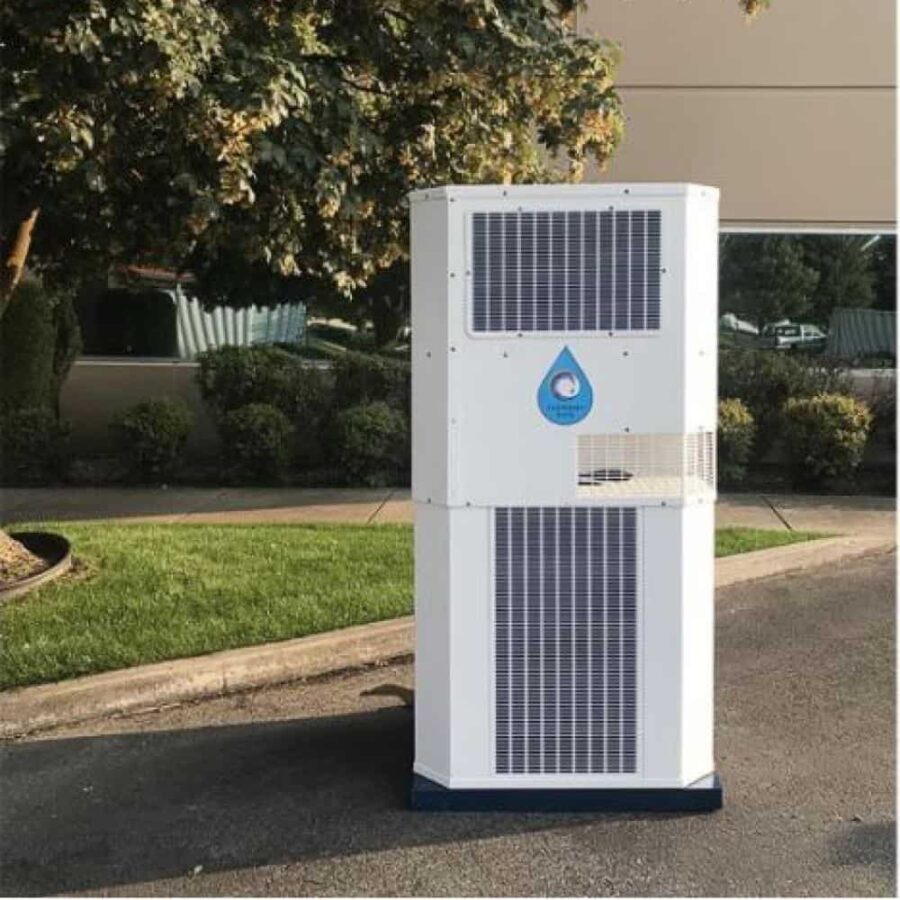
Tsunami 500]

If you are interested in more products that make your life easier without taking a toll on the environment, visit our online Permaculture shop! We have joined up with various small and large ethical businesses all across the world to offer products and services any Permaculture Designer or homesteader might need. After years of living a regenerative life, we realize the importance of a curated marketplace that caters to our community’s distinct needs.  When making purchases, we want to give our money to people that do not harm the planet or other people.

Continue Reading

Circularity

Improved Financial Systems (Ecological Economics)

Published

on

Infinite Growth, Finite Planet — Why the Math Won’t Pencil

Why it matters: An economy optimized for extraction, exploitation, and colonization treats living systems like fuel. That logic pushes us toward ecological collapse—and social breakdown with it.

The signal: If the goal is endless growth, the outcome is overshoot. If the goal is thriving within limits, the outcome can be shared prosperity.

  • See the Playbook
  • The Reset
  • Build the Media Commons

✦ ✦ ✦

The Big Picture

  • Design flaw: Externalized costs (pollution, illness, biodiversity loss) + privatized gains.
  • Time lag: Markets price damage after it occurs; ecosystems hit irreversible thresholds.
  • Power loop: Wealth concentrates → policy follows money → extraction accelerates.
  • Bottom line: We don’t just have a climate problem; we have a design problem.

✦ ✦ ✦

How We Got Here

  • Colonial blueprint: Land, labor, and resources treated as controllable “inputs.”
  • GDP as god: What we count (stuff produced) outweighs what we need (health, stability, meaning).
  • Cheap energy era: Fossil subsidies hid true costs, turning waste into “growth.”

✦ ✦ ✦

Reality Check

  • Nature’s limits are non-negotiable.
  • Status-quo “green growth” isn’t enough if materials, land, and energy stay linear and extractive.
  • Justice matters: those least responsible suffer first and worst.

✦ ✦ ✦

The Reset:

  • Ecological Economics + Ethical Leadership + Permaculture + Holistic Design
  • Ecological economics
  • Goal shift: from more to enough (well-being per unit of energy/material).
  • Tools: doughnut/safe-and-just space, Genuine Progress Indicator, caps + commons.
  • Ethical leadership
  • Fiduciary duty → stewardship duty.
  • Incentives for long-term outcomes, not quarterly optics.
  • Radical transparency on supply chains, lobbying, and impacts.
  • Permaculture
  • Design from patterns to details; stack functions; close loops.
  • Soil, water, biodiversity as capital bases, not afterthoughts.
  • Local resilience reduces global fragility.

Holistic system design

  • Think whole lifecycle (materials → use → recovery).
  • Price the true cost (health, climate, biodiversity).
  • Build feedback loops: measure → learn → adapt.

✦ ✦ ✦

What Works (when it’s real)

  • Circular flows: repair, reuse, remanufacture; materials as assets, not trash.
  • Distributed energy + grids: community power cuts emissions and bills.
  • Regenerative food systems: healthy soils = carbon sinks + drought buffers + better yields.
  • Mobility without combustion: transit, safe streets, right-sized logistics.
  • Finance that serves life: mission-locked funds, community banking, risk-sharing co-ops.

✦ ✦ ✦

Playbook (do this next)

  • Change the scoreboard: adopt well-being metrics alongside—or instead of—GDP.
  • Set hard ecological budgets: caps for carbon, water, land use; trade inside limits.
  • End perverse subsidies: stop paying to destroy ecosystems; redirect to regeneration.
  • Localize value creation: regional supply webs; public-interest utilities; community ownership.
  • Design for return flows: producer responsibility + materials passports + repair rights.
  • Educate for systems literacy: train schools, firms, and cities in feedbacks & thresholds.
  • Govern for participation: polycentric governance; citizens’ assemblies; transparent data commons.

✦ ✦ ✦

Yes, but…

  • Jobs? Regeneration is labor-rich: retrofits, restoration, repair, care economy.
  • Competitiveness? Efficiency + resilience beat brittle, far-flung chains.
  • Costs? Up-front investment prevents far greater tail risks (disasters, health, supply shocks).

✦ ✦ ✦

Signals of the Shift

  • Budgets tied to ecological ceilings + social foundations.
  • Corporate pay linked to impact KPIs, not just EPS.
  • Cities publishing material flow + soil-water-carbon accounts.
  • Banks offering regenerative term sheets with community downside protection.

✦ ✦ ✦

The Bottom Line

  • We can’t spreadsheet our way out of physics.
  • Infinite growth on a finite planet is a dead model.
  • The upgrade is ecological economics + ethical leadership + permaculture + holistic design—a reset that restores health, dignity, and durable prosperity.
  • Build the Media Commons
  • Become a Contributor
  • Partner with Us
  • Mobilized News is assembling the playbook and the people. Join us to push the systems reset—together.
Continue Reading

Circularity

The Hidden Cost of Bad System Design

Published

on

Understanding the Failure of Poor System Design: The Consequences we continue to experience


Why Everything Feels Like It’s Falling Apart: The Hidden Cost of Bad System Design
By Chuck Woolery (not the TV guy) and Steven Jay

Every day, we’re hit with stories that make us feel overwhelmed—mass shootings, collapsing public systems, social media disasters. It can feel like the world is spiraling out of control.

But what if these things aren’t just random events or separate issues?

What if they’re all connected symptoms of a much bigger problem?

These ongoing crises aren’t isolated problems to be solved one by one. They’re consequences—outcomes of a deeper failure in how our systems are designed and how our society thinks.

After the Great Depression and World War II, something started to shift. The idea of the “common good” faded from public conversation. America turned toward individualism, competition, and fear of anything that sounded like socialism. This change went mostly unquestioned, but it shaped our politics, values, and priorities in powerful ways.

As time went on, technology made it easier to spread division and fear. Instead of working together, people became more focused on their own narratives. The result? We’re now living with the consequences.

Donald Trump isn’t the core issue—he’s a symptom. Climate change isn’t just a problem—it’s the result of decades of poor decisions and unchecked systems. The same goes for mass shootings, the opioid crisis, obesity, and suicide. These aren’t random or isolated—they’re all signs of something deeper that’s broken.

Even environmental disasters—like poisoned water in Flint, collapsing bee colonies, or Florida’s red tide—aren’t just “environmental problems.” They’re consequences of how we’ve structured our society and ignored the long-term impacts of our actions.

Look around the world at the violence in Afghanistan, Yemen, and Syria. These conflicts didn’t just happen—they’re the result of choices made without considering long-term consequences. The same goes for economic inequality, the rise of fake news, and the erosion of privacy. These aren’t new “problems” popping up—they’re the fallout from flawed systems.

Until we’re willing to step back and see the bigger picture—to recognize the root causes—we’ll keep spinning our wheels, treating symptoms while the real issue continues to grow.


Continue Reading

Circularity

Flip the Script: Ecological Economics

Published

on

[fvplayer id=”15″]

Continue Reading

Subscribe


Translator

Featured Upcoming Events