
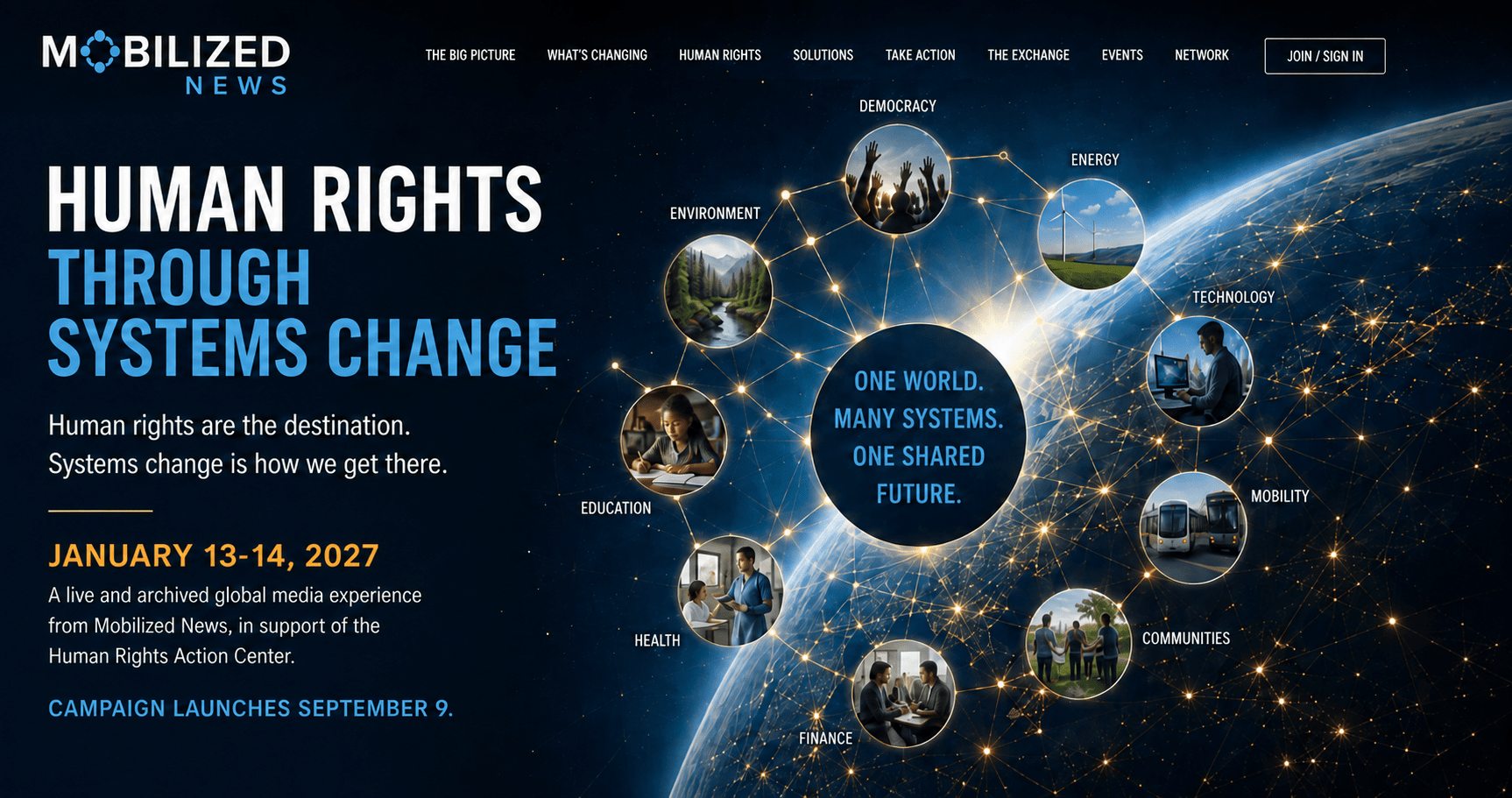
 A Global Media Experience from Mobilized News
Less talking. More doing.
The biggest challenges facing humanity are rarely separate problems.
Between Now and January 13, 2024
Mobilized is harnessing the collective wisdom of social entrepreneurs in their fields to present the world’s first Interactive and Interdependent Media Experience dedicated to how people around the world can establish a healthier, more just, civilized society that works for all.
We are currently inviting ethical leaders, media makers and earth shakers into the conversations which will be recorded and made public at our unveiling on October 9th.
Communities can interact with systems developers on the Mobilized Exchange. We are now seeking collaborators.
Every conversation should answer the same four questions:
- What is failing?
- What system is causing it?
- What is already working?
- What can we do now?
Human Rights in real life:
What does it actually take for human rights to be experienced in everyday life?
- Human Rights as a Systems Challenge
- Human Rights in Everyday Life
- Legal Empowerment: Putting Rights Into People’s Hands
- Protecting Civic Space
- Freedom, Dignity and Belonging
- Human Security for the 21st Century
Connection: Rights move from declaration → institutions → access → participation → dignity → security.
Democracy, Information and Digital Freedom:
How do we protect human agency and democratic participation in a digital world?
- Democracy Beyond Voting
- The Future of Digital Democracy
- Digital Rights Are Human Rights
- Cybersecurity as a Public Good
- AI, Power and Human Dignity
- Information Integrity and Democracy
Connection: Participation depends on trustworthy information, protected digital spaces, accountable technology and meaningful public power.
Central purpose
Mobilized brings together media makers and earth shakers to share knowledge, expose the connections between human rights and failing systems, and develop stories, projects and partnerships that improve quality of life.
Guiding question:
How can media, human rights and whole-system thinking combine to help people understand what is changing—and participate in what comes next?
January 13, 2027: See the whole picture
Human rights, media and the systems shaping our lives
10:00 a.m. ET — Global welcome
- Welcome from Mobilized News
- Introduction to the theme: Human rights through systems change
- Voices and images from participating communities around the world
10:15 a.m. — Opening keynote: Jack Healey
Human rights belong to everyone
Jack Healey opens the experience with a call to reclaim human rights as a living, practical framework—not simply a declaration, institution or historical ideal.
The keynote can explore:
- Why human rights must speak to everyday life
- The relationship between culture, media and public action
- Lessons from decades of organizing artists, advocates and citizens
- Why movements need compelling stories as well as demands
- How ordinary people become defenders of human dignity
- Why the next human-rights movement must address the systems producing injustice
10:50 a.m. — Keynote response circle
Media makers, organizers, young leaders and systems thinkers respond:
- What did we hear?
- What is missing from today’s human-rights conversation?
- What must become possible now?
11:20 a.m. — Main-stage conversation
From individual rights to systems change
How food, energy, finance, technology, governance, health and media systems determine whether people can actually exercise their rights.
12:00 p.m. — Breakout conversations: The systems
Participants select facilitated conversations connecting human rights with specific sectors.
1:00 p.m. — Global discovery break
- Virtual exhibition spaces
- Independent media showcase
- Solutions demonstrations
- Project and partner discovery
- Informal networking rooms
2:00 p.m. — The story exchange
Short presentations from journalists, filmmakers, artists, community leaders and innovators:
- A human-rights challenge
- The system producing it
- A solution already emerging
- The story that needs to be told
3:00 p.m. — Connection labs
Facilitated matchmaking among:
- Media makers seeking stories
- Change makers seeking visibility
- Projects seeking collaborators
- Communities seeking resources
- Funders seeking credible initiatives
4:00 p.m. — The daily synthesis
What the world told us
Mobilized News identifies:
- The strongest signals
- The most important connections
- Projects ready for collaboration
- Questions requiring deeper investigation
4:30 p.m. — Day-one close
January 14, 2027: Change the system
Turning shared understanding into projects and partnerships
10:00 a.m. ET — The morning signal
A concise visual summary of the discoveries, needs and opportunities uncovered during day one.
10:20 a.m. — Main-stage conversation
From awareness to agency
How media can move people from witnessing problems to understanding choices, finding collaborators and participating in solutions.
11:00 a.m. — Solutions studios
Small working sessions organized around real challenges. Each studio develops:
- The problem
- The affected rights
- The systems involved
- Existing solutions
- Missing voices
- Media and communication needs
- Potential partners
- A practical next step
12:15 p.m. — Collaboration marketplace
Participants present concise requests:
- “We have a story.”
- “We need a media partner.”
- “We need community expertise.”
- “We are seeking funding.”
- “We can offer technology or production support.”
- “We want to replicate this solution.”
1:00 p.m. — Discovery and networking break
2:00 p.m. — Project-building labs
Selected collaborations move from conversation to early project design.
Possible outputs include:
- Documentary or reporting collaborations
- Cross-border media partnerships
- Community information campaigns
- Human-rights education initiatives
- Shared research projects
- Solutions directories
- Public events and working groups
- Funding and distribution partnerships
3:15 p.m. — Commitments stage
Participants announce:
- What they will advance
- Who they need to meet
- What they can contribute
- What happens during the next 30, 60 and 90 days
4:00 p.m. — Closing plenary
The media we need for the world we want
A closing conversation about building a connected media ecosystem that helps people see the whole picture, discover working solutions and find meaningful ways to participate.
4:30 p.m. — Ideas into Action
A shared commitment to:
- Protect human dignity
- Tell stories in their full systemic context
- Elevate affected communities
- Make solutions discoverable
- Connect knowledge with action
- Continue the collaborations beyond the event
25 key conversation topics
Track one: Human rights for an interdependent world
- Human rights as society’s operating system
What would change if institutions treated human rights as design requirements? - From declaration to daily life
Why legal recognition does not always produce lived rights. - Human rights through systems change
Moving beyond isolated interventions toward changing root structures. - Civic space, democracy and authoritarian pressure
Protecting participation, dissent, organizing and public accountability. - Community rights and the rights of nature
Connecting human well-being with ecological protection and local authority.
Track two: Media, narrative and public understanding
- Journalism beyond the crisis cycle
Reporting causes, consequences, connections and credible responses. - Who gets to tell the story?
Shifting power toward communities most affected by an issue. - Rebuilding trust without compromising truth
Strengthening public confidence through transparency and accountability. - Making progressive media discoverable
Creating a trusted guide to independent reporting, ideas and solutions. - Creator rights, ownership and sustainable media
Helping creators retain control, receive compensation and reach audiences.
Track three: Technology, information and democracy
- Artificial intelligence and human dignity
Designing AI around rights, accountability and public benefit. - Privacy, surveillance and digital freedom
Who controls personal information, identity and access? - Misinformation and the architecture of confusion
Addressing the systems that reward manipulation and division. - The digital public square
Building healthier spaces for participation, dialogue and collective intelligence. - Open knowledge and communication infrastructure
Treating reliable information as a public resource.
Track four: Redesigning essential systems
- Food as a human right
Connecting hunger, land, labor, health, agriculture and distribution. - Energy democracy and a just transition
Ensuring communities share in the benefits of clean-energy systems. - Public and planetary health
Recognizing that healthy people depend on healthy social and ecological systems. - Circularity and whole-system design
Designing out waste, extraction, pollution and planned obsolescence. - Cities, housing and mobility for everyone
Creating communities that are accessible, affordable, safe and connected.
Track five: Power, economics and collective action
- Ethical finance and the right to economic security
Redirecting capital toward human needs and long-term public value. - Work, livelihoods and dignity in transition
Protecting people as automation, climate change and new economic models reshape work. - Climate displacement, migration and belonging
Defending dignity and rights as people are forced to move. - From audience to participant
Designing media experiences that help people learn, connect, build and act. - Building the collaboration infrastructure
Developing the directories, exchanges, funding mechanisms and shared platforms that allow media makers and change makers to find one another.
Mobilized News conversation method
Every session should move through the same five questions:
- Signal: What is happening?
- Story: Who is affected, and whose voice is missing?
- System: What structures are producing the situation?
- Solution: What is already working or emerging?
- Next step: What can participants build, support or advance together?
This structure makes THE IMX more than a conference. It becomes a global discovery, connection and project-development experience—turning collective wisdom into collaborative action.
Energy, Climate & Environmental Justice:
How do we meet human needs while restoring the systems that sustain life?
- Energy as a Human Right and Development System
- A Just Energy Transition
- Community-Centered Energy
- The Rights of People and the Health of the Planet
- Environmental Democracy
- Climate Justice Is Human Rights
Connection: Energy access → transition → community ownership → ecological health → public participation → climate justice.
Food, Water, Health & Human Security:
How do we design the essential systems every person depends upon to live?
- Food, Water and Human Security
- Resilience: Designing for Uncertainty
- Community-Led Systems Change
- The Global South as a Source of Innovation
- Who Is Already Getting It Right?
- What Can I Do Where I Am Now?
Connection: Essential needs → resilience → community ownership → global learning → proof → action.
Cities, Housing & Mobility:
How do we design places around people rather than infrastructure alone?
- Healthy Cities as Human Rights Infrastructure
- Local Governments as Engines of Systems Change
- Mobility as Access
- Transportation Equity
- Buildings, Housing and Human Well-Being
- Smarter Communities, Not Just Smarter Cities
Connection: Cities → governance → access → mobility equity → housing → quality of life.
This track should make a powerful point:
- A city is not successful because it is technologically advanced.
- It is successful because people can live well in it.
Ethical Finance & Regenerative Economics:
What happens when money is designed to serve life rather than extraction?
- Economies Designed Around Human Needs
- Regenerative Economics
- Ethical Banking and Finance
- Where Money Goes Determines What the World Becomes
- Impact Investing and Public Purpose
- Finance Within Planetary Boundaries
Connection: Human needs → economic redesign → banking → investment decisions → public purpose → planetary limits.
The central message:
- Finance isn’t separate from human rights.
- Finance helps determine which systems get built.
Circularity & Whole-System Design:
How do we stop fixing symptoms and start redesigning the systems creating them?
- Designing Systems That Work for Everyone
- From Extraction to Regeneration
- Nature as a Design Teacher
- A Rights-Based Circular Economy
- Changing the Rules, Not Just the Outcomes
- Institutional Redesign
Connection: Systems thinking → regeneration → nature → circularity → rules → institutions.
- This may be the methodological heart of October 9.
- Human rights establish the destination.
- This track explains how we redesign the machinery that gets us there.
Science, Technology & Indigenous Wisdom:
How can different forms of knowledge help humanity make better decisions?
- Indigenous Rights and Self-Determination
- Indigenous Knowledge for a Changing World
- Science in Service of Society
- Complexity: Why Simple Solutions Keep Failing
- Connecting Science, Indigenous Knowledge and Lived Experience
- From Pilot Project to Systems Change
Connection: Rights → Indigenous wisdom → science → complexity → integrated knowledge → implementation.
This track should avoid presenting Indigenous wisdom as simply another “technology.”
The deeper proposition is:
- Humanity possesses multiple ways of knowing.
- Our future may depend on learning how to listen to them together.
Arts, Media & Culture as Forces for Change:
How do people understand, feel and participate in systemic transformation?
- Artistic Freedom Is a Human Right
- The Arts as Infrastructure for Social Change
- Media as Infrastructure for Democracy
- Be the Media
- Culture, Peace and Healthy Coexistence
- From Information to Action
Connection: Expression → storytelling → democratic information → participation → culture → action.
- This should become one of Mobilized’s signature tracks because it explains why Mobilized News itself needs to exist.
- Traditional media often delivers information.
Mobilized is creating:
Information → Understanding → Connection → Collaboration → Action.
Convergence: From Solutions to Action:
How do we connect everything people are already doing and turn isolated progress into systemic change?
- Collective Leadership
- From Ego-System to Ecosystem
- Collaboration Without Compromise
- Networks as Infrastructure for Change
- How Solutions Scale Through Networks
- The Big Picture: How Everything Connects
Connection: Leadership → mindset → collaboration → networks → scaling → whole-system understanding.
This should probably be the final major segment of October 9.
It takes everything that came before and asks:
Now What?
THE ENTIRE OCTOBER 9 STORY
These 10 tracks now create a very logical progression.
TRACK 1 — HUMAN RIGHTS
Where are we trying to go?
↓
TRACK 2 — DEMOCRACY + DIGITAL FREEDOM
Who gets a voice and who controls information?
↓
TRACK 3 — ENERGY + ENVIRONMENT
How do we power society without destroying the conditions for life?
↓
TRACK 4 — FOOD + WATER + HEALTH
How do we meet fundamental human needs?
↓
TRACK 5 — CITIES + MOBILITY
How do we organize the places where people actually live?
↓
TRACK 6 — FINANCE
What determines which systems receive resources?
↓
TRACK 7 — WHOLE-SYSTEM DESIGN
How do we redesign the systems themselves?
↓
TRACK 8 — KNOWLEDGE
How do we know what to do?
↓
TRACK 9 — MEDIA + CULTURE
How do people understand and participate?
↓
TRACK 10 — ACTION
How do we connect and scale what works?
AND THAT CREATES ONE BIG STORY
Instead of:
60 subjects.
You now have:
ONE JOURNEY.
- Rights define the destination.
- Systems determine the conditions.
- Knowledge reveals possibilities.
- Solutions demonstrate alternatives.
- Media makes the connections visible.
- Networks connect the people.
- Collaboration moves solutions.
- Action creates change.