
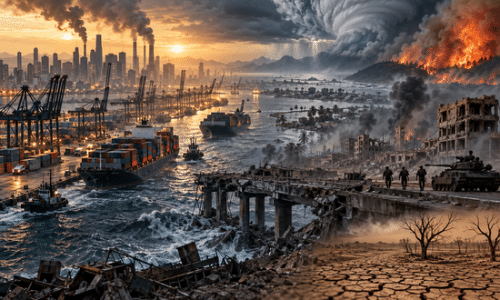
The Great Rebalancing
From the Industrial Age to an Interdependent Age
The Industrial Age was not simply a mistake.
It was an extraordinary leap in human capability.
Machines multiplied human power. Electricity transformed life. Mass production made goods available to billions. Transportation connected continents. Science, sanitation, communications and medicine transformed what was possible.
But the same operating model also created consequences its designers could not fully see.
Extract.
Produce.
Consume.
Discard.
Centralize.
Scale.
Repeat.
The problem is not technology.
The problem is what happens when a system designed for unlimited expansion operates on a finite, interconnected planet.
And now humanity has an opportunity to redesign it.
That should be the spine of the story.
THE STORY BEGINS WITH ONE QUESTION
How did we get here?
Not:
“Who ruined the world?”
But:
What did we build, what did it give us, what did we fail to anticipate — and what are we learning now?
That distinction is important.
It prevents the film from becoming an indictment of industrialization and turns it into something more powerful:
A story about human evolution.
From:
ISOLATED PARTS
to
MASS PRODUCTION
to
GLOBAL NETWORKS
to
INTERDEPENDENT SYSTEMS
to, potentially,
REGENERATIVE SYSTEMS.
And there is a strong factual foundation for that narrative. Global natural-resource extraction has roughly tripled over the past five decades, and UNEP projects that without significant changes it could increase another 60% from 2020 levels by 2060. UNEP – UN Environment Programme (https://www.unep.org/resources/Global-Resource-Outlook-2024?utm_source=chatgpt.com)
At the same time, WHO estimates air pollution contributes to roughly seven million premature deaths annually. World Health Organization (https://www.who.int/teams/environment-climate-change-and-health/air-quality-energy-and-health/air-pollution?utm_source=chatgpt.com)
FAO estimates that the unpriced environmental, health and social costs associated with today’s agrifood systems exceed $10 trillion annually. FAOHome (https://www.fao.org/agrifood-economics/publications/detail/en/c/1661523/?utm_source=chatgpt.com)
But another story is unfolding simultaneously. Renewable capacity additions reached a record roughly 800 GW in 2025, with solar accounting for more than three-quarters of additions; renewables supplied about 34% of global electricity generation. IEA (https://www.iea.org/reports/global-energy-review-2026/technology-solar-pv-and-wind?utm_source=chatgpt.com)
That tension is your story:
The consequences of yesterday’s design versus the possibilities of today’s redesign.
ACT ONE — THE WORLD WE BUILT
The machine
Begin with steam.
- Coal.
- Mechanized production.
- Railroads.
- Factories.
- Electricity.
- The assembly line.
- Oil.
- Automobiles.
- Telecommunications.
Each breakthrough solved a problem.
- Human muscle became machine power.
- Distance shrank.
- Production accelerated.
- Agriculture mechanized.
- Goods became cheaper.
- Cities expanded.
- Modern medicine and infrastructure became possible.
The question underneath the sequence: