
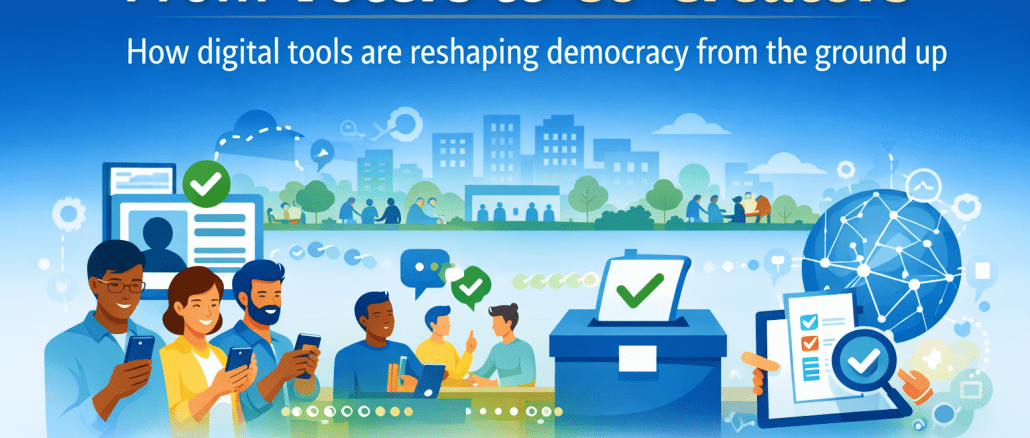
Elections matter. But in a world of rapid change, complex systems, and constant decisions, asking people to participate once every few years is no longer enough.
The big picture
Democracy was designed for a slower era.
Representative systems assumed:
- Decisions could be delegated for long periods
- Issues would remain relatively stable
- Institutions would earn long-term trust
That context is gone.
Today, political decisions shape everyday life — continuously. But public participation remains episodic.
Why trust is breaking down
Across regions, elections are becoming:
- Higher stakes
- More polarized
- Less trusted
People feel they are asked to legitimize outcomes — not help shape them.
When participation is thin, accountability weakens.
Civic tech changes the equation
Digital tools now make ongoing participation possible.
Examples include:
- Citizens’ assemblies supported by digital platforms
- Participatory budgeting at city and regional levels
- Online deliberation spaces linked to real decisions
- Crowdsourced policy input with transparent feedback
Used well, civic tech expands democracy.
Used poorly, it becomes performative.
From voters to co-creators
Participation doesn’t mean endless polling.
It means:
- Giving people context, not just choices
- Inviting deliberation, not just reaction
- Showing how input influences outcomes
When people understand trade-offs and see impact, trust grows.
What meaningful participation actually looks like
Real participation has:
- Clear purpose — people know why they’re involved
- Real influence — decisions reflect public input
- Transparency — how choices are made is visible
- Continuity — engagement doesn’t end after a vote
- Inclusion — barriers to entry are actively reduced
Without these, participation becomes theater.
The risks
Participation done wrong can:
- Overwhelm people
- Amplify loud minorities
- Create false expectations
Design matters. Facilitation matters. Institutions still have a role — but not a monopoly.
Why this moment matters
Public trust in institutions is fragile.
Social media amplifies division, not deliberation.
Global crises require collective intelligence.
Democracy must evolve — or continue to erode.
What comes next
The future of democracy won’t be defined by higher turnout alone.
It will be shaped by:
- Institutions willing to share power
- Civic infrastructure that supports dialogue
- Media that builds understanding, not outrage
- Citizens invited into the work of governance
The bottom line
Democracy isn’t just a system for choosing leaders.
It’s a system for collective problem-solving.
If people remain spectators, democracy weakens.
If they become co-creators, it adapts.
Mobilized News
Inspired by Nature — the original network.