
By Liddy Franco
Despite mentally preparing for Trump’s reelection, the day after the results came through, I paced a hole through my living room, rambling my rage to my mother.
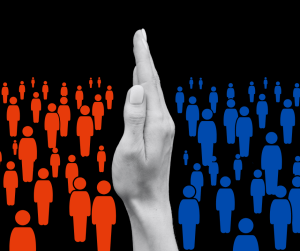 Not about the results themselves, but on the election cycle tactics. Every political advertisement came with intentionally angering and polarizing statements posed as facts. Every ad for a politician said nothing about actual goals, and only bashed the other running candidate.
All trying to win voters over through mob rage rather than actual supportable policy. All shouting, ‘Join me in the fight against the clearly evil and idiotic other side!’
I’m angry that these manipulation tactics worked as well as they did, but that’s why they’re used. They hook you well. Even I got caught up in highschool. Like everyone else, driven by a sense of righteous rage at the system, and looking for something to give me hope, I found it in a “justified hatred.’ An arrow to direct my passion towards. My rage towards how my friends’ parents and classmates treated my LGBT+ friends was easy to manipulate. I thought life would be better if these people didn’t exist. We don’t think—especially with compassion—when angry. Just like how these parents and classmates were manipulated, being told that specific problems in their life would not exist if my friends weren’t around.
Thankfully, several years have passed and I have had the privilege of going to college (and therapy).
These experiences came with becoming educated in topics like formal logic and manipulation tactics. Even more specifically, political manipulation tactics. I realize now, too late for this past election, but hopefully right on time for the next one, that raising awareness regarding how politicians try to deflect and disperse our very valid discontentment can help us reunite.
Why do they do it? Why try to pit us against each other? Because fracturing the majority to fight amongst ourselves means we fail to realize we all face and care about the same issues. Issues that are being perpetuated by lack of policy reform.
Politicians, as always, are funded by large businesses and lobbyists, not the public they serve. If the populous wants to change something the businesses do not, then politicians are unlikely to act in our favor. Despite our discontentment with their failure, they stay in office. How do they pull it off while ignoring the public’s desires?
By distracting us from realizing we are being ignored.
There are two main ways this misdirection is done.
- Intentional Political Polarization: Manufacturing a greater divide between ideological ideals of the populace to prevent a willingness to compromise (Psychological Manipulation Tactics, ARTT Research). Exaggerating political differences takes focus from the issues that people want addressed, and diverts it to fighting “the other side.”
- Scapegoating: Creating an easily digestible target to be angry at that is not the cause of the problem. Just like with polarizing, it takes the focus away from the actual cause of the issue, and directs the anger towards something or someone(s) who cannot easily fight back (The Dirty Politics of Scapegoating, Alexander Douglas, 2016).
These two tactics are perpetrated by both major political parties in the United States, and I think it’s a safe assumption that no one wants to be manipulated like this. To make it easier to spot, here are some examples and a further breakdown of how these tactics are used against us.
Intentionally inflating political polarization plays into our emotions. They intentionally bait us into anger that prevents us from questioning what was just said, and then gives us a target to direct our anger towards. The “other side.”
In Ohio, current Senator Sherrod Brown has been outvoted in favor of Bernie Moreno. A news article from Cleveland’s local news by Jeremy Pelzer summarized the two candidates’ campaigns perfectly.
- Brown’s entire campaign focused on proving that Moreno was a ‘crooked businessman’ and completely anti-abortion with “no exceptions”.
- Moreno’s entire campaign focused on proving that Brown was a radical leftist who voted with Biden “97% of the time.”
- Both campaigns focused intensely on discrediting the other candidate by making them seem the more radical option. As an Ohioan, I was personally bombarded by their ads for several months, and they were designed to make me angry.
I watched Moreno’s ad about Brown letting “transgender biological men in girls locker rooms” several times a day. This specific ad was designed to make me scared that my daughters were alone with grown men in their changing areas. Designed to make me blame Brown for this supposed danger. For Moreno, the ad should cause voters to think, ‘Sherrod Brown put child molesters where my daughter changes. I am angry that my children are in danger. If I vote Brown out of office, my daughter will be safe.’
When we’re angry though, we of course struggle to think critically. I would be angry too, if I actually thought my child was in danger.
Moreno seems to be arguing that Brown supports child predators. When taking a moment to breath, and think about what was just said though, you start to see cracks in the statement.
- Transgender men are people who were born a girl, and decided they are men. Why would a woman who was a child predator transition to become a man, if she could already go into the locker room?
- Does he mean transgender women? A “girl’s locker room” implies that it’s just for kids though, like at school. How would a grown adult get permission from the government to enter it anyways? This doesn’t make sense.
Then when looking for a fact check, you realize that isn’t what Sherrod Brown voted on at all. The above link to the actual ad also includes a fact check of it. The actual statement Brown gave was about how a child’s healthcare should not involve the government, just the child’s family and doctors. This has nothing to do with adults in anyone’s locker rooms, or child predators. In fact, it now sounds like a reasonable stance that I can get behind. Thinking about it, it does seem strange for the government to try having a say in my child’s medical care. I go to the doctor for that expertise for a reason, not a judge.
This polarizing ad that ran had nothing to do with the actual stance neither Bernie Moreno nor Sherrod Brown supported. It was just to make me angry at Brown over something that isn’t true, or even exists.
If I had not looked into finding actual information on this statement though, how would I know? I would only know Brown sounds crazy, and everyone who supports him must also support endangering my children. I personally would have no interest in talking it out with someone who wants to put my kids in danger. I would try to remove them from our life and strip them of their power over my family.
Now that I’m not talking to the ‘other evil side,’ I can’t talk to them about how much I care about my kids being safe. I would have no way of knowing that, actually, it’s not just ‘my side’ fighting to protect my kids. Fighting to protect kids is something we are all getting behind. That’s pretty much a universal agreement. People have different focuses to do so—like access to healthcare, catching child predators, or restricting gun access—but we all care and worry about the same thing.
What is this trying to distract from then? Wouldn’t it be beneficial to have a large group of people agree on the same thing? We could work to pass some important bills to improve our lives this way. If we stop fighting each other though, some of us might pay more attention to news surrounding child safety, like how Matt Gaetz is currently being investigated on allegations of sex trafficking minors.
This leads to scapegoating. The other main way of diverting our attention. When people are upset we want something to blame. Something to direct our anger and energy towards. But the bigger the issue, the harder it is to find a clear target. What do you yell at when you can’t afford groceries? So many systemic issues like inflation, low wages, and price gouging all play a role. Is it even possible to name each reason behind these issues, let alone express your frustration and fear? Let alone in a way that will actually make a difference?
Americans realize that the government is supposed to fix this problem. That’s why it comes up in elections. In this election we saw that the economy was the most important topic for many voters (Gallup Surveys). It comes with uncomfortable questions for politicians though, like why has so little been done to address these problems everyone is currently facing? As a voter, I ask the question each time of,
“If the politicians in power have done little to specifically address the problems facing my life, why should I re-elect them?”
If a politician has not worked towards anything that would benefit the voter base, it would definitely be in their best interest to draw that anger away to something else. The most desirable target is someone else who does not make up a noticeable portion of your voter base, and cannot easily fight against their unfair blame. It also has to be someone that most people do not know personally, to lessen the likelihood of drawing sympathy.
In the instance of the economy, Trump chose China. As we have heard throughout the campaign, Trump blames our outsourcing of goods for the current economic state, and has a long list of potential plans to lessen the United State’s reliance on them. While this specific issue is one of the many reasons that our economy is struggling, it does nothing to address how our minimum wage, and in general all wages, have not been raising to meet inflation within our country for decades. This is something our government could address. They can pass bills to increase wages, and penalize companies that are using ‘inflation’ as a way to justify their price gouging and shrinkflation. However, Trump has worked hard to publicize his blame on China, which distracts from how he has remained silent on increasing wages, and instead plans to cut taxes for corporations again. If the public believes that China is the only thing to blame for the economy, then less people will notice the failure to apply actual fixes to the consistently growing poverty rates.
This scapegoating has more consequences than just distraction. Depending on the chosen target, they can be put in genuine danger. It’s hard for people to attack an entire foreign country across the ocean, but a small minority within your own population? That’s entirely different.
I’d like to look a little further back in history before I bring us back to the present.
Germany during World War II is now one of the most infamous governments in history. A truly horrifying time to look back on now that we’re fully able to grasp exactly how the Nazi party was able to direct economic stress on the Jewish people. A small group of the population—Jews, disabled individuals, and the LGBT—pockets of the population with little voice and understanding by the greater population were easy targets. Scapegoating these groups led to 11 million people killed. No matter how illogical the arguments were to blame these people for the economic hardships, they still died painful and gruesome deaths directly because of it.
This disastrous crime against humanity is not something that will never happen again. The only thing preventing us from repeating this part of our history is consistent awareness. To now bring us back to the present moment, during Trump’s first presidential term, he made a bold statement about wanting to create a ‘Muslim Registry.’ It would have forced government surveillance of Muslim individuals both living in the United States, and those entering.
This idea was not new, taken from the Bush administration for the ‘war on terror.’ The fear of terrorist attacks after 9/11 led an entire group of people unrelated to a specific foreign terrorist group to face dangerous and targeted discrimination.
Tracking an entire population from one specific religion? That sounds an awful lot like the ‘Star of David’ badges that Jews were forced to wear in Germany before and during World War II, and helped Nazi officials round them up into concentration camps. The public agreed with this comparison, and national outcry against this idea prevented it from any implementation.
It was easier to spot this attempt as it happened. Most of the population has been educated in the Holocaust, and seeing one religion replaced with another makes the comparison clear.
The same clarity cannot be said for the current scapegoating target of our election; our transgender population.
What are they being blamed for? Thinking back to Bernie Moreno’s ad about ‘transgender biological men into girl’s locker rooms,’ there is a clear suggestion that people who are trans are child predators. If you have watched the news for the past several years, you’ll see that there has been a drastic spike in anti-trans bills and transphobia since 2019.
Well, what big things happened in 2019 that caused an increased concern about child predators? Jeffery Epstien was arrested for allegedly running a massive sex trafficking ring of minors. While investigations started years ago, his actual arrest, infamous list of benefactors, and death before going to trial became international news. This list included names of many prominent public figures in both the media and government.
Tragically, while there was massive public outcry about this discovery and calls for justice, a dead man cannot be prosecuted.
Who can be prosecuted though? The benefactors on that list. However, a lot of people with government power are on that list, and can use it to avoid further investigation. This includes Donald Trump. In the several years since the initial news break, little progress has been made with investigating and prosecuting the other people named.
How has the public been prevented from continuing to call for the justice they craved just five years ago?
When people can’t get justice through official means, we tend to lash out at the people accessible to us. This anger can be easily misdirected and manipulated because it comes with the nasty side effect of weakening our critical thinking. It gives us the power to act without thinking when we’re in danger, but it also means we could easily misjudge what to attack.
If politicians give the population a seemingly more attainable target to attack, it attempts to satisfy that desire for justice, without actually providing any. It also pulls the negative attention away from the people in power, and makes it feel like they are trying to fix the situation. In reality, they are trying to fix a problem that they artificially created to hide reality.
Our trans community has always been a target of ruthlessly violent discrimination. They are a small community that a majority of the population do not know personally. Only 3 million people, or 1.1% of the American population publicly identify as trans. This is even smaller than the Muslim population which sits at about 3.4 million people.
Because of this, the trans community has very little voice or rights under our current government.
When the public lacks basic education about sub-groups within it, misinformation is easily spread. This makes it easy for someone to intentionally spread false information when they have authority, as people have little personal experiences to compare it against.
It is even easier to do when playing into peoples already existing biases. If you have grown up being told that someone trans is directly going against the will of God, no matter if they are or not, it is hard to shake what everyone you trusted growing up said. Especially if someone in authority is still telling you this. Like our politicians.
The intentionally voiced misconception that trans individuals being sexual predators is clearly still used, since it was the focus in ads for this election.
Along with this, the spike in transphobic policies proposed since 2019 shows a clear and somewhat sudden shift in political focus overall.
Why are trans individuals the chosen target?
- They are a small community, which means misinformation is more easily spread and accepted.
- It is already a target for discrimination, making it easier to amplify the hate rather than cultivate it from scratch.
- They have little political voice. The small community means that politicians aren’t losing out on a significant number of votes if they ostracize the group.
If we do not keep awareness about us, we risk similar tragedies to what happened only a couple generations ago. We have to keep fighting against that possibility, and our own prejudices that could be used to cause it. No group of people, however small, deserves to be attacked for crimes they did not commit.
None of us deserve to have our anger manipulated against us. We deserve a chance to come together and call for genuinely positive change and protection from our government. Fighting back against every falsified statement is exhausting. No one has time to do it every single time. That does not mean we shouldn’t try.
Each attempt gets easier. The easier it becomes to identify manipulation, the easier it is to demand genuine plans and answers.
The easier it is to realize this polarizing climate has been manufactured. We all care about the same intentionally hidden issues. It is up to us to keep fighting to remove the hood pulled over our eyes. Only then will we actually see the change we demand.