

What might become possible if independent media creators, filmmakers, journalists, researchers, schools, innovators, human-rights advocates, nonprofits and community organizations began working as parts of a connected whole?
Build bridges, not walls: It’s time to create a media system that works for everyone
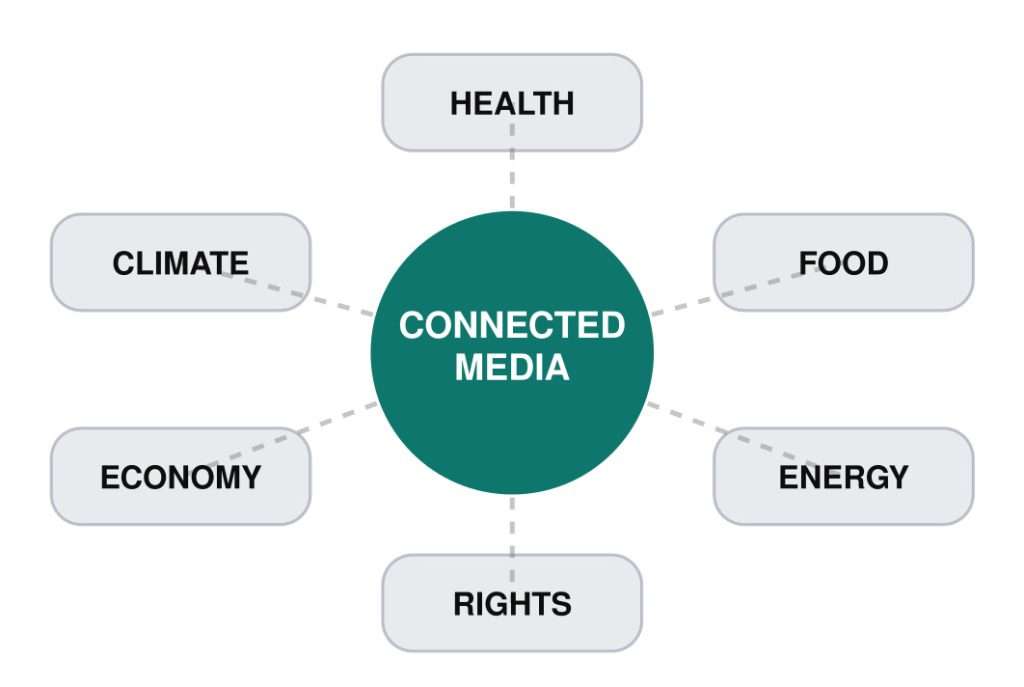
Human rights through whole-systems change | Connected media for an interconnected world
The world is filled with people working on solutions. The problem is that too many are working alone, disconnected from the knowledge, resources and communities that could help them succeed. What if media became the bridge that brought them together?
For generations, we’ve relied on mass media to inform the public, hold power accountable and help society understand itself.
But informing people about what’s going wrong is only part of the job.
- What about showing what’s working? What about connecting communities facing similar challenges? What about helping people turn knowledge into action?
- The world doesn’t suffer from a shortage of intelligence, imagination or people willing to help.
- It suffers, in part, from a shortage of systems that connect them.
The opportunity: Transform media from an industry that primarily distributes information into a public-interest system that also connects people, shares knowledge and enables collective progress.
Not right. Not left. Forward.
The evidence: Why our media system needs an upgrade
37%
Trust in news
Across 48 surveyed markets, 2026
42%
Avoid news
Sometimes or often, 2026
Source: Reuters Institute, Digital News Report 2026. Cross-market survey measures, not a census of the world’s population.
The warning signs are difficult to ignore.
Trust is weakening. Reuters Institute research finds that trust in news has fallen to its lowest level in the survey’s history.
Audiences are disengaging. News avoidance is widespread. Conflict, repetition, information overload and declining relevance contribute to the problem.
The economics are changing. UNESCO’s 2025 assessment describes a media viability crisis in which digital platforms capture much of the advertising revenue once available to journalism.
Public-interest information is vulnerable. When local newsrooms lack resources, communities can lose coverage of decisions that affect their housing, transportation, education, health and livelihoods.
And they raise a question:
If our most urgent problems are interconnected, why are our information systems still so fragmented?
The bigger problem: We are solving connected problems in disconnected silos
Consider the relationships between the challenges communities face.
A housing crisis is also a public-health issue. A food-system failure can become an economic and human-rights crisis. An energy disruption can undermine hospitals, communications and transportation.
Yet the organizations addressing these challenges often operate with separate databases, budgets, communications teams, audiences and networks.
One community develops a working solution. Another community, thousands of miles away, faces the same problem without knowing that solution exists.
The knowledge may be available. The connections are not.
The missing infrastructure isn’t simply another website or television channel. It’s a trusted way for people and organizations to discover one another, compare evidence, share resources and coordinate their efforts.
What we want: Media in the public interest
Imagine a media system built around five commitments.
1. All voices matter. Communities should help define the questions being asked, rather than appear only as subjects of stories. Especially important are the experiences of people historically overlooked or underserved.
2. Evidence before ideology. Report what is happening, verify claims, examine solutions and explain their limitations. Open debate requires facts that can be checked.
3. Human rights as a foundation. Accessibility, privacy, freedom of expression, cultural diversity and equitable participation should be built into the system rather than added later.
4. Main Street alongside Wall Street. Economic reporting should make room for workers, families, independent businesses, cooperatives and communities affected by financial decisions.
5. Collaboration instead of isolation. Journalists, researchers, filmmakers, educators, civil society organizations and problem-solvers should be able to share knowledge without surrendering their independence or ownership.
This is not about replacing investigative journalism with positive stories.
It is about completing the picture.
- Expose what is failing. Investigate why. Show what is working. Explain how others can learn from it.
- That is the difference between simply reporting problems and building public understanding.
The idea is not new. The technology to make it possible is.
In 1980, UNESCO published Many Voices, One World, the landmark report of the international commission chaired by Sean MacBride.
Its central concern remains relevant: How can communications become more democratic, equitable and responsive to the needs of people rather than concentrated centers of power?
The report called for a more just international information and communication order.
The underlying principle is straightforward.
People must have the ability not only to receive information, but also to participate in producing, questioning and sharing it.
Digital technology makes this more achievable. Affordable production tools, remote collaboration, translation, distributed publishing and shared archives can lower barriers that once limited participation to large institutions.
But technology alone does not produce trust, fairness or cooperation.
Those outcomes require standards, transparent governance and people willing to work together.
Who is already making this work?
These are not merely theoretical possibilities. Several organizations have demonstrated important elements of a more connected media system.
Outlier Media — Information people can actually use
This Detroit newsroom asks residents what information they need, then develops reporting and text-message services around housing, utilities and everyday challenges. Its model begins with community needs rather than an editorial agenda determined entirely from above.
City Bureau — Residents become reporters
The Documenters Network trains and pays community members to attend public meetings and report what happens. City Bureau reports that more than 6,000 people have been trained across more than 20 communities, creating records that journalists and residents can use.
This international network teaches journalists to investigate responses to social problems, examine evidence of effectiveness and disclose limitations. Its published impact figures report more than 100,000 journalists, educators and students trained or using its tools.
Associated Press — Cooperation at global scale
Founded in 1846, AP demonstrates that shared news gathering and distribution can operate through a cooperative structure. While AP’s model is different from a community-owned network, its history establishes that cooperation and professional journalism are compatible.
- These examples do not prove that every collaborative media network will succeed. They demonstrate that participation, cooperation, practical public service and rigorous journalism can coexist.
- The next opportunity is to connect approaches like these into a larger, interoperable ecosystem.
The Mobilized opportunity: From isolated efforts to collective intelligence
Imagine an independent filmmaker in Kenya documenting a community-owned energy project.
A researcher in Brazil has evidence from a similar initiative. A cooperative in India has experience financing it. A media producer in Canada can help turn the findings into an accessible documentary. A community organization in South Florida wants to explore the model locally.
Today, these people might never find one another.
In a connected media network, they could share knowledge, compare evidence, produce a story together, make it available in multiple languages and identify the steps needed to adapt the solution elsewhere.
- The result is not just more content.
- It is more useful knowledge, stronger relationships and potentially greater capacity for communities to act.
- That is the purpose of Mobilized News.
How the Mobilized ecosystem can work
From information to participation
Six connected functions. One shared purpose.
THE WIRE
Report verified developments and their implications.
THE UPGRADE
Investigate solutions, evidence and system improvements.
THE CONNECTIONS
Connect the knowledge, experiences and people behind the stories.
THE EXCHANGE
Match needs with skills, resources, projects and opportunities.
THE NETWORK
Enable continuing collaboration among communities and organizations.
MOBILIZED MEDIA
Co-create, produce, distribute and share independent media.
Shared knowledge → Coordinated action → Measurable results
The ambition is not to control what participating organizations say or do. It is to provide shared infrastructure that helps independent participants work together while protecting their autonomy.
For media creators, that could mean collaborative productions, pooled technical resources, affordable licensing, shared distribution, training and new revenue opportunities.
For community organizations, it could mean better access to credible information, expert knowledge, communications support, collaborators and practical solutions.
For the public, it could mean news that answers additional questions: What does this mean for my community? What’s being done? What evidence exists? Where can I participate?
From conferences and talk-fests to an always-on media experience
- The world does not lack conferences, summits, declarations or expert panels.
- These gatherings can generate valuable insights and relationships. The challenge is preserving and applying that knowledge after the event ends.
- A session is recorded. A report is published. People return to their respective organizations.
- Too often, the potential connections remain unrealized.
Mobilized proposes a different model.
| The conventional approach | The connected approach |
|---|---|
| A scheduled conference | An accessible, ongoing media experience |
| Speakers present | Contributors collaborate |
| Audiences consume | Communities participate |
| Ideas are discussed | Evidence and action pathways are documented |
| Content remains isolated | Knowledge is connected and reusable |
| Success is measured by attendance | Success is measured by participation, learning and results |
The proposed Mobilized International Media Experience can become a gateway into this continuous system.
- Record valuable conversations in advance. Connect expert insights to community experiences. Create multimedia explainers, tutorials and documentaries. Make them available on demand. Continue the conversations through collaborative working groups.
- Rather than asking people around the world to be in the same place at the same time, give them accessible ways to participate when they can.
- The event becomes a catalyst. The network becomes the lasting resource.
What must be different this time?
A collaborative system is not automatically a democratic or trustworthy one.
Its success will depend on how it is designed and governed.
- We must establish clear safeguards: independent editorial verification, transparent funding, protection of personal information, accessible participation, fair contributor agreements and documented rules for licensing, attribution and ownership.
- It must make room for disagreement. All voices deserve the opportunity to be heard; not all factual claims deserve equal credibility.
- It must also measure whether cooperation produces useful outcomes rather than simply more meetings, content or memberships.
- Possible measures include the number of working partnerships formed, shared resources used, independent productions completed, communities served and solutions successfully adapted.
These are proposed measures of impact, not accomplishments already established.
The Mobilized action pathway
1
Share what you know.
Contribute firsthand experience, research, verified evidence, a useful solution or an important question that deserves investigation.
2
Make your work discoverable.
Introduce your organization, independent project, documentary, community initiative or services to potential collaborators.
3
Find collaborators.
Identify the people, resources, technical assistance and production partners who can help advance a shared goal.
4
Create and distribute together.
Develop shared stories, tutorials, interviews and media productions with appropriate agreements on creative ownership and attribution.
5
Show what changes.
Document outcomes, share lessons and identify where solutions work, where they fail and what needs improvement.
The invitation: We already have much of what we need. Let’s connect it.
- What might become possible if independent media creators, filmmakers, journalists, researchers, schools, innovators, human-rights advocates, nonprofits and community organizations began working as parts of a connected whole?
- Could we reduce duplication? Share the cost of production? Expand the reach of independent voices? Make hard-won knowledge accessible to others? Help communities discover solutions they didn’t know existed?
These are questions worth testing together.
Mobilized News is building an ecosystem for that purpose: a place to inform, investigate, connect, collaborate and create.
- Not another platform that asks people to surrender their voice.
- A network that helps their voices travel further.
- Not another conference where ideas disappear when the lights go out.
- A living, evolving resource where the work continues.
- Not a promise that technology will solve humanity’s problems.
- An invitation to use our knowledge, technologies and human relationships more intelligently.
- A well-informed public is the most powerful and valuable natural resource of all.
- The future of media should be about more than who owns the channels and controls distribution.
- It should also be about what people can accomplish when they share access, knowledge, responsibility and opportunity.
Build bridges, not walls.
Be part of the Mobilized network
Whether you’re an independent creator, a community organization, a researcher, an educator or someone with a working solution, there is a place to begin.
- Explore Mobilized
- Explore