Australia, NZ and Oceania What changed the week of Feb. 7-13, 2026
AUSTRALIA/NZ/OCEANIA
Mobilized Weekly Risk Brief — Australia, New Zealand & Oceania
What changed this week
Trade controls intensity
- What happened: Critical-minerals policy coordination accelerated among allies, while China signaled tighter oversight via industry briefings on export controls for rare earths/strategic minerals.
- Where: Australia/NZ supply positioning + Asia-Pacific critical-minerals trade routes.
- Why it matters: Contracting, compliance, and pricing for “strategic inputs” can shift quickly—affecting mining investment, downstream manufacturing plans, and defense/clean-energy supply commitments.
- Affected first: Miners, refiners, exporters, port logistics, advanced manufacturing buyers.
- Confidence: Medium (clear direction; exact implementation varies).
- Watch next: New licensing guidance, buyer screening, minimum-price/stockpile moves, and any export-control expansions.
Financial rail fragmentation
- What happened: Australia’s monetary tightening bias and AUD dynamics remained in focus: RBA messaging stressed persistent inflation pressure; large institutional hedging flows signaled active currency positioning.
- Where: Australia (spillover to NZ/Oceania via trade invoicing, tourism, and import prices).
- Why it matters: Higher rates + currency swings transmit into household affordability, business borrowing costs, and import prices (fuel, food, equipment).
- Affected first: Importers, leveraged SMEs, households, infrastructure projects with FX exposure.
- Confidence: Medium–High.
- Watch next: AUD volatility, funding spreads, and any stress in credit-sensitive sectors.
Energy stress
- What happened: Domestic gas security and market rule changes stayed salient as government finalized/advanced gas market review steps; LNG politics/lobbying pressure continued to shape the “supply vs price vs transition” debate.
- Where: Australia (east coast gas market + LNG export dynamics).
- Why it matters: Gas price and availability affect electricity costs, industrial competitiveness, and household bills—especially under heat-driven peak demand.
- Affected first: Energy-intensive industry, utilities, households, critical services during heat events.
- Confidence: Medium.
- Watch next: Domestic supply commitments, price mechanisms, and peak-demand reliability measures.
Supply-chain chokepoints
- What happened: Extreme heat and wildfire conditions increased operational fragility risk (transport disruptions, worker safety shutdowns); meanwhile global maritime routing volatility remains a background driver for island logistics and import lead times.
- Where: Australia (heat/fire exposure); Oceania import routes (high sensitivity to shipping schedule swings).
- Why it matters: Small delays propagate fast in Oceania—inventory buffers are thin, and freight costs pass through quickly to prices.
- Affected first: Retailers, construction inputs, healthcare supplies, food distributors.
- Confidence: Medium (climate disruption signal strong; shipping impacts vary).
- Watch next: Port congestion, insurance advisories, and heat/fire restrictions affecting road/rail and warehousing.
Semiconductor constraints
- What happened: No region-specific “chip shock” headline this week; pressure remains indirect via global trade-control tightening around strategic inputs and tools, and via logistics volatility impacting electronics lead times.
- Where: Australia/NZ electronics import supply chains.
- Why it matters: Network gear, medical devices, industrial automation, and grid components are timing-sensitive to electronics availability.
- Affected first: Telcos, utilities, hospitals, defense contractors, device resellers.
- Confidence: Low–Medium (structural risk; weak week-specific constraint signal).
- Watch next: Any export-control expansion affecting electronics/industrial components; sharp freight spikes.
Compute & cloud sovereignty pressure
- What happened: Australia released a new whole-of-government cloud policy emphasizing secure, modern cloud adoption (effective July 1, 2026), reinforcing “secure-by-default” and modernization pressure.
- Where: Australia (APS), with spillover expectations for government vendors and critical-service operators
- Why it matters: Procurement standards reshape vendor requirements, security baselines, and continuity expectations across the ecosystem.
- Affected first: Government agencies, cloud/MSPs, SaaS vendors, regulated sectors aligning to government standards.
- Confidence: High (policy release).
- Watch next: Implementation guidance, certification requirements, and “approved service” lists.
Cyber / hybrid spillover
- What happened: Reporting and visibility gaps remained a material operational risk: many Australian federal entities reportedly under-report incidents to ASD, reducing shared situational awareness; analysts continued emphasizing persistent state-linked “quiet observation” targeting government and critical infrastructure.
- Where: Australia (federal entities + CI ecosystem)
- Why it matters: Under-reporting delays coordinated defense, increases dwell time, and raises systemic exposure for “upstream dependencies” (identity, networks, shared service providers
- Affected first: Government service operators, critical infrastructure, shared IT providers, citizens relying on digital services.
- Confidence: Medium–High.
- Watch next: New mandatory reporting/enforcement, and incident response capacity signals.
Technology standards divergence
- What happened: Government cloud policy and security baselines continue to harden—useful for resilience, but can increase interoperability friction for vendors operating across jurisdictions.
- Where: Australia public sector + suppliers; NZ/Oceania vendors aligning across multiple regimes.
- Why it matters: Divergent compliance requirements raise costs and slow deployment for cross-border operators and regional programs.
- Affected first: Multi-country MSPs, SaaS vendors, cross-border service integrators.
- Confidence: Medium.
- Watch next: Mutual recognition, shared certification, and standard mapping efforts.
Water / food stress
- What happened: Climate outlook shifted toward a likely La Niña → El Niño transition, with risks of worsening drought/heat in southeast Australia; Reuters also reported a severe heat/fires backdrop early in 2026.
- Where: Australia (drought/heat exposure), wider Pacific rainfall pattern sensitivity.
- Why it matters: Drought/heat elevates food price volatility, insurance losses, grid stress, and water restrictions—compounding cost-of-living pressures.
- Affected first: Households, agriculture, utilities, outdoor labor, remote communities.
- Confidence: Medium (probabilistic climate signal; strong recent extremes).
- Watch next: Reservoir levels, heatwave frequency, bushfire conditions, and crop stress indicators.
Social stability pressure
- What happened: The main stability amplifier is “essentials stress”: persistent inflation pressure (RBA) plus extreme heat/fire conditions increase affordability and service-disruption risk.
- Where: Australia; NZ/Oceania sensitivity through energy/food import costs.
- Why it matters: When bills rise while services become less reliable during climate events, trust and cohesion can degrade locally (especially in vulnerable communities).
- Affected first: Low-income households, remote communities, critical services, SMEs.
- Confidence: Medium.
- Watch next: Utility disconnections, localized protest/strike activity, emergency service strain.
Drivers & causal chain
Driver A — Strategic minerals tightening (controls + alliances)
- Mechanism: Export controls and allied coordination reshape who can buy/sell strategic minerals and under what compliance terms.
- Second-order: Contract repricing, investment delays, compliance overhead.
- Third-order: Manufacturing and defense/clean-energy deployment slowdowns; trade retaliation risk.
- Early-warning metric: New licensing categories, stockpile announcements, sudden export permit slowdowns
Driver B — Inflation persistence and tighter financial conditions
- Mechanism: Central bank tightening bias + valuation/hedging flows influence currency and borrowing conditions.
- Second-order: Higher debt service, reduced discretionary demand, higher import pass-through.
- Third-order: Rising insolvency risk pockets; public service strain.
- Early-warning metric: Wage/inflation prints, credit stress indicators, AUD volatility.
Driver C — Climate extremes hitting infrastructure and labor capacity
- Mechanism: Heat domes/drought/wildfire conditions force operational changes and increase outage and logistics disruption risk.
- Second-order: Insurance costs, supply disruption, health impacts.
- Third-order: Migration pressure from high-risk zones; stability strain.
- Early-warning metric: Fire danger indices, heatwave persistence, insured-loss estimates.
Driver D — Cloud modernization + sovereignty/security baselines hardening
- Mechanism: Government cloud policy raises minimum security and architecture expectations across suppliers and agencies.
- Second-order: Vendor consolidation, higher compliance cost, accelerated legacy retirement.
- Third-order: Better resilience—if implementation capacity exists; otherwise modernization bottlenecks.
- Early-warning metric: New mandated controls, audit cadence, procurement gate changes.
Driver E — Visibility gaps in cyber defense
- Mechanism: Under-reporting reduces shared detection and coordinated response, increasing dwell time and systemic exposure.
- Second-order: Repeated compromises via shared providers/identity.
- Third-order: Trust shocks if government or critical services are disrupted.
- Early-warning metric: Reporting compliance rates, incident volume disclosure, new enforcement actions.
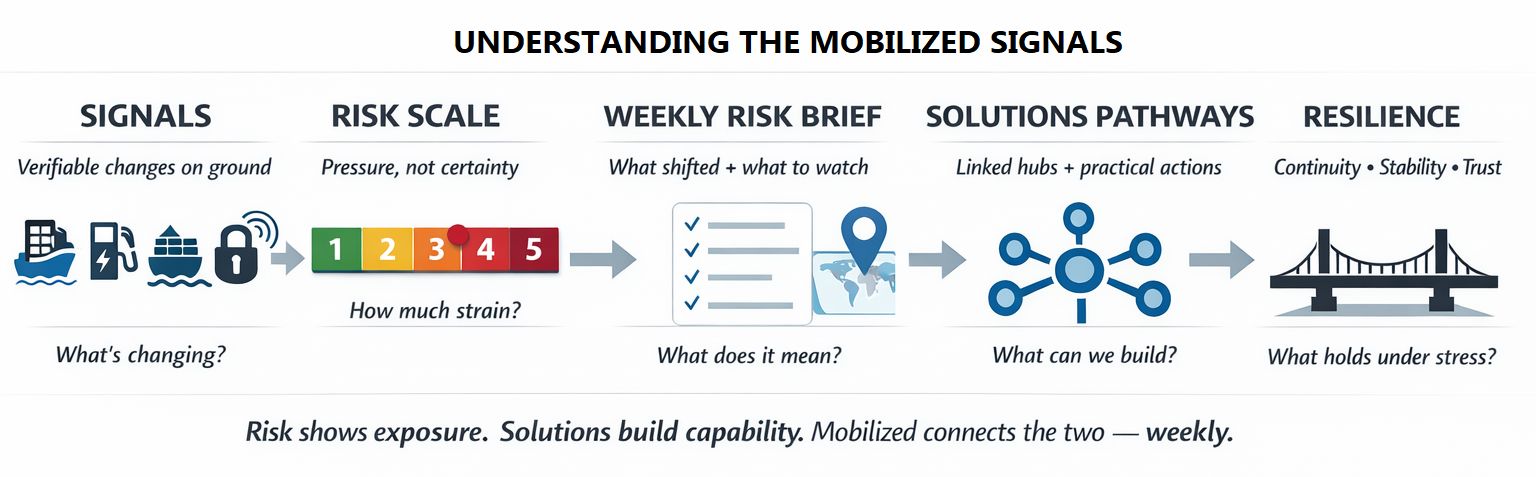
3️⃣ Weekly Risk Index — Pressure Tracking (1–5)
| Indicator | Score | Dir. vs last week | Rationale | Most important supporting signal |
|---|---|---|---|---|
| Trade controls intensity | 3 | ↑ | Strategic minerals controls/alliance moves raising compliance pressure | China rare earth controls briefing |
| Financial rail fragmentation | 3 | → | Tight conditions + currency positioning remain active, not acute | RBA inflation/tight labor signal |
| Energy stress | 3 | → | Gas market/security reform pressure persists; heat elevates peak-demand risk | Gas market review + heat extremes |
| Supply-chain chokepoints | 3 | ↑ | Climate disruption risk + global routing volatility keep lead times fragile | Record heat/fires operational risk |
| Semiconductor constraints | 2 | → | No local shock; indirect exposure via trade/logistics | Strategic minerals controls backdrop |
| Compute & cloud sovereignty | 4 | ↑ | Policy-driven modernization/security baseline tightening | New APS cloud policy |
| Cyber / hybrid spillover | 4 | ↑ | Visibility/reporting gaps + persistent state-linked activity | Under-reporting to ASD |
| Standards divergence | 3 | → | Hardening baselines improve security but can fragment compliance | APS cloud policy |
| Water / food stress | 4 | ↑ | El Niño risk increases drought/heat probability in 2026 | ENSO shift signal |
| Social stability pressure | 3 | ↑ | “Essentials stress” (inflation + climate disruption) is the main amplifier | RBA + heat/fires |
Top 3 rising pressures: Water/food stress; cyber spillover; compute/cloud sovereignty pressure.
Top 2 stabilizing pressures: Semiconductors (no shock); energy (policy active, but no acute supply break this week).
Most likely spillover path: Heat/drought → peak energy demand & higher costs → service disruption + affordability pressure → localized stability incidents.
Regional lens — real-world impacts
United States
- Pricing/supply chains: Critical minerals coordination and China’s controls affect input costs for EVs, defense, and electronics—feeding through to prices and lead times.
Europe
- Trade alignment: Allied critical-minerals positioning and compliance requirements can reshape sourcing and contracting with Australia/NZ suppliers.
Africa
- Food/water/logistics: Oceania climate volatility and global shipping swings can transmit into food price volatility and longer lead times for imports—especially for island and import-dependent markets.
Look Ahead — next 7–14 days watchlist
- Heatwave persistence & fire conditions (AU): triggers operational shutdowns. Trigger: multi-day extreme heat + high fire danger.
- ENSO transition confirmation: escalates drought risk planning. Trigger: updated probabilities + rainfall deficits in SE Australia.
- Government cloud implementation details (AU): clarifies compliance burden. Trigger: guidance, certification, audit cadence.
- Cyber reporting enforcement: improves/doesn’t improve visibility. Trigger: mandatory reporting actions or public posture metric
- Gas market rule/commitment updates: impacts industrial/household price outlook. Trigger: new domestic supply commitments, price mechanism changes.
- Critical-minerals pricing/stockpile moves: shifts market signals quickly. Trigger: new reserve purchases or minimum-price proposals.
- China export-control implementation signals: changes paperwork and timing. Trigger: licensing guidance, compliance inspections.
- AUD volatility and funding conditions: affects import pass-through. Trigger: sharp currency moves or widening credit spreads.
- Insurance / catastrophe loss updates: raises cost base. Trigger: revised insured loss estimates after major fire/heat events.
- Remote/community service strain: early stability signal. Trigger: water restrictions, outages, clinic/supply shortfalls.
Key decision points: RBA guidance; Australia energy/gas regulators; APS digital policy implementers; cyber reporting/enforcement authorities.
Biggest unknowns: How quickly El Niño conditions lock in; whether cyber reporting improves materially; the pace of trade-control tightening on strategic inputs.
Disconfirming signals: Cooling/relief rainfall; lower fire danger trend; measurable improvement in incident reporting/visibility; no new export-control tightening steps.
From Risk to Solutions — Build the bridge
Bridge 1 — Water/Food stress → /solutions/water-food/
- Pressure point: El Niño risk raises probability of hotter, drier conditions and drought stress in 2026.
- Why it matters:
- Higher food price volatility and farm output risk.
- Greater wildfire/health and service-disruption burden.
- Actions
- Business: Heat/drought continuity plans; diversify suppliers; lock in critical inputs earlier.
- Community: Local cooling centers; water conservation programs; community fire readiness networks.
- Policy: Accelerate drought resilience funding, water infrastructure maintenance, and land-use/fire mitigation.
Bridge 2 — Cyber → /solutions/cyber-resilience/
- Pressure point: Cyber situational awareness is weakened by under-reporting, while persistent state-linked activity continues
- Why it matters:
- Longer dwell time = higher blast radius if exploited.
- Shared providers/identity systems can create systemic outages.
- Actions
- Business: Require supplier incident reporting SLAs; identity hardening; tabletop exercises with critical vendors.
- Community: Digital service continuity (offline alternatives for key services); cyber hygiene drives for local orgs.
- Policy: Enforce reporting and minimum controls; fund legacy system remediation; cross-sector incident drills.
Bridge 3 — Compute/cloud sovereignty → /solutions/compute-continuity/
- Pressure point: New government cloud policy drives faster modernization and stronger security baselines.
- Why it matters:
- Procurement rules cascade into private-sector compliance expectations.
- Poorly managed migrations can cause outages or cost blowouts.
- Actions
- Business: Map apps by data sensitivity; adopt multi-region backup; confirm exit/portability plans.
- Community: Encourage resilient local service delivery (libraries/centers as digital access + fallback hubs).
- Policy: Publish clear migration playbooks; require resilience testing; support shared secure platforms for smaller agencies.
Mobilized Weekly Risk Brief — Publish-ready assembly
TL;DR (3 bullets)
- Climate-driven operational risk is rising (heat, fire, drought probability) and will pressure energy, logistics, and affordability.
- Cyber resilience is constrained by visibility gaps as incident reporting remains incomplete across entities.
- Sovereign-by-default cloud modernization is accelerating via new APS cloud policy requirements.
Pressure Map (Top 5)
- Water/food stress (4 ↑)
- Cyber / hybrid spillover (4 ↑)
- Compute & cloud sovereignty (4 ↑)
- Trade controls intensity (3 ↑)
- Supply-chain chokepoints (3 ↑)
What changed this week
- A stronger ENSO transition signal increased the drought/heat risk lens for 2026 planning in Australia.
- Government cloud policy raised the baseline expectations for secure cloud adoption across the APS ecosystem.
- Cyber risk management remains hindered by incident reporting gaps, increasing systemic uncertainty.
Why it matters (Business + Communities)
- Business: Expect higher volatility in operating conditions—worker safety disruptions, peak energy demand, and more stringent cyber/compliance expectations.
- Communities: “Essentials stress” (bills + disruptions) is the fastest pathway to instability—especially during extreme heat and service outages.
Regional Snapshot (USA / Europe / Africa)
- USA/Europe: Critical minerals controls and alliances reshape contracting and compliance, with downstream price impacts.
- Africa: Global supply volatility and climate-linked price effects can amplify food/energy affordability pressure.
Look Ahead (7–14 days)
Watch heat/fire conditions, ENSO confirmation, cloud policy implementation guidance, and cyber reporting/enforcement signals.
Mobilized Action
- Run a heat/drought continuity drill (staff safety, peak-demand power, supply reroutes).
- Stand up “essentials price + outage” local monitoring (water restrictions, blackouts, staple prices).
- Close cyber visibility gaps: require incident reporting SLAs from vendors and internal units.
- Cloud migration readiness check: data classification + resilience tests + rollback plans aligned to new policy.
- Strategic inputs map: critical minerals exposure by supplier/country/route; pre-negotiate alternates.
Accuracy & Trust Layer
- Overall confidence: Medium (strong on climate/cyber/cloud policy signals; weaker on week-specific semiconductors and shipping shocks).
- Top 3 uncertainties
- Speed and severity of El Niño-linked drought/heat impacts.
- True cyber incident rate given reporting gaps.
- How quickly trade controls tighten around strategic minerals and related supply chains.
- What would change our assessment (disconfirming signals): sustained cooling/rainfall relief; measurable improvements in cyber reporting; no further tightening in export-control implementation.
- Source types to verify (categories): meteorological agencies; emergency services/fire authorities; central banks; energy market regulators; port authorities and carriers; national cyber agencies/CERTs; government digital transformation offices.
- Weekly rhythm: Monday brief → publish + auto-link solution hubs → Tue–Fri explainers/signals/solutions stories → feed next Monday.