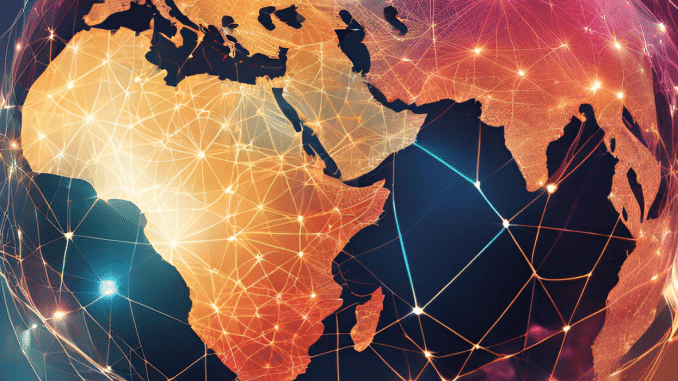
An interconnected world needs connected media
Why the way we organize information must change—and how Mobilized’s vision connects understanding with the ability to act.
Mobilized News | Analysis | October 24, 2026
A story about food prices belongs on the business page. A drought goes in the environment section. A hospital shortage becomes a health story. A dispute over water becomes politics.
Those categories help organize reporting. They can also obscure the relationships people need to understand.
Food, water, energy, livelihoods and health belong to the same living world. The IPCC’s synthesis report explicitly recognizes the interdependence of climate, ecosystems, biodiversity and human societies.
The big idea: An ecologically sensible future requires information that helps people understand relationships, evaluate choices and work together.
Mobilized’s vision—connected media for an interconnected coexistence—starts with that purpose.
What no longer fits
Much of legacy media took shape around print deadlines, broadcast schedules, specialist departments and a limited number of powerful distributors.
That inheritance still shapes how information is selected and presented. Yet people now face abundant information, fragmented attention and decisions whose consequences cross sectors, borders and generations.
Established newsrooms continue to produce essential investigations, science reporting and public-service information. The structural challenge is making that work consistently accessible, connected and useful.
Simply moving an old format onto a new screen does not resolve it.
1. Events arrive faster than explanations.
A breaking story tells us what happened. Understanding requires more: what produced it, which decisions sustain it, who benefits, who bears the costs and what could change.
A flooded street needs immediate reporting. It also needs sustained investigation into drainage, land use, housing, maintenance and public spending.
When coverage moves on before those relationships become clear, people receive updates without a usable account of the system.
2. Attention can compete with understanding.
A 2023 experimental study of headlines on Upworthy found that negative language increased the likelihood of a click. That finding concerns a particular publisher and dataset, but it illustrates how attention metrics can reward negativity.
A click measures a response to a headline. It does not tell us whether someone understood an issue, found reliable help or made a better decision.
The economics matter, too. UNESCO identifies advertising losses, job cuts and newsroom closures as threats to journalism’s viability. Sustained investigation and public-service reporting need dependable resources.
Mobilized’s argument is that public value needs to become an explicit measure of media success.
3. Distribution does not automatically create connection.
A feed can put thousands of people near the same story without helping them exchange knowledge, evaluate evidence or collaborate.
Broadcasting remains useful. So do social platforms. But sustainable change also requires listening, local knowledge, understandable research and continuing relationships.
Communication becomes more useful when people can ask questions, contribute experience and see what happened afterward.
People are signaling a problem.
In the Reuters Institute’s 2026 Digital News Report, 42% of respondents across surveyed markets said they sometimes or often avoided the news. Its analysis describes multiple influences on disengagement and trust, including factors beyond journalism itself.
That raises a public-service question: how can information become worth returning to because it helps people navigate their lives?
What information for an ecological future should provide
It should help people ask:
- What is connected? Trace relationships among environmental conditions, economic decisions and everyday life.
- What is the evidence? Identify sources, uncertainty and the limits of a claim.
- What is working—and for whom? Examine outcomes, costs and conditions.
- What could go wrong? Investigate trade-offs and unintended consequences.
- What can people do together? Identify relevant decisions, capabilities and opportunities.
UNESCO’s environmental information work similarly emphasizes verification, investigative reporting, local relevance, collaboration and actionable information.
Parts of this change are already happening.
The Solutions Journalism Network teaches reporting that examines responses to problems through evidence, insight and limitations. Its approach requires scrutiny of what works and what does not.
Covering Climate Now, co-founded by journalists Mark Hertsgaard and Kyle Pope, supports collaboration and training across newsrooms to improve climate coverage. Established and independent outlets participate.
These efforts demonstrate that media practices can change through deliberate choices and cooperation.
Where Mobilized’s vision comes in
Mobilized proposes connecting the parts of the information journey that people often have to assemble themselves:
Signals → Systems → Solutions → Action
A news update would lead to context. Context would connect related sectors. Reporting on a response would reveal its evidence, costs and limitations. People could then find relevant conversations, projects and opportunities to participate.
The vision brings journalism, research, practical experience and community knowledge into a continuing relationship.
Its ten connected sectors—from energy and food to health, finance, democracy and storytelling—would function as different ways into a shared picture.
What that could look like
Imagine someone arriving with a question about rising electricity bills.
A connected media experience could help them explore the drivers of those costs, compare independently assessed responses, understand relevant policy decisions and learn from communities with different ownership arrangements.
An interview could bring questions to a practitioner. A project listing could identify skills or partners needed. Follow-up reporting could examine whether promised savings actually appeared.
Each connection would help a reader move from an individual concern to an understanding of shared choices.
Trust must be built into the system.
Mobilized’s vision needs standards people can inspect:
- Disclose funding, sponsorship and relevant interests.
- Distinguish reporting, analysis, opinion and promotional material.
- Publish sources, corrections and meaningful uncertainties.
- Examine proposed solutions with the same care as the problems they address.
- Protect privacy and make participation accessible.
- Follow up on outcomes, including failures.
Connecting people to a project should never substitute for independently assessing its claims.
What participation can mean
A resident can contribute a local question. A researcher can explain findings and limitations. A practitioner can share results. A creator can help communicate them. A community can identify the capability it needs.
The editorial task is to verify, connect and make that knowledge useful.
The purpose is coexistence.
An ecologically sensible media system should help people consider how decisions affect other communities, the living world and future generations.
Mobilized’s promise should be judged by what people can understand, question and accomplish through it.
Good needs better distribution. Understanding needs useful connections.