
 Fanni Melles, PhD. is Smart Cities researcher where she focuses on SMARTER CITIES. Her podcast WTF4Cities is a highly recommended destination to discover how cities are gearing up and developing improvements in the ways cities function and operate. She focuses much of her attention on whole system design and is also part of the Smart Cities Council and often contributes to Mobilized News. She is based in Melbourne, Australia.
Mobilized:
Have you noticed any significant changes in this movement? What are they and what has been the response of communities in various parts of the world?
Fanni Melles:
People are realizing that we can’t wait for someone else to solve our problems, we need to step up and do our part. That does not mean that we all have to become giant change makers, just people who are willing to change one thing at a time.
This, that individuals can change the system, is part of our nature. There is the science of swarm intelligence which always encourages me. Swarm intelligence is the science of how the grouping of individual agents creates a cluster with its own intelligence – very much like how cities are in my understanding. However, swarm intelligence has an attribute for the swarms which we are so easy to forget – it is called stigmergy:
“One agent’s actions influences the whole swarm, and the swarm in turn influences the individual agents’ actions. All of our actions, choices and non-choices are the same – we influence the city, maybe not in major ways, but we do, which in turn changes and influences other individuals.”
Additionally, it seems that “sustainability” is getting old. I personally have a turbulent relationship with sustainability because if we go back to the root of the term, ‘to sustain’, it means that we are sustaining (keeping the same) systems, status quos, people just on their surviving level, instead of improving, developing, moving toward the future. My connections are shifting more towards resilience and adaptability, while I personally am a huge fan of antifragility, which means that systems are antifragile when they learn from the shocks and become better for them, instead of only surviving or needing to be protected.
What have you learned from those on the front lines of change for smarter cities?
That change is possible and it is coming. Potentially more rapidly than we ever imagined. This means that our challenges, like climate change, can and will be solved with already existing and upcoming solutions. I would like to repeat that: we have the technology (a.k.a. Applied knowledge) to solve climate change – we just need to use our knowledge to actually apply it to our challenges instead of fear mongering or cowering in the corner.
Additionally, since economics and money seem to be the main reasons for behavioural change to occur in humans, I am happy to report that the new solutions are not just good for the planet in philanthropic sense, but more economically viable – cheaper – than the previous ones. Thus, this change is without a doubt coming.
Which means that we need to get comfortable with the changing times instead of becoming obsolete with sticking to the old-age wrong solutions. This includes actual tools, devices, skills, policies, approaches, teachings, etc, and, in general, understanding that some of the older approaches are not useful anymore.
One of my interviewees on the What is The Future for Cities? podcast, Bradford Cross in episode 398 mentioned that, for example, the US Constitution is 300 years old. He was proudly saying that his family had a huge role in establishing the Constitution across the ages but he is still in favour of updating it:
“Just imagine that the Founding Fathers come back to life and see that we are still sticking with the same 300-year old document instead of updating it for modern times.”
There are new approaches to governance, policies, approaches, problem solving, so why are we still sticking with the old ones which proved good at the beginning but become obsolete once we evolved enough?
What are some of the most significant stumbling blocks that slow down the movement? How can people overcome them?
There seems to be 2 big stumbling blocks: human aversion to change and government/governance limitations.
Humans do not do well with fast change just based on our nature. We are afraid of fast-paced change because we don’t know what lies on the other side or the road seems too risky or not clear enough. Well, these are certainly true, I don’t want to diminish the challenging nature of change. However, we also need to see that although the expression exists that ‘change is messy’, we can’t just ignore that beside the ‘messy’ adjective, there is also ‘change’ in that expression, as Richard Gill talked about this in episode 274 of the What is The Future for Cities? Podcast. Through change, we can alter our current not-so-ideal or downright bad situations to better or even good. Change can help us create the urban conscious evolution which means that we create the future (of cities) instead allowing it to happen to us.
The other part is the limitations in governments and governance. Bureaucrats and governments systems are very slow and averse to change, innovation, and improvement. Partially, because they can justify their existence through the current systems and status quos – and I am being facetious here. Maybe they need to be more cautious of change because they are responsible for more people than an innovative company who creates a new solution for a specific subset of people. However, for us to be able to solve problems, the innovators (let it be in digital technology or the building industry) need to have more freedom than what they usually currently experience with red tape and regulations. Remco Deelstra from the Municipality of Leeuwarden (NL) described in episode 378 that sometimes governments need to leave cities and communities alone for solutions to pop up and innovation to happen. If innovation in slowed, our progress and evolution can halt to a degree which risks our capability to solve new problems. And we will face new problems. But if we handicapped our ability to invent new solutions, then we just shot ourselves in the foot.
One additional thing came to mind: if we stick to sustainability, then we are slowing down our evolution and I can’t imagine a more dangerous thing than that. Cities, which stop evolving with people – stop answering the need of their inhabitants – are left behind to die. Stagnation is dangerous according to Casey Handmer as well, who talked about this in episode 410 (coming out on the 12th of March, 2026) of the What is The Future for Cities? Podcast. If humans don’t evolve because we glorify the old days, solutions, and approaches instead of updating them to the current times – because we need to sustain the old ways – then we are sentencing ourselves to a slow and painful death. Slow because some things can be sustained, and painful because there are solutions we are just not using them. Death, nonetheless.
Some people are concerned and scared that this all means constant surveillance of their lives. What can be said to dispel that information?
Smart city can definitely mean more digital technology which can bring in surveillance at the same time. One thing I would like to ask people who are afraid of this: do you know how much you are currently being watched? Through your personal devices and applications, not public ones. I am not saying that this is not a problem, just that maybe being more conscious of data management through companies we trust our lives with is more important than the big fear of some is surveilling me from a dark room.
However, in my opinion, this is not really a smart city. I would encourage everyone to ditch the common understanding of smart cities – which is the technologically advanced city – and think more about smarter cities or even smarter approaches. We are over the era when we (consultants, clients, decision-makers, developers, etc) thought that the new and shiny gadget is enough to impress everyone. We are getting to the understanding that technology needs to solve a problem or serve a purpose, it is not technology for technology’s sake. This is a shift in thinking, but not a new one.
Lots of talk about Barcelona, New Zealand and Australia. What are some other key cities that are advancing their commitments?
This very much depends on what the smart city definition is. In my PhD, I discovered that there is no such thing as The Smart City – every jurisdiction, ranking, geography, and community have their own understandings. Which is good – cities are different, so they need different solutions and approaches to their future, one definition would not and should not apply to all of them. There are good location specific smart city solutions however, which I personally would call more of smarter approaches to the urban fabric, but that might be semantics.
Singapore, Barcelona, Dubai, NEOM, New York and Amsterdam are usually highlighted as smart cities which have great smarter approaches to their built environment. A few cities which are rarely mentioned as smart cities but have great programs which approach their futures in a smarter way in my understanding are Paris, Christchurch (NZ), the Scandinavian countries with Copenhagen, Oslo, etc, Maricopa (AZ, US). All of these, and many more, have great specifics which are targeting their own problems with local specifics. If they copy a solutions, they try to translate that to their own environment (economic, social and natural) and that gives them a better handle on the solutions. It is not enough to copy blindly a solution, we need to translate them.
This is what Frans-Anton Vermast is doing for Amsterdam – even though they have decades long history with being a smart city, they are still learning and translating others’ solutions, as explained in episode 003 on the What is The Future for Cities? Podcast.
So, there are many smarter solutions and approaches across the globe. We just need to be conscious of how to implement them to the specific location and city and community.
What about smaller communities, rural communities?
In terms of smarter approaches, smaller or rural communities need their own definition of where they want to go and how they can achieve that. Cities (regardless of their size) in general need to reinvent themselves, especially after COVID, because we realised that not everyone has to go in the centre for work, so city = work equation is not valid anymore. Smaller and rural communities now have the chance to siphon out talent from the big cities who can work remotely with better quality of life for example. Casey Handmer also mentioned that cities need to grow economically, otherwise they can’t provide the opportunities for people to live in them – it’s not enough to stagnate, it needs to grow economically. Nick Lalla talked about this need for reinvention for mid-sized US cities in episode 348 on the What is The Future for Cities? Podcast which he helped in Tulsa, Oklahoma.
Smaller and rural communities have so many opportunities if they are willing to grasp them and move forward with urban conscious evolution.
Is this something that cities can elevate towards?
The Smarter City Flywheel.
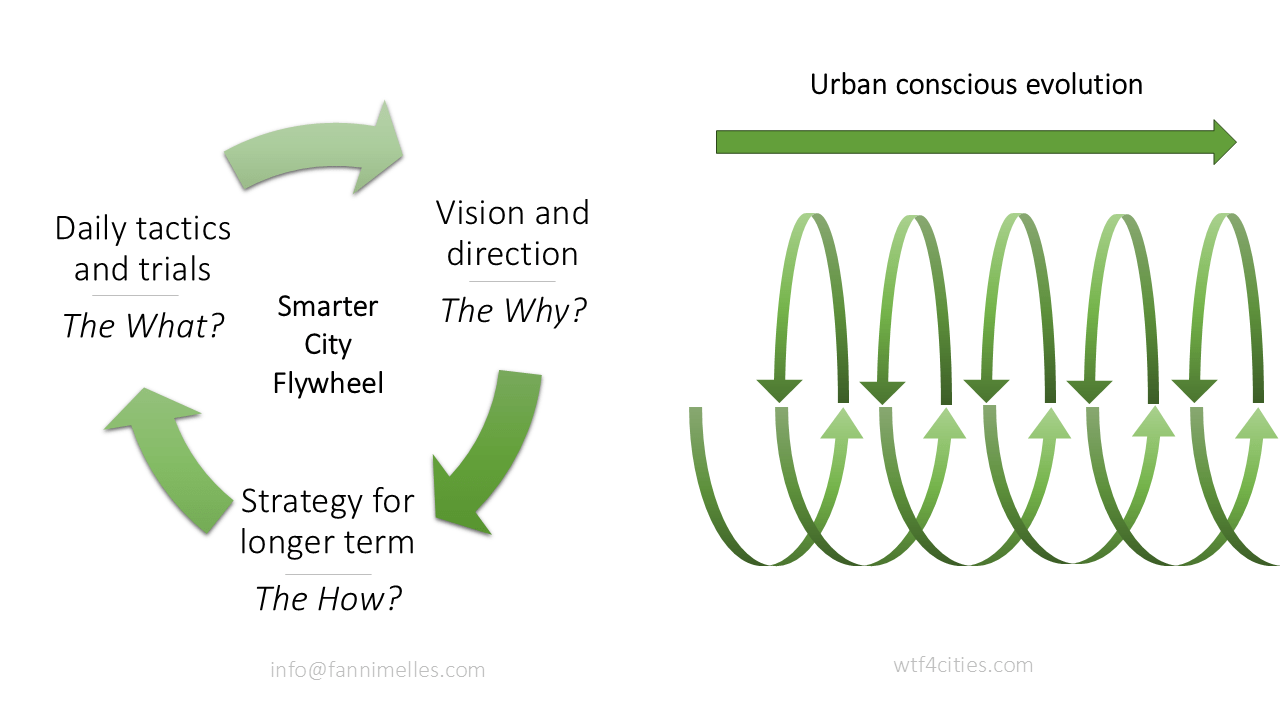
Based on my research and experience, I would like to see and help cities and communities to get on their urban conscious evolution with their own Smarter City Flywheel. Cities need to establish their own smarter approaches and future directions, something like a long-term but loose vision. This vision can guide the longer strategies, and the day-to-day projects, trials and tactics. These trials, tactics and strategies in turn need to inform the vision itself. This whole mechanism can work like a flywheel: a strategic approach to create urban conscious evolution and changes by creating a self-reinforcing loop with small steps towards an established direction or vision. Each city could create their own smarter city flywheel, establishing what their direction is, what the future means to all of their stakeholders, and then create strategies and tactics to start spinning that flywheel.
Ideally, it would work not as a circle but a spiral, bringing cities and communities towards a better future through urban conscious evolution.
I am happy to help cities or communities which would like to investigate this approach and don’t know where to start.
Is there anything else you would like to add?
We can all be architects of our futures. Let’s not be the victims of it!
About the Author Fanni Melles, PhD, is a future of cities researcher, an architect by profession, and a project manager by experience. Before her PhD studies, Dr Melles was the project manager and a master planner for Hungary’s biggest urban development in the last 150 years (911 412.13 m2) across 10 design teams. Earning her PhD from Swinburne University in 2023, she specialised in the practical implementation of the future of cities and smart cities concepts. Dr Melles hosts the podcast “What is The Future for Cities?” with more than 390 episodes and growing, and excels at harnessing chaos and ambiguity into practical systems. Passionate about tailoring unique futures for cities, she’s an adept facilitator, working with various stakeholders to ensure urban influence and client satisfaction. Her belief: cities reflect the people in them, and she’s here to shape their transformation.