What changed the week of Feb. 7-13, 2026
Mobilized Weekly Risk Brief (Asia)
What changed this week
Trade controls intensity
- What happened: U.S. lawmakers pressed for tighter export controls on China’s access to advanced chipmaking tools (including services/maintenance), reinforcing the “controls + compliance” direction.
- Where: U.S.–China tech trade (Asia-wide downstream impact).
- Why it matters: Even talk of broader controls drives stockpiling, vendor screening, and longer procurement cycles across Asian electronics and industrial supply chains.
- Who is affected first: Semiconductor fabs, equipment vendors, electronics manufacturers, cloud/AI infrastructure buyers.
- Confidence: High (clear policy signal).
- Watch next: Whether controls expand to “countrywide” restrictions and allied coordination (EU/Japan/Netherlands toolchain).
Financial rail fragmentation
- What happened: The Indian rupee stayed under depreciation pressure with markets citing persistent USD demand and the likelihood of RBI support/intervention to curb sharper moves.
- Where: India (spillover via trade invoicing, import costs, and regional risk sentiment).
- Why it matters: Currency pressure = higher cost of imported energy/inputs + tighter working capital, especially for SMEs and import-reliant sectors.
- Who is affected first: Importers (fuel/chemicals/electronics), leveraged firms, households via inflation pass-through.
- Confidence: Medium–High.
- Watch next: NDF/spot dislocations, FX reserve changes, and any explicit tightening of cross-border payment compliance.
Energy stress
- What happened: China’s LNG imports were expected to recover in 2026 (after a 2025 drop) but not necessarily back to 2024 levels—pointing to a “demand returns, but price sensitivity remains” dynamic.
- Where: China + broader Asia LNG market (procurement and price-setting).
- Why it matters: Gas/LNG pricing and availability shape industrial output, power reliability, and household affordability across Asia—especially during weather volatility.
- Who is affected first: Power generators, heavy industry, city utilities, vulnerable households.
- Confidence: Medium.
- Watch next: LNG spot price moves, procurement tenders, and weather-driven demand spikes.
Supply-chain chokepoints
- What happened: Red Sea/Suez uncertainty continued to distort capacity and planning; large carriers still framed 2026 as sensitive to route normalization vs renewed disruption.
- Where: Asia–Europe lanes and transshipment hubs (South Asia/SEA port networks).
- Why it matters: Transit-time volatility hits inventory, cash conversion cycles, and delivery reliability—especially for electronics, auto parts, and apparel.
- Who is affected first: Exporters, retailers, OEMs, ports/forwarders.
- Confidence: Medium.
- Watch next: Carrier routing announcements + insurance advisories (fastest leading indicators)
Semiconductor constraints
- What happened: Control pressure increased around the tools that enable leading-edge chips (and keeping existing tools running), raising constraint risk even without a “chip shortage headline.”
- Where: East Asia manufacturing ecosystem (China/Taiwan/Korea/Japan toolchain).
- Why it matters: Capex delays or service restrictions can ripple into device availability, industrial automation, and AI infrastructure rollout timing.
- Who is affected first: Foundries, equipment maintenance/service vendors, downstream electronics assemblers.
- Confidence: Medium–High.
- Watch next: New restrictions on subcomponents + service/maintenance support.
Compute & cloud sovereignty pressure
- What happened: Sovereign cloud demand continued to surge globally (large growth forecast for 2026), reinforcing Asia’s push toward local hosting + data residency architectures.
- Where: Asia-wide, with pressure strongest where localization rules are strict (e.g., China/Vietnam/Indonesia; “potentially India”).
- Why it matters: Firms face higher compliance costs, architectural redesign, and vendor restructuring—yet gain resilience and political durability.
- Who is affected first: Banks, telcos, health/ID systems, AI builders, multinationals.
- Confidence: Medium.
- Watch next: New enforcement actions, “approved cloud” regimes, cross-border transfer restrictions tightening.
Cyber / hybrid spillover
- What happened: Singapore disclosed a cyber-espionage campaign that targeted national telecom infrastructure (with limited disruption but successful infiltration/exfiltration of technical data).
- Where: Singapore; broader Asia telco and critical-infrastructure threat surface.
- Why it matters: Telcos are “upstream dependency” for finance, logistics, emergency services, and cloud—espionage access can become future disruption leverage. )
- Who is affected first: Telcos, government networks, banks/fintechs, critical services relying on carrier networks.
- Confidence: High (official disclosure).
- Watch next: Follow-on advisories, mandated controls, and any lateral movement into government or finance.
Technology standards divergence
- What happened: Cross-border data-transfer frameworks exist (APEC CBPR, ASEAN mechanisms), but legal recognition/adoption remains uneven—creating interoperability friction as localization grows.
- Where: Pan-Asia digital trade + privacy governance.
- Why it matters: Fragmented standards increase transaction costs for regional trade, identity/KYC, payments, and cloud portability.
- Who is affected first: Cross-border platforms, fintechs, exporters using digital channels, regulators.
- Confidence: Medium.
- Watch next: Mutual recognition agreements and “regional compliance rails” that reduce duplication.
Water / food stress
- What happened: The climate signal shifted: forecasters saw La Niña weakening with a higher likelihood of El Niño emerging later, with implications for Southeast Asia rainfall and crop conditions.
- Where: Southeast Asia + broader Asia-Pacific agricultural belts.
- Why it matters: Weather pattern transitions can quickly move rice yields, hydropower output, and food price stability.
- Who is affected first: Farmers, food processors, water utilities, low-income households.
- Confidence: Medium (probabilistic climate signal).
- Watch next: Rainfall anomalies + staple price jumps + reservoir levels.
Social stability pressure
- What happened: Bangladesh’s Feb 12 election environment centered on corruption and inflation pressures—highlighting “cost-of-living + governance trust” as a stability amplifier.
- Where: Bangladesh (and similar inflation-sensitive contexts across South Asia).
- Why it matters: When essentials inflate and trust is low, disruption risk rises around elections, labor markets, and public services.
- Who is affected first: Households, garment/export sectors, local government services, investors.
- Confidence: Medium.
- Watch next: Inflation prints, labor unrest, disruptions to export production.
Drivers & causal chain
Driver A — Tech controls tightening at the tooling layer
- Mechanism: Export controls target enablers (tools/subcomponents/services), slowing capacity expansion and raising compliance friction.
- Second-order effects: Stockpiling, procurement delays, vendor lock-in, higher capex costs.
- Third-order effects: AI/compute rollout slows; downstream device/industrial automation timelines slip.
- Early-warning metric: New rules limiting maintenance/service + allied alignment announcements.
Driver B — Currency/FX pressure + import-cost pass-through
- Mechanism: USD demand and risk-off conditions pressure local currencies; central banks lean on intervention signaling strain.
- Second-order effects: Higher fuel/input costs; tighter margins; reduced discretionary demand.
- Third-order effects: Fiscal stress and political pressure; localized instability.
- Early-warning metric: Parallel/NDF premiums, reserve drawdowns, widening import payment delays.
Driver C — Maritime route volatility and schedule whiplash
- Mechanism: Route uncertainty changes transit times/capacity; markets re-price freight quickly; ports see congestion risk during transitions.
- Second-order effects: Inventory swings; cash tied up in transit; missed delivery windows.
- Third-order effects: Export competitiveness erosion; inflation pockets in import-heavy economies.
- Early-warning metric: Carrier route guidance + insurance risk notices + spot rate jumps.
Driver D — Cloud/data sovereignty becoming “table stakes”
- Mechanism: Localization + sovereign cloud adoption pushes data to stay in-country and reshapes enterprise architecture.
- Second-order effects: Higher compliance and build costs; fewer vendor options; slower cross-border scaling.
- Third-order effects: Regional digital fragmentation and reduced interoperability.
- Early-warning metric: Enforcement actions, new data-transfer constraints, mandated local hosting.
Driver E — Critical infrastructure cyber-espionage targeting “upstream dependencies”
- Mechanism: Telcos and network gear are targeted for long-dwell access and future leverage.
- Second-order effects: Increased security spend; audits; vendor restrictions.
- Third-order effects: Potential outages or systemic trust shocks if access is weaponized.
- Early-warning metric: New telecom advisories; public attribution; mandatory controls.
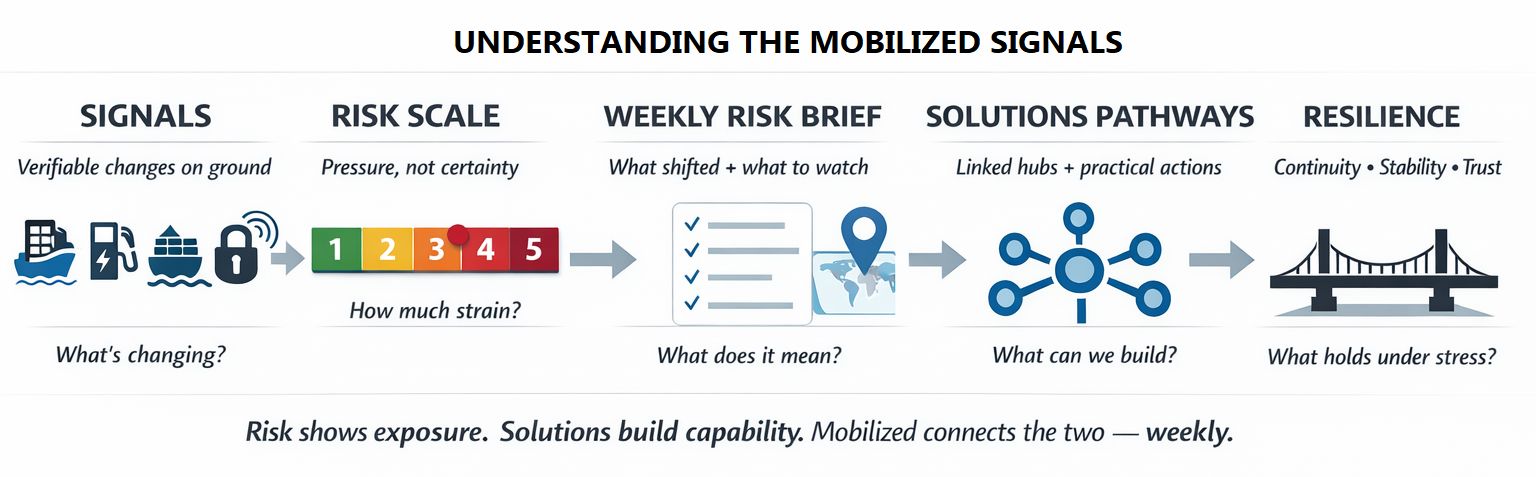
Weekly Risk Index (1–5) — pressure tracking (not prediction)
| Indicator | Score | Dir. vs last week | Rationale | Most important supporting signal |
|---|---|---|---|---|
| Trade controls intensity | 4 | ↑ | Control tightening pressure is rising, especially on tech | US lawmakers push tighter chip-tool controls |
| Financial rail fragmentation | 3 | ↑ | Currency pressure + intervention dynamics persist | INR strain + RBI support |
| Energy stress | 3 | → | Demand recovery, but price sensitivity and weather exposure remain | China LNG import outlook |
| Supply-chain chokepoints | 4 | ↑ | Route volatility keeps lead times/freight unstable | Maersk on Suez return sensitivity |
| Semiconductor constraints | 3 | ↑ | Constraints are policy-driven at tooling/services layer | Controls include tools + maintenance focus |
| Compute & cloud sovereignty pressure | 4 | ↑ | Sovereign cloud adoption and localization are accelerating | Sovereign cloud spend growth |
| Cyber / hybrid spillover | 4 | ↑ | Critical infrastructure targeting confirmed | Singapore telco targeting disclosure |
| Technology standards divergence | 3 | → | Frameworks exist but adoption is uneven | APEC/ASEAN mechanisms uneven |
| Water / food stress | 3 | → | Weather regime transition risk is meaningful but not yet a shock | La Niña weakening / El Niño odds |
| Social stability pressure | 3 | ↑ | Inflation + trust issues elevate disruption risk in sensitive periods | Bangladesh election issues: inflation/corruption |
Top 3 rising pressures: Trade controls; supply-chain chokepoints; cyber spillover.
Top 2 stabilizing pressures: Energy (steady, not spiking); water/food (watchful, signal-based).
Most likely spillover path: Tech controls → semiconductor/tooling friction → electronics lead-time/cost spikes → downstream industrial + consumer inflation pockets.
Regional lens — what it means where you are
United States
- Pricing/supply chains: More tech controls can lift costs for electronics and AI infrastructure inputs; routing volatility affects landed costs for goods.
- Policy: Export control posture is tightening, with higher expectation of allied alignment.
Europe
- Trade alignment: Asia–Europe lanes remain sensitive to Suez/Red Sea route decisions, influencing inventory cycles and inflation.
- Regulation: Interoperability and data-transfer requirements continue to complicate cross-border operations with Asia.
Africa
- Logistics: Asia shipping volatility transmits into African import lead times and costs (machinery, electronics, medicines).
- Currency/essentials: Any Asia-driven price swings in fuel or food inputs can amplify local affordability pressure.
Look ahead — next 7–14 days watchlist
- Any new export-control action on chip tools/services (or allied support). Trigger: new rules/briefings announced.
- Carrier routing changes (return vs avoid Suez/Red Sea). Trigger: major line guidance + insurance warnings.
- Spot freight rate spikes on Asia–EU lanes. Trigger: sudden capacity withdrawals or port congestion.
- India FX stress (NDF/spot gaps, reserves). Trigger: persistent USD demand + larger intervention footprint.
- Telecom sector cyber advisories across Asia. Trigger: new public disclosures or mandated controls.
- Sovereign cloud enforcement steps (data transfer restrictions, “approved cloud” lists). Trigger: enforcement notices or audits.
- LNG pricing and tender cadence (China + NE Asia). Trigger: price jump or unusual tender volume.
- Weather anomaly confirmation in SE Asia (rainfall/heat). Trigger: sustained deviation from normals.
- Food price volatility in import-reliant markets. Trigger: sharp weekly moves in staples.
- Election-related disruptions where inflation/trust are acute. Trigger: strikes, transport disruption, export slowdowns.
Key decision points: export-control agencies; carrier route policies; central bank FX posture; data protection regulators.
Biggest unknowns: route security trajectory; whether controls hit maintenance/services broadly; extent of telco campaign spillover.
Disconfirming signals: stable freight indices; no expansion of chip-tool controls; no further critical-infrastructure disclosures.
From Risk to Solutions — Build the bridge
Bridge 1 — Trade controls → /solutions/adaptive-trade/
- Pressure point: Export-control tightening around advanced chip tooling is rising.
- Why it matters:
- Procurement cycles lengthen and compliance costs rise for Asia manufacturing.
- Downstream device/AI infrastructure availability becomes less predictable.
- Actions
- Business: Dual-source critical tooling/components; build “control-risk” clauses into contracts; map tier-2/3 supplier exposure.
- Community: Support repair/reuse ecosystems for electronics; workforce training for maintenance and refurbishment.
- Policy: Expand trusted-trade lanes; publish clear licensing guidance; coordinate standards to reduce duplicative compliance.
Bridge 2 — Supply chains → /solutions/supply-resilience/
- Pressure point: Asia–Europe logistics remain volatile due to route uncertainty
- Why it matters:
- Inventory and cash get trapped in transit; delivery reliability drops.
- Freight-rate shocks transmit into inflation pockets.
- Actions
- Business: Raise safety stock for critical SKUs; diversify forwarders/ports; renegotiate Incoterms and buffer lead times.
- Community: Localize essentials supply where possible; parts-sharing and repair co-ops to reduce import dependence.
- Policy: Port clearance modernization; transparent dwell-time reporting; priority lanes for medicines and staples.
Bridge 3 — Cyber → /solutions/cyber-resilience/
- Pressure point: Telecom infrastructure targeting confirms high-risk upstream dependency exposure.
- Why it matters:
- Telco compromise can cascade into finance, logistics, and emergency services.
- Espionage access can be repurposed for disruption.
- Actions
- Business: Require carrier security attestations; implement network segmentation and offline failover for core ops.
- Community: Strengthen local continuity plans (communications redundancy for clinics, schools, responders).
- Policy: Minimum security baselines for telcos; rapid disclosure protocols; joint exercises with critical sectors.
Mobilized Weekly Risk Brief — Publish-ready assembly
- Tech controls are tightening at the tooling layer, raising semiconductor and AI infrastructure friction across Asia.
- Shipping volatility remains a top operational risk for Asia exporters/importers tied to Asia–Europe corridors.
- Cyber pressure is “upstream and strategic,” with telecom infrastructure explicitly targeted in a disclosed campaign.
Pressure Map (Top 5)
- Trade controls intensity (4 ↑)
- Supply-chain chokepoints (4 ↑)
- Cyber / hybrid spillover (4 ↑)
- Compute & cloud sovereignty (4 ↑)
- Financial rails fragmentation (3 ↑)
What changed this week
- Export-control rhetoric sharpened around advanced chipmaking tools and support services.
- Carrier routing uncertainty continued to keep Asia–Europe logistics planning fragile.
- A high-credibility telecom targeting disclosure reinforced critical-infrastructure cyber risk.
Why it matters (Business + Communities)
- Business: Expect longer procurement timelines, higher compliance overhead, and inventory/cashflow volatility.
- Communities: Cost pressures and service reliability are increasingly coupled to invisible dependencies (telcos, ports, cloud).
Regional Snapshot (USA / Europe / Africa)
- USA: Export controls drive global supply chain behavior and pricing expectations.
- Europe: Freight and scheduling volatility affects inventory, inflation, and industrial inputs.
- Africa: Asia-linked logistics and price swings transmit into import costs and lead times for essentials and capital goods.
Look ahead (7–14 days)
Watch: export-control actions, carrier routing, India FX stress signals, telco cyber advisories, and SE Asia weather anomalies.
Mobilized Action
- Run a “controls exposure map” on top 50 parts/tools/services linked to advanced chips and networking.
- Add logistics volatility buffers (inventory + time) for Asia–Europe lanes and key components.
- Harden telecom dependency plans (segmentation, offline fallback, carrier assurance).
- Prepare for localization (data classification + residency-ready architecture) before enforcement hits.
- Stress test FX and import-cost sensitivity for fuel, chemicals, electronics, and food inputs.
Accuracy & Trust Layer
- Overall confidence: Medium–High (strong on trade controls, shipping, cyber; medium on water/food because it’s a probabilistic climate transition signal).
- Top 3 uncertainties
- Whether chip-tool restrictions expand to services/maintenance broadly and how allies align.
- Red Sea/Suez security and the timing/shape of routing normalization.How far telco intrusion activity spreads across the region’s critical infrastructure supply chain.
- What would change our assessment (disconfirming signals)
- Stable freight indices for two consecutive weeks; no further expansion of chip-tool measures; no additional critical-infrastructure disclosures.
- Source types to verify (categories)
- Export-control agencies and customs; major carriers/insurers; port authorities; central banks/FX market bulletins; national CERTs/telecom regulators; cloud/data protection regulators.