
THE MOBILIZED SIGNAL: BECAUSE PREVENTION IS THE BEST MEDICINE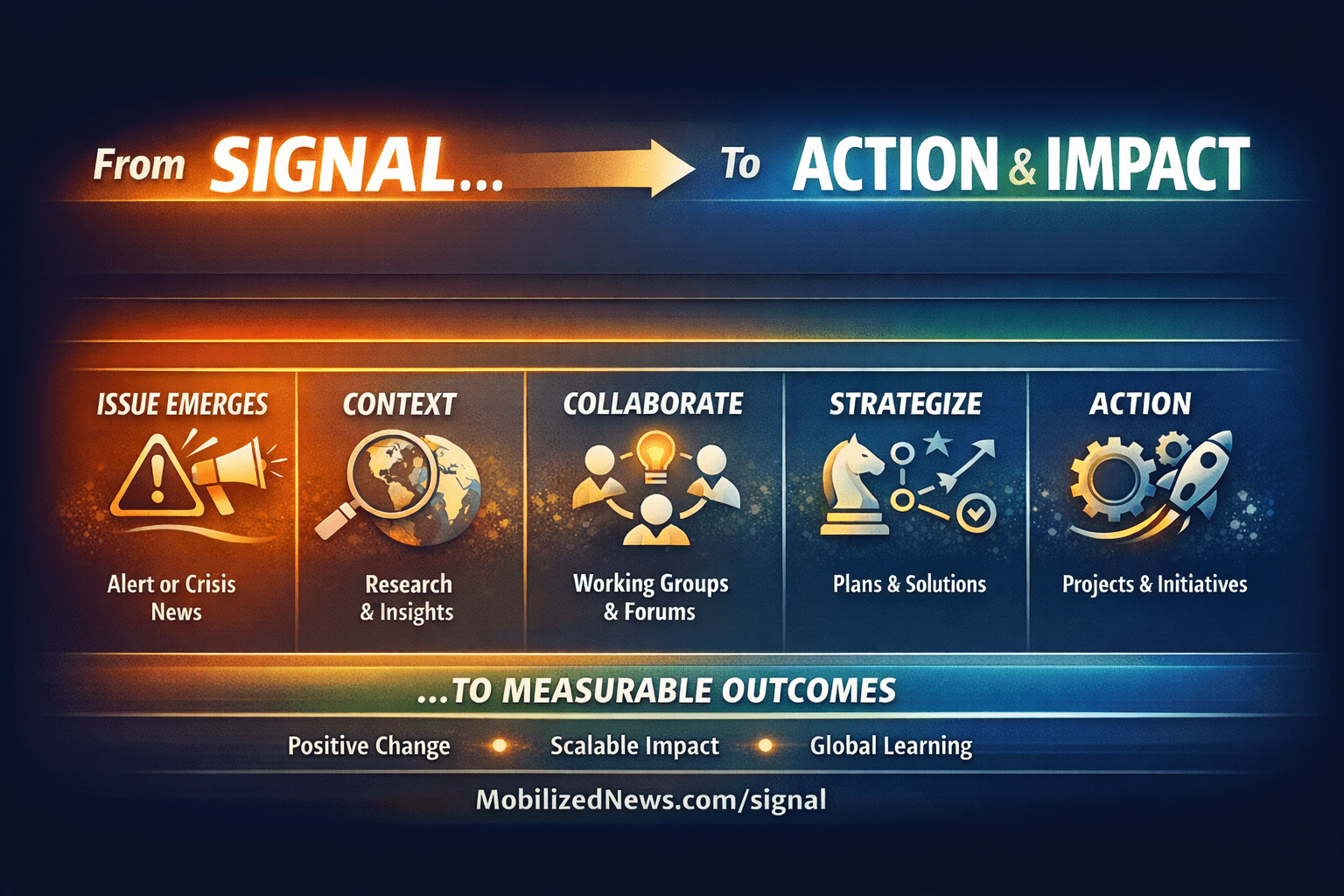
Every week, the world throws more information at us than we can process.
Breaking news. Alerts. Crises. Outrage.
Endless headlines telling us what just happened —
but almost never telling us what’s actually changing,
or what we can do about it.
That’s the gap we built the Signal to fill.
A Signal is not another headline.
It’s not hot takes.
And it’s definitely not doom scrolling.
A Signal answers three simple questions:
What changed?
Why does it matter now?
Who is affected first — and what could be built next?
Signals are short, verifiable, and grounded in reality.
They focus on patterns, pressure points, and early shifts —
before those shifts turn into full-blown crises.
Think of the Signal as an early warning + early opportunity system.
Most media is optimized for attention.
The Signal is optimized for understanding and coordination.
Because risk doesn’t just appear overnight.
It builds quietly — across energy, food, finance, health, cities, and democracy —
often in places the headlines don’t look.
By the time the crisis is obvious, the options are already limited.
The Signal helps us see earlier,
so we can act smarter.
Here’s how it works:
- Signals from the field — journalists, researchers, operators, communities — are shared into a commons.
- Those Signals are then interpreted together — across regions and systems — to understand what’s really driving change.
From there, Signals feed:
- strategy briefs
- action sprints
- pilot projects
- policy pathways
- and public storytelling
So insight doesn’t just sit there.
It moves.
This is how Signals become action —
and action becomes measurable impact.
WHY IT MATTERS
The Signal does four critical things:
First: it reduces surprise.
You’re not reacting late — you’re preparing early.
Second: it connects silos.
Energy doesn’t move alone.
Food doesn’t fail alone.
Finance, climate, cities, health — they’re linked.
Signals help us see the system.
Third: it turns risk into capability.
Risk shows exposure.
Signals help build responses.
And fourth: it creates shared reality.
When people see the same signals,
they can finally coordinate instead of arguing past each other.
WHY PARTICIPATION MATTERS
Here’s the most important part:
The Signal only works if it’s collectively built.
No single newsroom, institution, or expert sees the whole picture.
But together — across regions, sectors, and lived experience —
we do.
You don’t need permission to contribute.
You don’t need to be famous.
You just need to notice something changing —
and share it clearly and responsibly.
This is how the public becomes co-creators of foresight,
not just consumers of news.
The future doesn’t arrive all at once.
It shows up as signals.
The question is:
Do we notice them early enough — and act together?
That’s why we built the Signal.
And that’s why we invite you to help build it with us.
MobilizedNews.com/signal
Because when we share what we see,
we can build what we need —
before it’s too late.