




Week of Jan 17–23, 2026
The big picture
This week’s Africa risk moved from “policy” to physical access and collapse dynamics:
Sahel corridor insecurity → fuel scarcity → national downtime, while Sudan conflict escalation pushed food and stability risk toward system failure conditions. Financing and connectivity risks are rising in parallel.
What changed (signals)
1) Sahel logistics became a de facto trade restriction
What happened: Mali announced nationwide fuel rationing after militant attacks cut supply routes and sharply reduced fuel-truck flows.
Why it matters: When fuel can’t move, everything becomes more expensive — transport, food distribution, generators, construction.
Hit first: Households, transport operators, hospitals (generator fuel), retailers, government services.
Watch next: Whether convoy protection restores flows — or attacks spread to adjacent corridors.
2) Fuel scarcity became an energy-security event
What happened: Rationing directly constrained mobility and generator availability across Mali.
Why it matters: In many markets, fuel is the grid — shortages become downtime for clinics, telecom towers, and SMEs.
Hit first: SMEs, logistics fleets, clinics, telecom sites on gensets.
Watch next: Secondary impacts on food prices and public order around stations.
3) Corridor insecurity destroyed supply capacity
What happened: Attacks on fuel trucks/convoys reduced deliveries; the government shifted to rationing rather than rapid stabilization.
Why it matters: Landlocked states are corridor-sensitive — one disrupted route can cascade into multi-category shortages.
Hit first: Import-dependent cities, wholesalers, transport unions.
Watch next: Re-routing feasibility and whether insurers and operators regain confidence.
4) Sovereign refinancing pressure rose in Central Africa
What happened: IMF signaled an expected staff visit to Gabon amid weaker investor demand and ratings pressure.
Why it matters: Refinancing stress tightens domestic credit, delays public payments, and pressures FX liquidity.
Hit first: Banks, importers needing FX, contractors, households (price pass-through).
Watch next: Whether a formal IMF program is requested and whether arrears/fiscal measures follow.
5) Connectivity stayed a live election-period operating risk
What happened: Uganda experienced an internet disruption around its election period, reported restored late Jan 17.
Why it matters: Even short outages disrupt payments, dispatch, customer support, and safety communications — especially where mobile money is foundational.
Hit first: SMEs, fintech/mobile money users, gig workers, logistics dispatch.
Watch next: Recurring throttling, platform restrictions, curfews.
6) Cyber risk rose as an operating constraint
What happened: Africa-focused risk reporting kept cyberattacks at top-tier concern for 2026; repeated targeting of public agencies and essential services remains a pattern.
Why it matters: When cyber hits labs, registries, utilities, and payments, the spillover is economic: delays, fraud, downtime.
Hit first: Financial services, healthcare labs, utilities, government systems.
Watch next: Phishing/ransomware waves tied to elections, tax season, procurement cycles.
7) Standards tightened into a compliance gate (select markets)
What happened: Kenya reporting pointed to a harder posture on approved digital certificate approaches (PKI/certificates).
Why it matters: Standards shifts can force vendor/architecture change quickly; non-compliance becomes operational risk.
Hit first: Telecom operators, enterprises integrating certificates, government digital services.
Watch next: Enforcement actions, transition windows, interoperability failures.
8) Sudan became the acute system-failure accelerator
What happened: Reporting described escalating strikes and deepening civilian impacts; humanitarian warnings flagged collapse conditions including famine risk in besieged areas.
Why it matters: Conflict-driven market collapse and access constraints trigger displacement, regional price spikes, and aid corridor stress.
Hit first: Households, aid operations, border communities, transporters.
Watch next: Access constraints, market closures, displacement surges, cross-border friction.
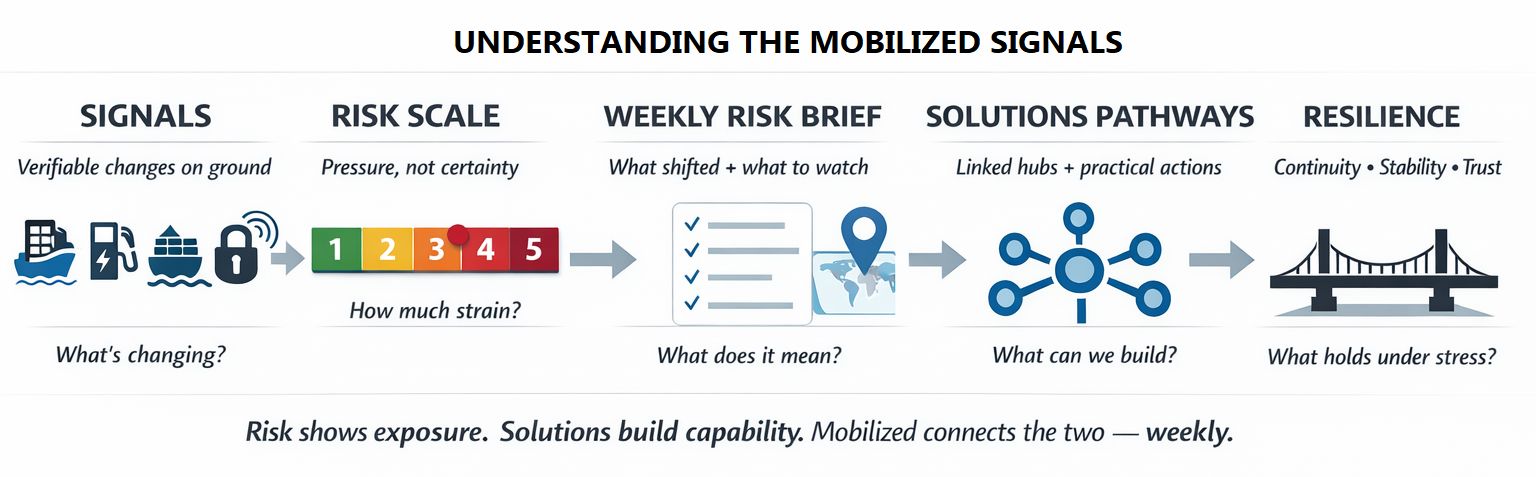
Pressure map (1–5)
Highest / rising
- Water/food stress: 5 ↑ (Sudan conflict-driven collapse conditions)
- Social stability pressure: 5 ↑ (Sudan intensity + Sahel scarcity)
- Supply-chain chokepoints: 4 ↑ (Sahel corridor throughput loss)
- Energy stress: 4 ↑ (Mali fuel scarcity = downtime risk)
- Financial rail fragmentation: 4 ↑ (Gabon refinancing/FX pressure risk)
Elevated
- Compute/connectivity risk: 3 ↑ (election-period disruptions)
- Cyber pressure: 3 ↑ (public services + enterprises)
- Semiconductors: 3 → (import + FX constraint, no step-change this week)
- Tech standards divergence: 3 → (tightening, not a sudden spike)
Most likely spillover path
Sahel corridor insecurity → fuel scarcity → transport + generator downtime → food/essential price spikes → localized unrest + service interruptions.
What to watch (next 7–14 days)
- Mali rationing tightens or loosens (trigger: new attacks or throughput recovery).
- Convoy protection effectiveness (trigger: repeated ambushes vs stable truck volumes).
- Sudan escalation near key cities (trigger: higher strike frequency or new sieges).
- Humanitarian access + famine indicators (trigger: corridor closures, market shutdowns).
- Gabon IMF engagement outcome (trigger: program request, fiscal package, arrears policy).
- Uganda connectivity stability (trigger: renewed throttling/platform restrictions).
- Public-sector cyber disruptions (trigger: ransomware wave causing service downtime).
- Mobile money reliability in high-tension areas (trigger: outages or agent liquidity stress).
- Fuel and food price jumps in corridor-constrained markets (trigger: sustained rationing).
- Cross-border displacement pressure points (trigger: sudden violence/access collapse).
Mobilized actions
- Sahel-exposed operators: set two-week fuel + critical input buffers; add a dual-route logistics plan.
- Sudan-adjacent corridors: pre-stage essentials; contract alternates; coordinate with humanitarian logistics calendars.
- FX-sensitive importers: shorten payable cycles; tighten inventory-to-cash; maintain multiple payment options.
- Connectivity-dependent firms: build offline fallbacks (manual dispatch, cash contingency, alternate comms).
- Critical services: prioritize continuity (fuel, backup power, basic cyber hygiene) for clinics, water, telecom.
Trust layer
Confidence: Medium–High
Top uncertainties:
- Whether Sahel fuel corridors recover or face further attacks
- Sudan access/displacement pace (fast-moving, under-reported)
- Whether financing stress spreads into broader FX/import compression
Disconfirming signals:
- Verified restoration of fuel truck volumes and loosening of rationing in Mali
- Sustained improvement in Sudan access and reduced strike intensity
- Clear, stable refinancing plan for Gabon without arrears buildup

