



🚨 MOBILIZED NEWS SIGNAL
What Changed This Week (Jan 17–23, 2026)
Region: South America + Caribbean
🌍 Trade Is Re-Routing — With Friction
Signal: The EU–Mercosur free trade agreement was signed, while regional tariffs inside Latin America rose.
Why it matters:
Trade gravity is shifting fast — opening markets at the bloc level while raising near-term compliance and political risk.
What happened:
- EU and Mercosur (Argentina, Brazil, Paraguay, Uruguay) signed a deal set to remove 90%+ of tariffs over time.
- Ecuador announced a 30% tariff on Colombian goods starting Feb 1.
Where:
South America ↔ Europe; Ecuador–Colombia border trade.
Who’s hit first:
- Ag exporters (beef, soy, wood pulp)
- Importers of EU machinery & auto parts
- Customs brokers and compliance teams
Confidence: High (deal signed; outcomes hinge on ratification)
Watch next:
- EU parliamentary/legal steps and side-letter demands
- Colombia’s response to Ecuador’s tariff move
💸 Financial Rails Are Fragmenting (Venezuela)
Signal: Control over Venezuela’s oil export revenues shifted toward the U.S., disrupting debt repayment and settlement routes.
Why it matters:
Unclear payment priority raises transaction risk premiums and complicates oil-for-debt mechanisms (notably with China).
What changed:
Oil revenues are routed through managed accounts, altering who gets paid — and when.
Where:
Venezuela (spillovers across commodity and finance networks)
Who’s hit first:
Commodity traders, banks, insurers, shipping firms, governments in restructuring talks.
Confidence: Medium–High
Watch next:
Creditor disputes, legal challenges, and shipment rerouting.
⚡ Energy Stress Is Structural (Not Shortage)
Signal: Brazil’s renewables boom is creating grid balancing and transmission strain.
Why it matters:
Risk has shifted from “not enough power” to “can’t move power efficiently,” affecting reliability and pricing for industry.
What changed:
High solar/wind growth increased curtailment and operational complexity.
Where:
Brazil
Who’s hit first:
Heavy industry, data centers, utilities, project developers.
Confidence: Medium
Watch next:
Curtailment rates, transmission upgrades, market rule changes.
Solutions signal:
Puerto Rico clinics expanded solar + storage, boosting care continuity during outages.
🚚 Supply Chains Under Acute Stress (Haiti)
Signal: Haiti’s political and security crisis intensified, threatening ports, roads, and last-mile delivery.
Why it matters:
Disruptions hit fuel, food, and medical supply flows, raising prices and humanitarian risk.
Where:
Haiti (Caribbean spillover)
Who’s hit first:
Households, NGOs, hospitals, importers, logistics providers.
Confidence: High
Watch next:
Feb 7 political transition deadline and security force scale-up.
🧠 Semiconductor Pressure Is Indirect — But Real
Signal: No local chip shock, but global strategic-tech controls are tightening, raising import costs and lead times.
Why it matters:
Longer delays affect telecom upgrades, fintech infrastructure, and industrial automation.
Where:
Region-wide (import-dependent economies)
Who’s hit first:
Telecom operators, OEM importers, utilities needing advanced spares.
Confidence: Medium
Watch next:
OEM allocation shifts and distributor pricing.
☁️ Compute & Cloud Sovereignty Is Rising
Signal: Venezuela’s hydrocarbons reforms and renewed services interest imply rapid digital modernization — with cyber risk trailing close behind.
Why it matters:
Cloud + OT integration often outpaces governance, increasing continuity and sovereignty exposure.
Who’s hit first:
Energy operators, vendors, regulators.
Confidence: Medium
🛡️ Cyber Risk Tracks Instability
Signal: Haiti’s instability increases exposure to opportunistic cybercrime (fraud, ransomware).
Why it matters:
Digital outages compound humanitarian and supply-chain fragility.
Who’s hit first:
Hospitals, telecoms, banks, NGOs, government registries.
Confidence: Medium
📏 Standards Are Becoming Trade Gates
Signal: EU–Mercosur momentum accelerates standards, traceability, and customs alignment pressure — even before ratification.
Why it matters:
Compliance readiness becomes a competitive advantage.
Who’s hit first:
Food/ag exporters, autos, chemicals, customs brokers.
Confidence: High
💧 Water & Food Stress Remains a Background Constraint
Signal: Hydro-dependent systems remain vulnerable to drought variability.
Why it matters:
Water stress cascades into power prices, food processing, and household costs.
Confidence: Medium (chronic)
✊ Social Stability Is the Top Risk
Signal: Haiti’s governance turbulence and gang violence are the most acute social stability pressure this week.
Why it matters:
Directly impacts workforce safety, logistics, and humanitarian access.
Confidence: High
📊 Pressure Map — This Week
Rising fastest:
- Social stability (Haiti)
- Supply-chain chokepoints (Haiti)
- Financial rail fragmentation (Venezuela)
Holding steady:
- Energy stress (structural, not acute)
- Water & food stress (baseline elevated)
Most likely spillover path:
Haiti instability → distribution breakdown → shortages & price spikes → wider social stress.
🔭 What to Watch (Next 7–14 Days)
- Haiti’s Feb 7 transition outcome
- Security mission scale-up pace
- Ecuador–Colombia tariff enforcement
- EU–Mercosur provisional steps or legal friction
- Venezuela oil shipment and payment routing changes
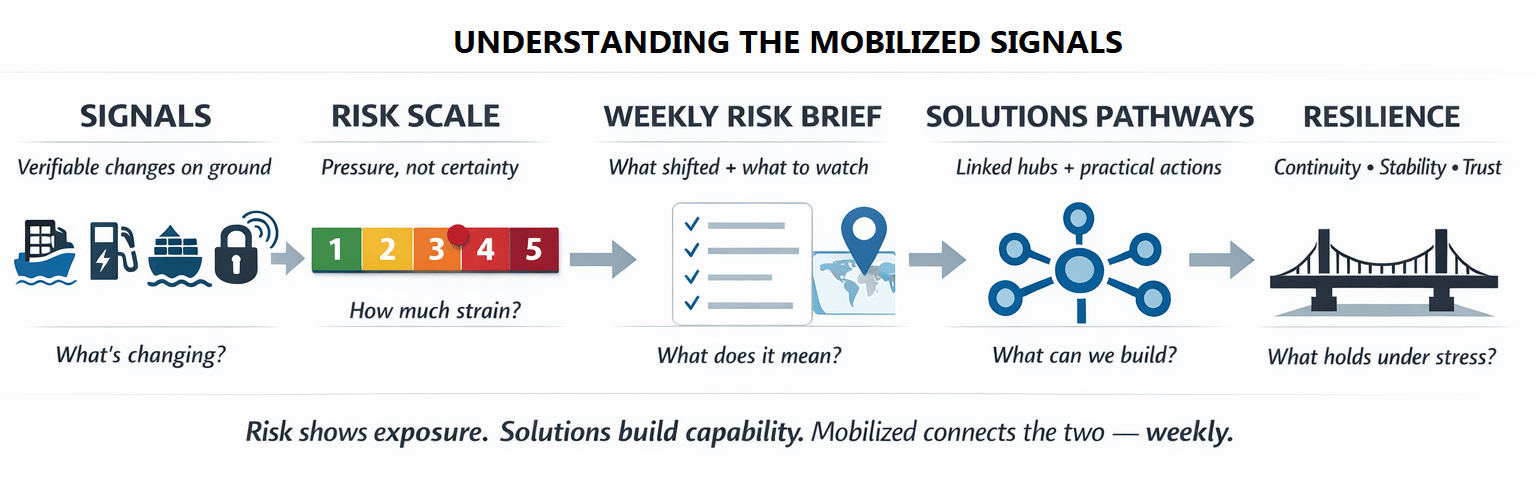
🔗 From Risk to Solutions
- Social stability → community continuity & de-escalation
- Supply chains → multi-route logistics & local storage
- Financial rails → resilient payments & escrow clarity

